

Review
Review: Lovense Edge 2 Prostate Massager
Same app, same charging cable — but for the prostate.
29 July 2026
 Author's pick
Review · Glans massage · Oscillation and vibration
Lovense app-controlled glans massage reviewed against the manufacturer’s own specifications and price data from eight Swedish stores. Food-grade approved silicone, oscillation directed at the frenulum, IPX7 according to IEC 60529, 70–110 minutes of runtime, and handsfree via two included straps — but neither measurements, battery capacity, nor sound level is published, and the warranty stays at one year.
The most connected product in its category: oscillation aimed at the frenulum in addition to normal vibration, all silicone all the way through, handsfree via two included bands and an app with its own patterns, partner control at a distance, and video synchronization. What you pay for is documentation full of holes — no measurements, no battery capacity, no sound level — the shortest runtime in the comparison, and a warranty of just one year.
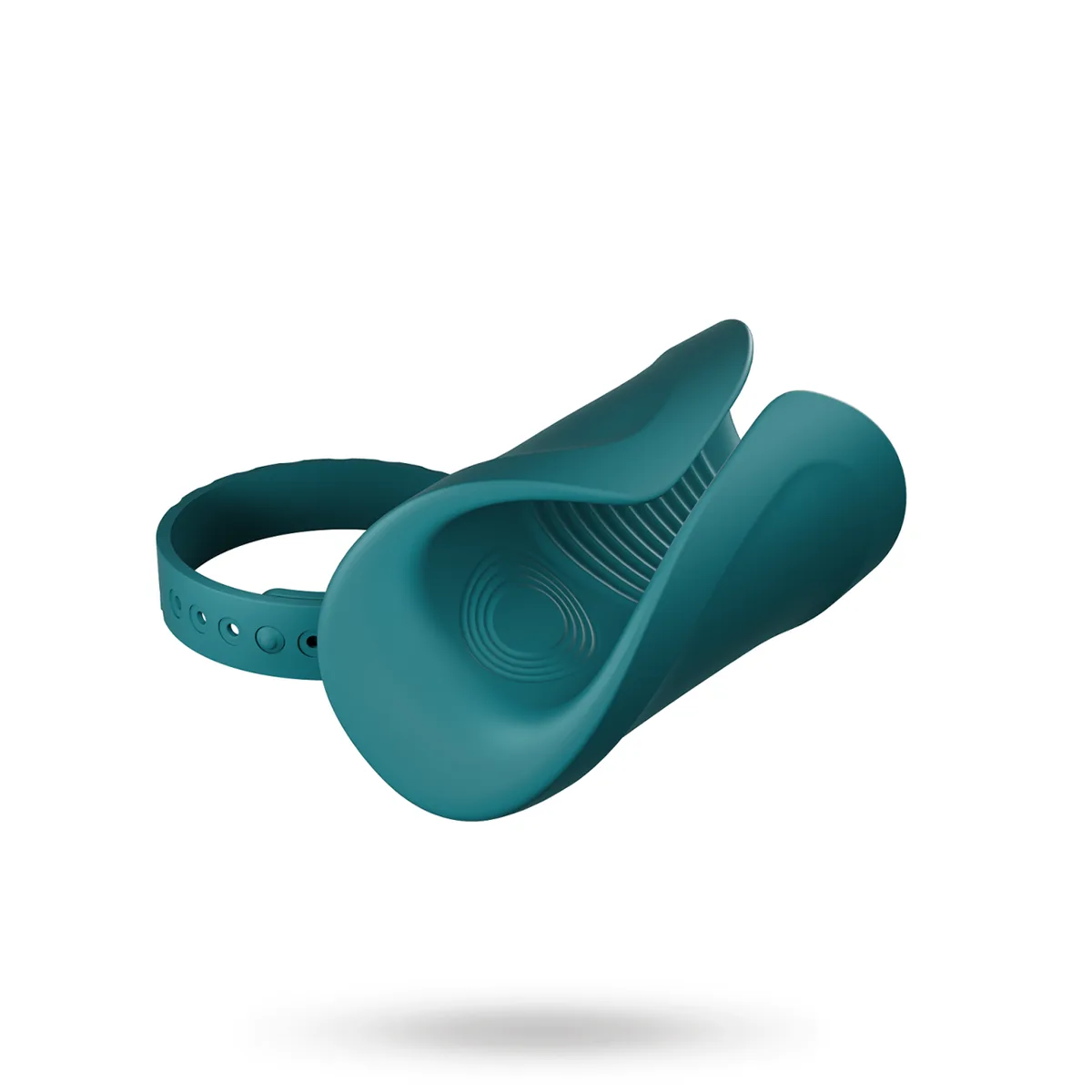
Lovense Gush 2 is an app-controlled glans massage: a soft silicone body with two wings that fold around the penis head instead of enclosing the entire shaft like a regular masturbator. The manufacturer explicitly describes the construction as a glans massager, meaning a product built for the glans, and states that the oscillating plate is positioned to work against the frenulum — the sensitive band on the underside of the glans. This is the single most important piece of information about the product, and it determines whether it’s right for you or not.
The specification looks like this according to Lovense: food-grade silicone, 195 grams, a lithium polymer battery, 75 minutes charging time, up to 110 minutes of operating time, up to 120 hours standby, IPX7 ingress protection rating, an unlimited number of oscillation and vibration patterns via the app, and a one-year manufacturer’s warranty. The manufacturer also states 4,300 oscillations and vibrations per minute as the product’s technical key figures. In Sweden, the item is sold by eight stores at prices between 1,095 and 1,595 SEK, and seven of them have it in stock.
This review is about the item with EAN 6972677430494, which is the same number that Lovense itself lists in the gtin13 field on its product page for Gush 2. The number has therefore been checked against the manufacturer’s own structured data and not just against the stores’ feeds — worth knowing because Lovense sells both a predecessor called Gush and a parallel model called Gush 2 Motion at the same time.
The difference is fundamental and shows immediately in the shape. A classic masturbator is a closed tunnel into which you insert the entire penis, and the stimulation comes from friction against the tunnel’s inside as you move the product back and forth. A glans massage, instead, is open at both ends and built to close around just the head. The movement doesn’t have to come from your arm — it comes from the motors.
The consequence is that the two product types solve different problems. A tunnel mimics intercourse. An ȯllon massage does something that a hand can hardly do at all: it delivers a constant, directed motion to a couple of square centimeters of the most nerve-rich part of the penis, and does it without you having to hold on to anything. Lovense also markets Gush 2 for endurance training and edging, meaning controlled buildup without ejaculation, and that’s a use case where the hands-free feature is the whole point—there’s no way to train not to move if you also have to keep holding the product.
What can be confirmed purely from a construction standpoint is that the open design has two practical consequences. The first is that the size of the user matters less than it does with a tunnel with a fixed inner diameter, because the wings bend outward. The second is that the product is easy to rinse out, because there’s no long, enclosed channel where water and residue can remain. It’s a real hygienic advantage compared with sleeve-based products, and the manufacturer’s own customer ratings point in the same direction: the rating for how easy Gush 2 is to clean is 4.9 out of 5 in Lovense’s own store.
This is the question that determines how you should read the entire specification, and Lovense answers it itself in its FAQ. Vibration is described as an even buzzing sensation, while oscillation is described as a back-and-forth motion. On Gush 2, they work together as a combined stimulation system aimed at the glans and frenulum.
Technically, the difference is that a vibration is a high-frequency oscillation that propagates through the material and is felt across the entire contact area, while an oscillation is a visible, low-frequency shifting of a surface in one direction and back again. A vibration spreads; an oscillation stays where it’s applied. That’s why Lovense can place the oscillation plate over the frenulum and describe it as directed—if it had been the same placement with a vibration motor, it would have been felt all over the head.
The figure 4,300 oscillations plus vibrations per minute is the manufacturer’s combined key metric for the two systems. What is not shown in the specification is how the number is split—how many of the 4,300 are oscillations and how many are vibrations, and at what intensity the number is measured. Lovense does not publish the oscillation’s amplitude, its frequency per position, or the motors’ power. That makes 4,300 more of a marketing value than a comparable measurement, and it’s worth knowing before you compare it with another brand’s figure.
Three names are close to each other in Lovense’s lineup and get mixed up in Swedish store text. This is what the situation looks like as of the control date.
The takeaway for you comparing prices is simple: check the EAN or item number. Several stores use the word Gush in the product name without specifying which generation it applies to, and the first generation sometimes costs more than the current one just because it’s sold out and the price hasn’t been updated since the stock ran out.
The material issue is the only feature of an intimate product that can’t be compensated for with experience or care, and it determines whether the product is still hygienic after five years. Lovense lists a single material for Gush 2: food-grade silicone. In its FAQ, the manufacturer further tightens the wording to one hundred percent body-friendly silicone and adds that no product in Lovense’s range contains phthalates or other harmful chemicals.
Silicone is a non-porous material. A non-porous surface can be cleaned, because there are no microscopic cavities where residue can get trapped. It’s the single most important property of a material that’s meant to sit against mucous membrane, and that’s why the material declaration weighs more heavily than almost any other line in a specification.
On Gush 2, the material choice has an extra consequence that ties in with the shape. Since the entire product is molded in the same soft silicone without hard plastic shells, and since the chamber is open on both ends, there is no seam between two materials where dirt can collect, and no enclosed tunnel that has to be turned inside out. It’s a design advantage versus a sleeve-based product, where the sleeve almost always sits inside a hard outer casing and where the seam between them is the place that’s hardest to get clean.
What speaks against full silicone in this exact shape is wear and tear. The manufacturer’s own guide includes a warning that rarely shows up in store texts: the product must not be pulled fully straight, because it can then break. The wings are therefore designed to bend within a certain range, not to be straightened out. It’s a reasonable limitation for a soft molded body, but it’s worth knowing before you start experimenting with how the product should fit.
Phthalates are a group of softeners used to make plastic — above all flexible PVC — pliable. Kemikalieinspektionen describes them as substances that can affect the hormone system and make reproduction more difficult, and several of them are therefore restricted or banned within the EU in a large number of products. This product category is a recurring subject of oversight, because it contains soft plastic that lies directly against the skin and mucous membranes.
Lovense explicitly states that none of their products contain phthalates. Silicone also doesn’t require phthalate plasticizers to become soft — the softness comes from the polymer’s own structure — and therefore silicone as a material specification is, by itself, a better indication than labels like TPE or jelly rubber, which say absolutely nothing about which plasticizers are included.
Two things are still missing from the declaration. Lovense does not state anything about latex, which brands like Womanizer and Satisfyer include as a matter of routine, and they also do not list a separate material for the included band — based on the manufacturer’s own images, the band appears to be made of the same silicone, but it’s nowhere stated. These are small gaps, but they are gaps: if you’re allergic to latex, you won’t get any written notice from the manufacturer in this case.
Here is the biggest shortcoming in Lovense’s documentation, and it deserves to be stated clearly: the manufacturer publishes no length, width, or height for Gush 2 — either on the product page, in the online guide, or in the user manual. The specification table lists materials, weight, battery type, charging time, runtime, standby, pattern, water resistance, and warranty. The measurements are not included. It’s unusual in this price range, and it makes the product difficult to compare directly to a model like Satisfyer Men Heat Vibration, where the manufacturer states 140 × 82,6 × 78 millimeter.
The weight is stated as 195 grams. Even that figure has a caveat: Lovense does not specify whether the 195 grams refer to only the product or the product with the band attached, and since two bands are included in the package, it’s not an academic question. For comparison, Satisfyer lists 193 grams for Men Heat Vibration, a product that’s significantly larger in volume — which suggests that Gush 2 is denser and more massive than the shape makes it look.
What can be established about the fit, however, is found in the manufacturer’s own FAQ, and that information is more useful than a single external measurement would have been. See the next section.
According to the manufacturer, two adjustable bands are included in the package, and it’s the band that makes the product hands-free. Lovense publishes a fit table with two outer settings, and that is the only measurement information available at all about the product:
So the range is a circumference of 89 to 165 millimeters. It covers a large part of the variation, but it has two ends, and it’s one of them that’s interesting: if your circumference is over 165 millimeters, the band can’t be tightened around you, and then Gush 2 becomes a product you hold in your hand instead of a hands-free product. Since the hands-free mode is half of the selling point, it’s worth measuring before you order.
The manufacturer is also clear that the band is optional. The product can be used either fastened or manually like a regular stroker, and Lovense describes both ways of using it in its materials. What can be established is that the band doesn’t just hold the product in place—it also increases the pressure against the body. That’s also the reason the manufacturer gives for why you might want to use it even when you’re holding the product.
The interface on the product consists of exactly one button. According to the manufacturer’s user manual, you turn Gush 2 on and off by holding the button down for three seconds, and you step between the vibration and oscillation modes with a short press. The online guide clarifies that the button should be pressed down firmly and held for three to five seconds, and that the product vibrates for one second when it starts up.
One button is a deliberate design choice, and it’s both the product’s strength and its weakness. Being able to turn it on, cycle through settings, and turn it off without having to look at the button is exactly what’s needed in a product that’s meant to be fastened in place. The downside is just as obvious: everything beyond the preset modes requires the phone.
There’s a gap in the documentation that’s worth pointing out. Lovense doesn’t state how many fixed modes are in the button sequence on Gush 2. The specification table writes “unlimited” for both oscillation patterns and vibration patterns, but it’s unlimited via the app, where you can build your own patterns. The online guide refers to “standard toy levels” without listing them in text.
In practice, that means that a comparison with a product that specifies a certain number of programs is misleading in both directions. Satisfyer Men Heat Vibration specifies eleven vibration programs — a number you can rely on without a phone. Gush 2 specifies no number at all on the product, and an unlimited number in the app. Which of the two gives you the most depends entirely on whether you plan to install the app or not.
The online guide also states that you can save up to ten of your own patterns in the product via the app’s programming mode. That’s the number that actually matters for anyone who wants to use Gush 2 without the phone on hand: ten of your own patterns can stay in the product and be accessed with the button.
App control is what sets Gush 2 apart the most from cheaper products in the category. The manufacturer lists four functions that are worth distinguishing, because they solve different things.
The first is custom patterns: you draw an intensity curve in the app and save it, up to ten at a time in the product. The second is partner control, where someone else takes control of vibration, oscillation, intensity, and patterns in real time — according to Lovense both up close and over any distance. The third is synchronization with interactive video content and compatible games, where the product responds to the material. The fourth is sound and music control.
What can be established is that this functionality isn’t free. It requires an app, an account, and a Bluetooth connection, and it means that the product’s most heavily advertised features are in software that the manufacturer controls and can change. The manual specifies the frequency band 2402–2480 MHz and a radiated power of 0.71 dBm — in other words, standard Bluetooth Low Energy with short range. Long-distance control therefore doesn’t work directly between two people, but via Lovense’s own service, and it’s a trade-off you should make consciously rather than discover afterward.
The manufacturer describes two ways to use it, and they come with different requirements. In the hands-free mode, you secure Gush 2 with the band and let the motors do the work. In the manual mode, you hold the product and stroke with it while it vibrates and oscillates.
The difference is bigger than it sounds. The hands-free mode is what Lovense builds its marketing around — endurance training, edging, partner control, and synchronized video all require your hands to be free. The manual mode instead turns Gush 2 into a regular, albeit unusually soft and open, stroker. Having both in the same product is a genuine advantage, but it also means that someone who only wants one ends up paying for the other.
A practical note from the manufacturer’s own material: lubricant is needed. Lovense states that lubricant should be applied generously to both the product and the body, and that water-based lubricant dries out and needs to be reapplied during use. With an open design like this—where the surface against the skin is large and air can reach it—drying out is more noticeable than in a closed tunnel.
The question is reasonable for a product marketed for long sessions, and the answer has to be honest: Lovense does not publish any measured decibel value for the Gush 2, either on the product page, in the online guide, or in the user manual.
The closest the manufacturer comes is its own customer ratings. On the product page, Lovense presents an overall rating of 4.8 out of 5 from 110 reviews, broken down into four sub-ratings: Oscillation 5.0, Orgasm rating 4.7, Easy to clean 4.9, and Quiet 4.0. So the sub-rating for quietness is the lowest of the four, with a fairly good margin. It’s not a measurement and shouldn’t be read as one, but it is the manufacturer’s own material and it points consistently in one direction: the sound is the product’s weakest point according to the customers Lovense itself cites.
A Swedish retailer, Vuxen.se, states in its product text that the Gush 2 makes 38–45 dB. That information does not come from the manufacturer and can’t be verified against anything Lovense publishes. The same retailer text also states a charging time of 72 minutes, while Lovense themselves write 75 minutes in two different places—which says something about how carefully such figures are passed along. Treat 38–45 dB as a store claim, not as a specification.
A practical tip that applies regardless of model: place the product on a soft surface between uses. A hard tabletop works like a resonance box and noticeably amplifies the sound.
Lovense Gush 2 is rated IPX7. The rating comes from the international standard IEC 60529, which defines enclosure ratings for electrical equipment. The number 7 in the second position means that the product has been tested for submersion in water to a depth of one meter for 30 minutes. The manufacturer lists the rating in both the specification table and the user manual, and explicitly highlights use in the shower.
The difference from a splash-proof product is bigger than the wording suggests. Splash protection covers water droplets and—at best—water jets, but not submersion. Such a product can handle a damp cloth and possibly a shower, but not a bathtub, and it shouldn’t be held under running water without thinking carefully about the button and charging contact.
With IPX7, the entire product can be rinsed off without any care, and with an open design like the Gush 2, it’s a noticeable advantage: the entire inside of the chamber gets direct access to water, without anything needing to be turned inside out. If a product completely lacks an IPX rating, it should be treated as not waterproof. The absence of a rating is never a sign that the product would be approved.
Note the limit at the same time. The manual expressly states that the product must not be boiled in water — the battery can explode or water can get in — and that it should be kept away from extreme heat and cold. IPX7 is about watertightness when submerged in room-temperature water, not about heat resistance, so boiling and dishwasher cleaning are therefore ruled out despite the rating.
The manufacturer’s instructions are brief and unambiguous. Clean the product before and after each use with warm water and mild soap or a cleaning agent intended for intimate products. Dry it thoroughly before putting it away. Keep it away from extreme heat and cold.
On the question of lubricant, Lovense is just as clear: use only a water-based lubricant, and do not use silicone-based or oil-based. Silicone-based lubricant should never be used on silicone products — it breaks down the silicone surface over time and makes it porous, and a porous surface can no longer be cleaned properly; it only needs to be replaced. Oil-based products like coconut oil leave a film that’s difficult to remove and that also attracts dirt.
Two instructions belong here because they rarely appear in store texts. The product must not be used while it’s charging. And the charging cable must not be attached to metal or stainless steel — the cable is magnetic, and a magnet that gets stuck to the wrong thing can short-circuit the charging contacts.
Lovense specifies a lithium polymer battery with a runtime of up to 110 minutes and a charging time of 75 minutes. In its FAQ, the manufacturer clarifies the runtime to 70–110 minutes depending on which level you run at — an unusually honest range that says more than a single top value would have done. The standby time is stated as up to 120 hours.
A range of 70 to 110 minutes is short in this context. Lovense’s own Diamo indicates clear 2.5 to 3 hours of continuous use, i.e., roughly twice as long. On the other hand, Gush 2 charges quickly: 75 minutes versus about 3.5 hours for Satisfyer Men Heat Vibration according to the manufacturer’s quick guide. The ratio between charging time and runtime is therefore about 1 to 1.5 on the Gush 2, which is a reasonable figure for a product that should be able to be charged between two uses the same evening.
Charging takes place via a magnetic charging cable that, according to the manufacturer, can be connected to any USB port or a USB/AC adapter. The manual states that a steady red light turns on when charging is in progress and goes off when the battery is fully charged, and the online guide adds that the battery level can also be read in the app if you’re unsure.
Magnetic charging is a trade-off, not a pure advantage. The advantage is that no opening in the housing is needed, which makes it easier to achieve IPX7 without a rubber plug—and on a soft silicone body like the Gush 2, a rubber plug is also a weak point that would need to be somewhere. The downside is that the cable is product-specific: tappar du laddkabeln fungerar ingen vanlig USB-C-kabel.
Here, though, there’s a mitigating circumstance worth noting. Lovense uses the same charging cable across a large part of its range—the manufacturer’s own accessory page lists a cable that fits, among others, Max 2, Nora, Edge 2, Lush 3, Diamo, Hush 2, Lush 4, Lush Mini, and Gush. If you already have a Lovense product, the chances are therefore good that you already have a spare cable. It’s a real practical advantage over brands where each model has its own connector.
The manual also includes a maintenance instruction that’s easy to miss: the product should be charged at least once every six months, even when it isn’t being used. Lithium batteries can be damaged by being left in a deeply discharged state, and a cell that has been empty for a year may have permanently lost a large part of its capacity.
Lovense does not publish the battery’s capacity in mAh or its voltage for the Gush 2. The specifications table only states “Li-polymer battery”. The manual lists the power supply as DC 5 V and 0.4 A and the rated voltage as 5 V, but those are the values on the charging side—they tell you what the cable delivers, not how much the cell can hold.
It’s worth noting because competitors do it: Satisfyer specifies 3.7 volts and 700 mAh for the Men Heat Vibration in its quick guide, along with charging voltage 5 V and maximum charging current 500 mA. Without the capacity, you can’t convert runtime into power consumption, and you can’t assess how heavily the cell is loaded between models.
The Swedish retailer Vuxen.se states 3.7 volts and 380 mAh in its product text. That information does not come from Lovense and is not found in any of the manufacturer’s three documents, and the same text also contains, as mentioned, a charging time that differs from the manufacturer’s. Take it for what it is: a store claim that can’t be verified against the source.
What applies generally to lithium batteries also applies here: capacity drops with the number of charge cycles, and the battery is not replaceable. Using it a couple of times a week, it’s the battery, not the silicone, that sets the limit for service life — and because the cell is built in, the product is, in practice, used up when the battery is. A one-year warranty doesn’t go very far within that time horizon, but the statutory right to make a complaint of three years does.
We do not have price data from shops in your market yet.
Lovense does not publish length, width, height, battery capacity, or sound level for Gush 2. It’s unusually common to omit these at this price point.
Three comparisons are relevant: against its own predecessor, against the cheapest route to a vibrating glans stimulation, and against Lovense’s own alternative solution to the same problem. All information below comes from the respective manufacturer’s own specifications, and all prices come from the shops’ product feeds on July 29, 2026.
The first generation, Lovense Gush with EAN 6972677430043, is the most natural comparison and at the same time the least useful — for a reason that is in itself informative. The manufacturer’s old product address for the model now redirects to the Gush 2 page, which means Lovense no longer publishes any separate specification for it. And in Sweden it’s sold out in all four stores that still list it, at prices between 995 and 1,769 SEK.
So what can be established is this: first-generation Gush is no longer a realistic option, regardless of what price-comparison sites show. If you see it listed cheaper than Gush 2, it’s almost certainly an old price from an empty stock. A store listing 1,769 SEK for a sold-out predecessor to a product that costs 1,095 SEK new is a good reminder that stock status has to be read together with the price.
What Gush 2 adds compared with the predecessor, Lovense describes in its marketing as an extended oscillation plate aimed at the frenulum, an adjustable band, and a higher intensity level. Since the manufacturer has removed the old specification, there’s no sourced numeric comparison to make — and pretending otherwise would be to guess.
Satisfyer Men Heat Vibration costs from 429 SEK and is in stock. Gush 2 costs as low as 1,095 SEK. The difference is 666 SEK, i.e., two and a half times the price. Both are vibrating products aimed at the glans, both are IPX7, and both charge via a magnetic cable.
That’s where the similarities end. Satisfyer is a closed product measuring 140 × 82.6 × 78 millimeters and weighing 193 grams, made of ABS plastic and medical-grade silicone—that is, not full silicone. It has eleven fixed vibration programs that you can access without a phone, a lithium-ion battery of 700 mAh and 3.7 volts, an operating time of about 60 minutes, and a charging time of about 3.5 hours. It also has a warming function up to 40 degrees, and a 15-year manufacturer’s warranty—fifteen times as long as Lovense’s one-year warranty.
The differences that actually matter: Gush 2 has full silicone, an oscillation function that Satisfyer completely lacks, hands-free control via a strap, app control with partner control, and video synchronization, with almost twice the operating time and a charging time that’s just over a third as long. Satisfyer has heating, published dimensions, published battery capacity, a fixed number of programs without an app, and a warranty in a completely different order of magnitude—at one third of the price.
If you want to know whether vibration against the glans works for you, Satisfyer is a hard-to-beat way to find out in under five hundred SEK. If you already know that it does, and you want oscillation, hands-free and app control, then the price difference is justified—but it’s big enough to be a deliberate choice.
Lovense Diamo costs from 1,195 SEK and is in stock—so it’s 100 SEK more than Gush 2 at the cheapest. On the price tag, they’re in practice the same product; functionally, they aren’t. Lovense even sells them as a bundle, which says something about how the manufacturer itself views the relationship: they don’t compete; they complement each other.
Diamo is an app-controlled penis ring. Lovense lists 2.5 to 3 hours of continuous use, body-friendly materials, and IPX7. The manufacturer’s own customer ratings are 4.6 out of 5 from 76 reviews, with a sub-rating of 4.2 for quietness—so something better than Gush 2’s 4.0 on the same scale, although from a smaller base.
The difference in purpose is the deciding factor. A penis ring works toward stamina and erection and stays in place during intercourse. Gush 2 works against the glans and is designed for solo use or partner-controlled play at a distance. If you choose based on operating time, Diamo clearly wins. If you choose based on targeted stimulation of the glans and frenulum, there’s no comparison at all—Diamo doesn’t do what Gush 2 does.
Eight Swedish stores sell the item under EAN 6972677430494. The cheapest are Blush Me, SexleksakerOutlet and Joyland—each at 1,095 SEK and each in stock. The most expensive are Lekosmek and Taboo at 1,595 SEK. That’s a 500 SEK difference, or 46 percent, for the exact same item number and the same packaging.
The inventory situation is unusually good for this category. Seven of eight stores had the product in stock during the price check — the only exception is Lustly at 1 313 SEK. That means the price spread is real and not an artifact of old prices on empty shelves, which is common when the spread looks large. Here you can actually save 500 SEK by choosing the right store.
It’s also worth noting that three stores are at exactly the same price—1 095 SEK. It looks more like a list price than a promotional price, and it’s the level you should compare against. If a store is significantly below 1 095 SEK, it’s worth checking that it really is Gush 2 and not the sold-out first generation.
The manufacturer’s own price is also worth mentioning as a reference, because it isn’t entirely consistent. Lovense lists Gush 2 at 199 US dollars, with a promotional price of 99 US dollars, on its product page, while the structured data on the same page shows 119 US dollars. Which of the numbers is the actual list price can’t be determined from the page, and it’s a reminder that recommended prices in this industry are a weak basis for comparison. The prices in the table above are updated when the stores’ product feeds are updated, but always check the final price at checkout—shipping costs are added by several stores under a certain order value.
It’s for you if you want stimulation aimed at the glans and frenulum rather than at the whole shaft, and if you want to be able to get it without having to hold anything. It’s for you if you want full silicone all the way through instead of silicone in the contact area and plastic in the rest. It’s for you if you’re thinking of using the app—partner control at a distance, custom patterns, and synchronization with video are the product’s real distinguishing features, and what you pay the premium price for. And it’s for you if you want to be able to rinse off the entire product under running water, which the open design and IPX7 make easy.
It isn’t for you if you want a classic closed tunnel—that’s a different product type, and Gush 2 doesn’t do that. It isn’t for you if you have more than 165 millimeters in circumference, because then the band can’t be tightened and half the function falls away. It isn’t for you if you refuse to install an app, because the button alone gives you an undefined number of fixed modes that the manufacturer doesn’t even list. It isn’t for you if you require published dimensions, published battery capacity, and a measured sound level before buying, because Lovense doesn’t publish either of these things. And it isn’t for you if you want a long warranty—one year is short for this price range, and Satisfyer gives fifteen for a product that costs one-third of the price.
One more thing belongs in the decision. The run time of 70 to 110 minutes is the shortest of the compared products, and it’s short compared to how Lovense themselves market the product. Endurance training and edging are, by definition, long sessions, and a little over an hour of operation at the highest level isn’t generous for that use. The charging time being only 75 minutes eases the problem but doesn’t solve it—you can’t use the product while it’s charging.
Lovense offers one year of voluntary manufacturer’s warranty counted from the original purchase date, and Gush 2 is explicitly listed among the products covered by the warranty terms. The warranty covers material and manufacturing defects when the product has been used according to the manual, and in that case Lovense replaces the product free of charge and covers the shipping.
Read the exclusions before you count on the warranty. It does not cover damage from use in violation of the manual, normal wear and tear, commercial use, lack of maintenance, accidents, modifications, or attempts to repair it yourself. To make a claim, you need proof of purchase with a receipt, invoice number, order number, purchase date, and place of purchase, as well as a photo or video showing the defect. The warranty is also tied to the first buyer and cannot be transferred—so a used Gush 2 has no warranty left regardless of how new it is.
Lovense’s ten-year quality warranty is often quoted in store texts and deserves a clarification. According to the manufacturer, it applies only to the person who bought the product on lovense.com, it provides 55 percent off a new product rather than a repair or replacement, and it can be used once for up to three items in the same order. So if you buy from any of the eight Swedish stores listed above, you are not covered by it.
What always applies, however, are your statutory rights—and in this case they’re worth more than the manufacturer’s warranty. Under the Swedish Consumer Sales Act (konsumentköplagen), you have three years of right to complain about defects in the goods—three times as long as Lovense’s one-year warranty, regardless of what the manufacturer promises. In distance purchases, you also have a right of withdrawal for fourteen days under the Act on distance contracts and contracts outside business premises. Be aware that in practice the right of withdrawal is limited for hygiene products that have been taken out of a sealed package—however, the right to complain about defects always applies. If you have questions about what applies in your case, Konsumentverket (the Swedish Consumer Agency) guides you via Hallå konsument.
Lovense Gush 2 isn’t included in any ranking yet. In best i test guides, the entire categories are compared against each other using five shared criteria, with what was left out shown.
Every numerical piece of information in the text can be traced to one of the sources below. The links were checked manually on the specified date.
This page is machine-translated from Swedish. Read the Swedish original