
Review · Glide lubricant · Hybrid
RFSU Sense Me Magic Glide 75 ml: review
A hybrid glide made of water and silicone reviewed against RFSU's safety data sheets and the manufacturer's own packaging images. Sixteen ingredients, 75 ml, and six months of shelf life after opening — but the product has changed names to Magic Lube, pH is not measured, and the information about silicone sex toys differs.
My rating
A hybrid glide with a fully published ingredient list and a safety data sheet. What you don't get are measurements: pH is given as “the right pH” but is not measured according to the datasheet, and osmolality is not published even though the formula contains both propylene glycol and glycerin. The information about silicone sex toys differs, and the product is being phased out — the same formula is now sold as Magic Lube with a new EAN.
- Hybrid: water and silicone in an emulsion, water-soluble according to the datasheet
- 16 ingredients — complete INCI list on the tube and in the data sheet
- Fragrance-free, paraben-free, without colorants
- 75 ml, 6 months of shelf life after opening
- Same formula as Magic Lube, EAN 7310571600046
- No shop in our data sells it in this market for the same EAN.
RFSU Sense Me Magic Glide at a glance
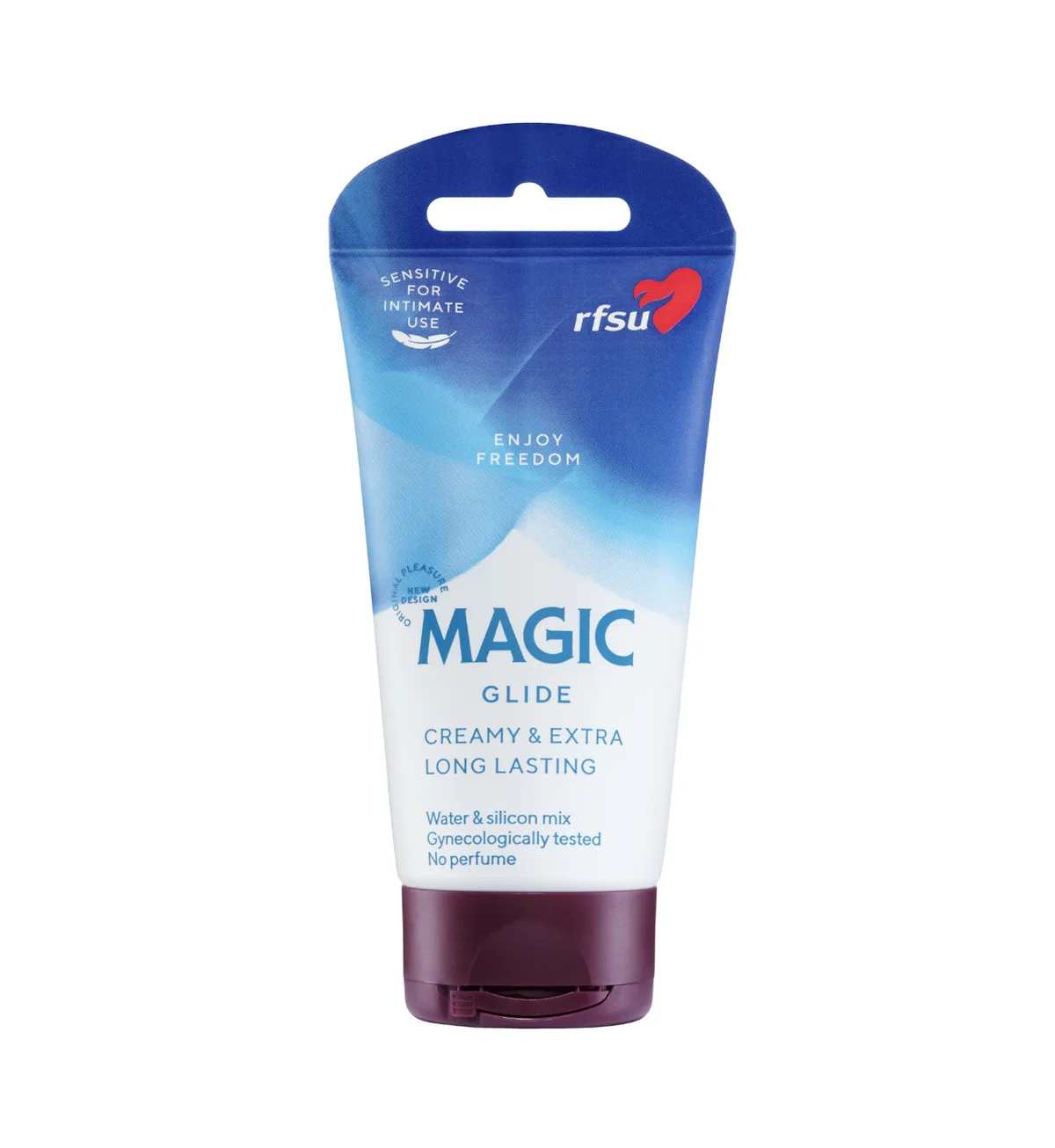
RFSU Sense Me Magic Glide is a hybrid glide lubricant — a creamy gel that mixes water and silicone — in a 75 ml tube from Swedish RFSU. This desk review applies to the item with EAN 7310572000111, which in September 2026 had no shop in our data selling it in this market.
The specification is, in one way, unusually well put together and, in another way, unusually messy. Well put together, because RFSU publishes everything needed to review the contents: a complete ingredient list with sixteen INCI names, a safety data sheet, and product images of the back of the tube where the barcode can be read. Messy, because the product, during its lifetime, has been sold in at least three different packages under three different names — Sense Me Magic Glide, Magic Glide, and nowadays Magic Lube — and the information about it has been scattered through the retail channel in various versions. The stores alternately describe it as water-based, silicone-based, and hybrid, and one of them even calls it a medical device product, which the manufacturer’s own data sheet contradicts.
What can already be established here are two things. The base is a blend: the ingredient list starts with Aqua and Dimethicone, meaning water and silicone. And the two pieces of information that determine how gentle a water-based lube is on mucous membranes—pH and osmolality—RFSU does not publish as measured values. The safety data sheet states the pH as “not measured.”
Is Magic Glide still available—or is it called Magic Lube now?
Short answer: the product has changed name and barcode, but not the formula. RFSU no longer has a product page for Magic Glide, and the manufacturer’s previous English address for Magic Glide 75 ml is permanently redirected to the product page for Magic Lube. There, RFSU lists exactly the same sixteen ingredients in the same order as on the Magic Glide tube: Aqua, Dimethicone, Propylene Glycol, Isopropyl Palmitate, Glycerin, Polysorbate 60, Sorbitan Stearate, Phenoxyethanol, Butyrospermum Parkii Butter, Acrylates/C10-30 Alkyl Acrylate Crosspolymer, Tocopheryl Acetate, Hydroxypropyl Guar, Xanthan Gum, Allantoin, Ethylhexylglycerin, and Sodium Hydroxide.
The new name has a new EAN. The manufacturer’s own picture of the back of the Magic Lube tube shows the barcode 7310571600046. The item that this review is about, 7310572000111, is therefore the older package. In this market, no shop in our data sells it.
For the buyer, that practically means two things. According to the manufacturer’s own ingredient lists, the contents of the tube are the same regardless of name. But what’s around the ingredient list—the packaging material, the sustainability symbol, and the labeling—differs between the versions, and those are the differences that the rest of this section clarifies.
Three packages, two EAN numbers
RFSU’s image archive contains back-of-tube images of three tubes. The oldest is dark blue and is called Sense Me Magic Glide. The middle one is light blue with a burgundy cap, is called Magic Glide, and has the text “New Design” on the front. The latest is called Magic Lube. The first two have the same barcode, 7 310572 000111, while Magic Lube has 7 310571 600046. Several other shops show the middle, light-blue tube in their product images.
The differences between the two tubes with the same EAN are small but not cosmetic. The older Sense Me tube carries a CE mark without a number or symbols for the best-before date and batch number, but no symbol for shelf life after opening. The later Magic Glide tube lacks a CE mark, instead has the PAO symbol 6M — six months after opening — and is labeled “100% vegan”. The Swedish product text is otherwise the same on both: “Water- and silicone-based cream with the right pH”, which “can be used with sex toys and with or without a condom.”
The Magic Lube tube adds a feature that neither of the older ones has: that the packaging consists of 50 percent recycled plastic, with the cap excluded. RFSU states the same thing on the product page and that Magic Lube is available in 75, 100 and 150 ml. For the older article, RFSU publishes no information about the share of recycled plastic, and there is no reason to assume that it applies retroactively.
Ingredients: sixteen INCI names in water and silicone
The ingredient list is the single strongest part of the documentation. It is printed on both tubes with the same barcode, it is reproduced in the safety data sheet, it appears on the successor’s product page, and it is available from multiple retailers. All sources list the same sixteen names. The safety data sheet has two pairs in reverse order — Sorbitan Stearate before Polysorbate 60 and Allantoin before Hydroxypropyl Guar — but the same content.
Roughly, the sixteen ingredients can be divided into five groups. The carriers are water (Aqua) and silicone (Dimethicone). The humectants are propylene glycol (Propylene Glycol) and glycerin. The emollients are isopropyl palmitate (Isopropyl Palmitate), a fat-soluble ester, and shea butter (Butyrospermum Parkii Butter), a vegetable fat. The emulsifiers Polysorbate 60 and Sorbitan Stearate keep the water and oil phase together. The rest are thickening agents (acrylate polymer, guar and xanthan gum), caring additives (vitamin E ester Tocopheryl Acetate and allantoin), the preservative system (Phenoxyethanol and Ethylhexylglycerin) and sodium hydroxide to adjust pH.
The safety data sheet provides a number for: sodium hydroxide is the only ingredient listed as a hazardous substance, with the concentration below 0.1 percent. As a pure substance, it is corrosive, which is why it is listed, but the mixture as a whole is not classified as hazardous. RFSU does not publish the other concentrations. How much water, silicone, propylene glycol or glycerin the tube contains as a percentage does not appear from any source, and that is the gap that makes it difficult to say anything definite about osmolality.
What is a hybrid lubricant?
A hybrid lubricating gel is an emulsion: water and silicone that, with the help of emulsifiers, are kept together in a single cream. RFSU describes Magic Lube as a “hybrid lubricating gel (water-based + silicone-based)” and the Magic Glide tube as a “water- and silicone-based cream.” The manufacturer’s point about the mixture is that the silicone makes the glide not absorb as quickly and therefore it doesn’t need to be topped up as often as a traditional water-based lubricating gel.
The safety data sheet gives a concrete sign of which phase dominates: the product is listed as water-soluble. That sets it apart from a pure silicone lube, RFSU Velvet Lube, which consists of only Dimethicone and Dimethiconol. As a rule, a water-soluble lube can be rinsed off more easily than a pure silicone lube, and that matches retailer descriptions, which describe the product as “colorless and easy to wash off.” At the same time, the data sheet states that the skin should be washed with soap and water upon skin contact—silicone and shea butter are not water-soluble by themselves.
That also explains why the shops aren’t in agreement about what the product is. Some retailers call it a “water-/silicone-based lubricating gel,” while others call it a “hybrid,” and another lists the product type as “silicone-based lubricating gel.” RFSU itself lists Magic Lube on both of its category pages, both for water-based lubricating gel and for silicone-based lubricating gel. The ingredient list decides the question: it’s a hybrid, with water first. In this market, no shop in our data sells the product.
Propylene glycol and glycerin — and the osmolality that isn’t published
Osmolality is a measure of how concentrated an aqueous solution is, and it is the characteristic in an aqueous lubricating gel that research has pointed out as most relevant for mucous membranes. In their guidance from 2012, WHO, UNFPA and FHI360 write that the osmolality in a lubricating gel preferably should not exceed 380 mOsm/kg, and that procuring organizations should for the time being buy lubricating gels with no more than 1,200 mOsm/kg. By way of comparison, the same guidance states that vaginal secretions are at 260–290 mOsm/kg and semen at 250–380 mOsm/kg—and that most commercial lubricating gels are at 2,000–6,000 mOsm/kg.
The guidance also points out what determines the value. Glycols—practically glycerol and propylene glycol, which are added as humectants—are the main factor behind osmolality in most lubricating gels. To stay under 1,200 mOsm/kg, the guidance says that the glycerol content should not exceed 9.9 weight percent and the propylene glycol content should not exceed 8.3 weight percent; if several glycols are mixed, the total content should be kept below roughly 8.3 percent.
Magic Glide contains both. Propylene Glycol is listed as the third ingredient and Glycerin as the fifth. RFSU does not publish either the osmolality or the concentrations of the two glycols, and neither do any of the stores or pharmacies reviewed here. Therefore, it is not possible to place the product on WHO’s scale. What can be said is that it contains exactly the substances that the guidance identifies as determining for its value. How large a share of the tube is the water phase is not published either.
Preservatives, fragrance, and parabens
A water-based lubricant needs to be preserved, and Magic Glide does this with phenoxyethanol, supplemented with ethylhexylglycerin. WHO guidance mentions phenoxyethanol among the preservatives used in lubricants, together with parabens, sorbic acid, and benzoic acid, and states that preservatives can cause irritation and sensitization in certain people. It is a general statement, not a claim about this particular product.
Parabens are not present in the list. The older Sense Me tube was labeled “Free from perfume and parabens,” and some retailers state “hormone- and paraben-free.” Fragrance is not present either: the safety data sheet lists the scent as “Without perfume,” the later tube is labeled “No perfume,” and Magic Lube is “Perfume free.” Colorants are missing as well—the datasheet states the color as transparent, and RFSU writes that Magic Lube is free from fragrance and colorants. One retailer also states that the product lacks taste and does not contain sperm-killing agents.
Two ingredients deserve a comment for anyone with a known contact allergy. Shea butter is a plant fat from the shea nut, and tokoferyl acetate is a vitamin E compound. RFSU writes on the Magic Lube page that the product has no allergens, which is wording that cannot be verified against any published list—the person who knows they react to one of the sixteen ingredients has the ingredient list to go by, and it is complete.
What pH does Magic Glide have?
It is not published as a number. The tube states “correct pH,” the Magic Lube page “pH-adapted” and “pH-balanced,” but RFSU’s safety data sheet for Magic Glide states the pH value as “Not measured”. The stores have made their own interpretations of the wording: some write “pH-balanced: Yes,” others “pH-balanced,” and one writes “pH-neutral.”
The difference between the words is not just linguistic. WHO guidance states that normal vaginal pH is 3.8–4.5, that a lubricant for vaginal use preferably should have a pH of around 4.5, that 5.5–7 is recommended when use is not known, and that lubricants with a pH over 7 are not recommended. A “pH-neutral” lubricant in the chemical sense — pH 7 — therefore lands at the upper end of the recommended range, while one that is adapted to the vagina is significantly lower. It is not clear which one RFSU means by “the right pH.” The fact that the product contains sodium hydroxide, which is used to raise pH, also says nothing about the final value.
For a pure silicone-based lubricant without water, like RFSU Velvet Lube, pH is a question without much importance. For a water-based lubricant like Magic Glide, it is one of the most important properties, and here a measured value would have been relevant.
Condoms and sex toys: what RFSU promises and what is missing
RFSU’s promise is broad. Both tubes with EAN 7310572000111 state that the product “can be used with sex toys and with or without a condom”. The Magic Lube page says that the lubricant is “safe to use with all types of condoms”, and Apoteket reproduces that RFSU’s lubricant “can be used together with all kinds of condoms and sex toys”. However, no test report or test method behind the promise has been published.
Can you use Magic Glide with a condom?
According to the manufacturer, yes, with all types. What makes the question worth a closer look is the formula. WHO guidance states that water- and glycol-based lubricants and silicone-oil-based lubricants are generally compatible with natural rubber latex condoms, but that oil-based lubricants are not. The guidance lists household products that should not be used with latex condoms, including butter, palm and coconut oil, cooking oil, and body lotion, and it points out that polyisoprene condoms are as sensitive to oils as latex condoms.
Magic Glide contains two fat-soluble ingredients: isopropyl palmitate and shea butter. They are embedded in a water-based emulsion and are listed at positions four and nine in the ingredient list, and none of the sources says that the product damages latex. On the contrary: The adult label marks it “Suitable for latex condoms” and Shop Apotheke says “Latexkondomsicher”. What is missing is a published test showing that the emulsion does not affect latex or polyisoprene. The manufacturer’s promise is the only supporting evidence. WHO guidance also notes that a generally accepted test method for condom compatibility did not yet exist when it was written.
A shop makes this more confusing than it needs to be. Shop Apotheke labels the product both “Ölfrei” and “Fettfrei” — oil-free and fat-free — even though the ingredient list on the same page includes isopropyl palmitate and shea butter. That information is wrong compared with the ingredient list and should not be used as an argument for condom compatibility.
Does Magic Glide work with silicone sex toys?
Here, the sources contradict each other, and this is the most important clash in the entire documentation. The text on the tube says “can be used with sex toys” without any reservations. The Magic Lube page writes “most sex toys”. RFSU’s own category page for silicone-based lubricants — where Magic Lube is listed — warns against using silicone-based lubricant with silicone sex toys, because it can damage the material and affect the product’s service life. And Shop Apotheke writes plainly “Nicht für Silikon-Toys geeignet” — not suitable for silicone sex toys, but suitable for toys made of other materials.
The manufacturer does not specify which toys fall outside “most”. For RFSU’s pure silicone lubricant Velvet Lube, the manufacturer is unambiguous: it should not be used with silicone sex toys. Magic Glide contains the same main silicone, Dimethicone, although diluted in water. The cautious interpretation is to avoid using it together with silicone toys, or at least test it first on a small, hidden area. For toys made of glass, metal, or hard plastic, there is no corresponding warning in any source.
It’s worth comparing with a pure water-based lubricant. pjur Aqua is stated by the manufacturer as suitable for sex toys without any reservations, and RFSU itself writes on its category page that water-based lubricants work with both condoms and sex toys without affecting sensitive materials. Anyone who uses silicone sex toys and wants to avoid the question altogether is better off with a lubricant without silicone.
Cosmetics or a medical device?
Lubricants are sold in Europe either as cosmetics or as medical devices, and the difference matters for how they are reviewed. WHO guidance states that in Europe, lubricants are classified as medical devices of class I or IIa depending on the product claims, and that class I products may be made available on the market based on the manufacturer’s own declaration, while class IIa requires review by a notified body.
For Magic Glide, the answer in the manufacturer’s own documentation is clear: the safety data sheet from 2021 states that a cosmetic safety assessment (CPSR) has been carried out according to the EU’s cosmetics legislation. The later tube has no CE marking, but it has the PAO symbol 6M, and the ingredient list is given using INCI names. Läkemedelsverket describes exactly the symbol “open jar” and INCI names as typical indicators of cosmetic products.
Meds, however, states on its product page that “This is a medical device.” That information does not match the safety data sheet or the packaging that the stores display. The manufacturer’s statement applies.
The CE mark that disappeared
The explanation for Meds’ statement is most likely on the oldest tube. RFSU’s image of the back of Sense Me Magic Glide shows a CE mark without a four-digit number, and no PAO symbol—instead, symbols for best-before date and batch number. According to the Swedish Medical Products Agency (Läkemedelsverket), a CE marking, with or without four digits, can indicate that a product is a medical device. A mark without a number corresponds to Class I, which, according to the WHO guidance, is released on the market based on the manufacturer’s own declaration without review by a notified body.
What RFSU has done in the transition between the tubes is not published by the manufacturer. What can be established is that the same barcode, 7310572000111, has been on a tube with a CE mark and on a tube without one, that the ingredient list on both is identical, and that the currently applicable safety data sheet describes the product as cosmetics. The person who buys the item receives the light-blue tube according to the stores’ product images, and it is labeled as a cosmetic product.
Compare this with pjur Aqua, which is a pure water-based lubricant: its label carries CE marking with the notified body’s number 0482 and the MD symbol—meaning it is a medical device that has been reviewed by a third party. This says nothing about whether one is better than the other for the user, but it does say something about how much external scrutiny lies behind the claims on the packaging.
Use, storage, and durability
RFSU’s instructions for use are simple: squeeze out the desired amount into your hand or onto your fingers and apply where extra moisture and glide are needed. According to the manufacturer, the product can be used during intercourse, foreplay, and masturbation, and because it contains silicone, RFSU says that a smaller amount is sufficient than with a water-based lubricant. Some shop listings also list oral sex as a use area, and the Magic Lube page states that the formula can work as a moisturizing intimate gel in cases of dryness.
The packaging is a tube with a snap cap of 75 ml. A shop lists the package dimensions as 13.70 × 6.00 × 3.70 centimeters and the weight as 0.09 kilograms. The tube has a hanging hole at the top and stands on the cap.
6 months after opening
The later Magic Glide tube has the PAO symbol 6M, and RFSU states the same thing for Magic Lube: a shelf life of six months after opening. For a 75 ml tube, it’s a practical limitation to factor in. Anyone who uses lubricant infrequently will most likely need to throw away part of the tube—and that’s an argument not to buy more than they use. Magic Lube is available in 75, 100, and 150 ml, but for the older product, 75 ml is the only size mentioned.
RFSU’s storage advice is room temperature, max 25 °C, not in direct sunlight, and not frozen. Both the older and the later tube list “Store at room temperature.” The oldest Sense Me tube has no PAO symbol; instead, it has a best-before date—so anyone who gets such a tube should check that date instead of counting six months.
Is Magic Glide washed off with water or soap?
The product is described as colorless and easy to wash off. The safety data sheet states that the product is water-soluble, but at the same time says that if it comes into contact with skin, the skin should be washed with soap and water, and it also refers to the fact that it may be experienced as slightly sticky if you get a lot on the skin. Reasonably, both parts apply: the water phase is rinsed away with water, and the silicone and shea butter require soap.
Shop Apotheke also warns that silicone oil can leave stains on textiles and other surfaces that are difficult to remove. This is a retailer statement, but it follows from the fact that the product contains silicone. Put a towel underneath if the sheet is sensitive, and wipe up spills on the floor—silicone on a smooth surface becomes slippery.
The safety data sheet also provides advice about disposal: the gel can be put out as household waste, and the tube should be recycled as plastic packaging. In case of eye contact, the data sheet states that the gel can cause temporary mild irritation and blurred vision; rinse with lukewarm water for several minutes.
Where can you buy it — and what does it cost?
We do not have price data from shops in your market yet.

The tube promises the “right pH”. RFSU’s own safety data sheet states the pH value as not measured.
Pros
- Price information isn’t available in our market data.
- Full ingredient list with 16 INCI names on the tube, datasheet, and product page
- Safety data sheet published: not classified as hazardous
- Fragrance-free, paraben-free, and without colorants
- Water-soluble according to the datasheet, despite silicone in the formula
- Compatible with all types of condoms according to the manufacturer
Cons
- Discontinued packaging — replaced by Magic Lube with a new EAN
- pH is stated as “the right pH” but is “not measured” in the safety data sheet
- Osmolality is not published despite propylene glycol and glycerin in the formula
- Conflicting information about silicone sex toys between RFSU and retailers
- Only 6 months of shelf life after opening in a 75 ml tube
- 16 ingredients, including the preservative phenoxyethanol
Rating in detail: five criteria, the same for the entire category
- Ingredients and declaration
- 7,5
- 16 INCI names on the tube, the safety data sheet, and the website — but “right pH” versus “not measured”.
- Mucosal compatibility
- 5,0
- Fragrance- and paraben-free, but propylene glycol and glycerin without published osmolality.
- Compatibility
- 6,0
- All types of condoms according to RFSU, but conflicting information about silicone sex toys.
- Use and packaging
- 5,5
- 75 ml tube, 6 months after opening — and the packaging is being phased out of the range.
- Price per milliliter
- 8,0
- We don’t have price-per-100-ml data for this market.
Magic Glide compared with the alternatives
Three comparisons are relevant: against RFSU’s own pure silicone lubricant, against a pure water-based lubricant in the same price range, and against the successor with the same formula. The prices for Velvet Lube and pjur Aqua come from the same product streams and the same price checks, on September 12, 2026.
Against RFSU Velvet Lube 40 ml
RFSU Velvet Lube is the manufacturer’s pure silicone lubricant, with two ingredients: Dimethicone and Dimethiconol. It is sold in tubes of 40 ml. No shop in our data sells the RFSU Sense Me Magic Glide 75 ml in this market.
The difference in ingredients is as big as the difference in price. Velvet Lube contains no water and therefore no glycols, preservatives, or the pH issue at all, while Magic Glide has sixteen ingredients, two glycols, and a preservation system. On the other hand, Magic Glide is water-soluble according to its datasheet, while a pure silicone lubricant is not. RFSU explicitly advises against Velvet Lube with silicone sex toys; for Magic Glide, the manufacturer is less clear. Both have a shelf life of six months after opening.
The choice comes down to prioritization. If you want as few ingredients as possible, Velvet Lube is the clear choice, at a significantly higher price per milliliter. If you want a silicone glide that is easier to get off and costs less, Magic Glide is the alternative.
Against pjur Aqua 100 ml
pjur Aqua is a pure water-based lubricant of 100 ml. The ingredient list has seven names: water, glycerin, ethoxydiglycol, phenoxyethanol, two thickeners, and citric acid. As with Magic Glide, it therefore contains glycols and is preserved with phenoxyethanol, and just like with Magic Glide, the manufacturer does not publish the levels or the osmolality on the product page.
The differences are in what is stated around the ingredient list. pjur Aqua is CE-marked with notified body 0482 and the MD symbol, stated as compatible with both latex and polyisoprene condoms, and as suitable for sex toys without any reservations. Magic Glide is cosmetics according to its datasheet, stated as compatible with all types of condoms but gives contradictory information about silicone sex toys. Magic Glide, in turn, contains silicone in the formula, which according to RFSU means the glide lasts longer and needs less top-ups.
Against the successor Magic Lube 75 ml
Magic Lube is the same formula in a new package, with a new EAN, 7310571600046. Apotea sells it. The pharmacy sells the older Magic Glide tube with the old EAN number.
That makes the price comparison simple. In this market, no shop in our data sells the product. Since the ingredient list is identical, there is no content-related reason to pay more for one than the other. Magic Lube, on the other hand, has a tube made of 50 percent recycled plastic, vegan labeling by The Vegan Society, and it will remain available when the leftover stock of the older tube is used up.
The price range isn’t available for this market (no local price data).
In this market, no shop in our data sells the product with EAN 7310572000111.
We don’t have per-100 ml price data for this market.
We don’t have local comparison-price and discount details for this market.
Shipping affects the real cost more than the price of a purchase of this size. Some shops offer free shipping, while another charges a shipping fee for this size and offers free shipping above a threshold. Delivery is listed as 1–2 days for orders placed before 4:00 PM, 1–2 days, and 1–3 business days.
When the stores contradict each other
A review of five store pages and four pharmacies and retailers found four discrepancies that are worth reporting, because they affect how the product is perceived.
Base. One shop lists the product type “Silicone-based lubricant” even though water is the first ingredient. Other shops write “water-/silicone-based”, while other shops write “hybrid”. The manufacturer’s ingredient list applies: it’s a hybrid with water first.
Ingredient list. Some shops publish a Swedish version of a list with fourteen names instead of sixteen. Allantoin and Ethylhexylglycerin are missing, and “etylgummi” and “hydroxi-propylgylar” are there where Xanthan Gum and Hydroxypropyl Guar should be. Anyone looking for a specific ingredient should go by the tube or RFSU’s own list.
Classification. Meds calls the product a medical device, while RFSU’s safety data sheet refers to a cosmetic safety assessment, and the current tube lacks a CE mark.
Silicone sex toys. Shop Apotheke states that the product is not suitable for silicone sex toys and also labels it as oil- and fat-free, despite isopropyl palmitate and shea butter in the list. The first statement matches RFSU’s own warning for silicone lubricants; the second matches nothing.
Who is Magic Glide for — and who isn’t it for?
It’s for you if you want a lubricant with silicone. The ingredient list is fully published. It’s for you who want a fragrance- and paraben-free lubricant from a Swedish manufacturer that publishes safety data sheets, and who thinks that a water-soluble lubricant with silicone is a reasonable compromise between durability and cleaning.
It’s not for you if you want a measured pH or a published osmolality. RFSU publishes neither, and the formula contains both propylene glycol and glycerin—the two substances that WHO guidance identifies as governing osmolality. It’s not for you if you use silicone sex toys and want a clear answer—in that case, a plain water-based lubricant is a safer choice. It’s also not for you if you want the shortest possible ingredient list; sixteen ingredients are many for a lubricant. And it’s less suitable if you want to buy a size that lasts a long time, because 75 ml is the only size and the shelf life after opening is six months.
Anyone who wants exactly the same recipe in a package that’s left when the remaining stock runs out buys Magic Lube. Anyone who finds an older tube may pay less for the same content.
Complaints, a 14-day right of withdrawal (health/hygiene exception), and the 2-year legal guarantee for defects that exist at delivery.
No voluntary manufacturer warranty is provided by RFSU, and that’s normal for consumable goods like lubricants. What applies are your statutory rights. In the EU and EEA, the seller is liable for defects that exist at delivery and appear within at least 2 years (the legal guarantee)—for example, a tube that leaks during delivery or a lid that’s broken. That the tube has a best-before date or a shelf life after opening affects what counts as a defect, but not the right to make a complaint itself.
For distance purchases, in the EU and EEA consumers generally have a 14-day right of withdrawal, starting when the goods are received. Under EU rules, sealed goods that are not suitable for return for health or hygiene reasons are exempt from the right of withdrawal once unsealed. An opened tube of lubricant typically falls within that description. So don’t open the tube until you’ve decided.
The retailers’ own terms follow the same logic. In this market, no shop in our data sells the product—so check the seller’s terms for what applies in your case.
Specifications: ingredients, compatibility, packaging, and purchase
Base and ingredients
- Base
- Hybrid: water and silicone
- The listing uses a deviating “silicone-based lubricant” wording
- Ingredients (INCI)
- Aqua, Dimethicone, Propylene Glycol, Isopropyl Palmitate, Glycerin, Polysorbate 60, Sorbitan Stearate, Phenoxyethanol, Butyrospermum Parkii Butter, Acrylates/C10-30 Alkyl Acrylate Crosspolymer, Tocopheryl Acetate, Hydroxypropyl Guar, Xanthan Gum, Allantoin, Ethylhexylglycerin, Sodium Hydroxide
- Same on the tube, the safety data sheet, and the Magic Lube page
- Number of ingredients
- 16
- Share per ingredient
- Not published by the manufacturer
- Sodium hydroxide
- Under 0.1 %
- The only hazardous substance according to the safety data sheet
- Glycerin and glycols
- Yes: Propylene Glycol and Glycerin
- Oils and fats
- Yes: Isopropyl Palmitate and shea butter
- Preservatives
- Phenoxyethanol, Ethylhexylglycerin
- Parabens
- No
- According to the ingredient list
- Fragrance
- No
- “Fragrance-free” according to the safety data sheet
- Coloring agents
- No
- Transparent according to the safety data sheet
- Flavor
- No
- Store information from shop product data
- Spermicide
- No
- Store information from shop product data
- Vegan
- Yes
- “100% VEGAN” on the latter tube
Measurement values and classification
- pH
- Not measured according to the safety data sheet
- The tube states “correct pH”; Shop Apotheke writes pH-neutral
- Osmolality
- Not published by the manufacturer
- Viscosity
- Not measured according to the safety data sheet
- Solubility
- Water-soluble
- According to the safety data sheet
- Physical state
- Gel, transparent
- Classification
- Cosmetic product
- CPSR according to 1223/2009 according to the safety data sheet; Meds states a deviating “medical device”
- CE marking
- No on the current tube
- The older Sense Me tube had a CE mark without a number
- Hazard classification
- Not classified as hazardous according to CLP
- Safety data sheet
- Version 1, issued 2021-02-22, formula no. 7272
- Dermatologically tested
- Yes, according to the manufacturer
- No study data published
- Gynecologically tested
- Yes, according to the manufacturer
- No study data published
Compatibility and use
- Condoms
- All types according to the manufacturer
- Latex condoms
- Yes
- Store information from shop product data
- Polyisoprene condoms
- Not mentioned separately by the manufacturer
- Sex toys
- “Most sex toys” according to RFSU
- The tubes: “can be used with sex toys”
- Silicone toys
- Contradictory
- Shop Apotheke: not suitable; RFSU generally warns against silicone lubricant with silicone toys
- Oral sex
- Yes
- Store information from other retailers
- Cleaning
- Soap and water on skin contact
- According to the safety data sheet
- Sound level
- Not applicable — no electronics
- Battery and charging
- Not applicable — no battery
Packaging, purchase and warranty
- EAN
- 7310572000111
- The successor Magic Lube 75 ml has 7310571600046
- Supplier’s item number
- G6169XN
- According to shop product data
- Volym
- 75 ml
- Förpackning
- Tube with snap-on cap
- Förpackningsmått
- 13,70 × 6,00 × 3,70 cm
- According to shop product data
- Vikt
- 0,09 kg
- According to shop product data
- Hållbarhet efter öppning
- 6 månader (PAO 6M)
- Förvaring
- Rumstemperatur, högst 25 °C
- According to RFSU for Magic Lube
- Tillverkningsland
- Market
- Manufacturer
- RFSU AB, Kista
- Share of recycled plastic
- Not published for this tube
- Magic Lube: 50% excl. cap
- Price data not available
- Not available
- No shop in our data sells it in this market.
- Price per 100 ml
- Not available
- No price data available
- Manufacturer's warranty
- Not stated by the manufacturer
- Right to make a complaint (legal guarantee for at least 2 years in the EU/EEA)
- 3 years
- Under EU rules, the seller is liable for defects that exist at delivery and appear within at least 2 years, regardless of the manufacturer’s promises
Common questions about RFSU Sense Me Magic Glide
Is Magic Glide water-based or silicone-based?
Has Magic Glide changed its name to Magic Lube?
Can you use Magic Glide with a condom?
Can Magic Glide be used with silicone sex toys?
What pH does Magic Glide have?
Does Magic Glide contain glycerin or parabens?
Is Magic Glide a medical device?
How long does Magic Glide last after opening?
The best overall product
RFSU Sense Me Magic Glide 75 ml is ranked på plats 8 av 12 in lube best i test, where the entire category is compared against each other using five shared criteria. Guiden vinns av Pjur Aqua 100 ml.
Related guides and searches
Sources
Every numerical piece of information in the text can be traced to one of the sources below. The links were checked manually on the specified date.
- Safety data sheet for RFSU Magic Glide, issued 2021-02-22, version 1, formula no. 7272: intended use lubricant, not classified as hazardous according to CLP, no hazard pictograms, sodium hydroxide as the only listed hazardous substance with a concentration below 0.1%, that the mixture does not meet the criteria for PBT or vPvB, the INCI list, skin contact “Wash the skin with soap and water”, “May feel a little sticky if you get a lot on the skin”, temporary mild irritation and blurred vision upon eye contact, physical state gel, color transparent, odor “No perfume”, pH value “Not measured”, kinematic viscosity “Not measured”, solubility “Water-soluble”, that the gel can be disposed of as household waste and the tube recycled as plastic packaging, and that a cosmetic safety report (CPSR) according to the cosmetics legislation EC no. 1223/2009 has been made: RFSU AB — Safety data sheet RFSU Magic Glide (PDF) — checked 26 September 2026
- The back of the Magic Glide tube in the later packaging: the barcode 7 310572 000111, the text “Water- and silicone-based cream with the right pH” and “Can be used with sex toys and with or without a condom”, the sixteen ingredients under the heading INGREDIENTS, the manufacturer RFSU AB, the importers in Norway, Denmark and Finland, the symbol “Store at room temperature”, the PAO symbol 6M, 75 ml and “100% VEGAN” — and that no CE marking is visible on the label: RFSU — the manufacturer’s product image of the back of Magic Glide 75 ml — checked 26 September 2026
- The back of the older tube with the name Sense Me Magic Glide: the barcode 7 310572 000111, the same sixteen ingredients, the same Swedish product text with “the right pH” and “Can be used with sex toys and with or without a condom”, the symbol “Store at room temperature”, 75 ml, the symbols for best-before date and batch number, a CE marking without a four-digit number — and that no PAO symbol is visible on the label: RFSU — the manufacturer’s product image of the back of Sense Me Magic Glide 75 ml — checked 26 September 2026
- The front of the older tube: the name Sense Me Magic Glide, “Personal lubricant”, “Creamy moisturizing gel”, “Sensitive for intimate use”, “Extra long lasting glide”, “Free from perfume and parabens” and “Gynecologically tested”: RFSU — the manufacturer’s product image of the front of Sense Me Magic Glide — checked 26 September 2026
- The front of the later tube: the name Magic Glide, “New Design”, “Creamy & Extra Long Lasting”, “Water & silicone mix”, “Gynecologically tested” and “No perfume”: RFSU — the manufacturer’s product image of the front of Magic Glide 75 ml — checked 26 September 2026
- Successor Magic Lube: hybrid lubricant (water-based + silicone-based) enriched with shea butter and vitamin E, the same sixteen ingredients, “Fragrance-free and pH-adapted”, gynecologically tested, dermatologically tested, 100% vegan and certified by The Vegan Society, packaged in 50% recycled plastic, shelf life 6 months after opening, sizes 75, 100, and 150 ml, store at room temperature max 25 °C, avoid direct sunlight and freezing, sorted as rigid plastic packaging, “safe to use with all types of condoms”, “most sex toys” that the product does not contain animal-derived ingredients or allergens and is free from fragrance and colorants, and that the formula can be used as a moisturizing intimate gel in case of dryness: RFSU — official product page for Magic Lube (Swedish) — checked 26 September 2026
- That RFSU’s former English address for Magic Glide 75 ml (/rfsu-magic-glide-75ml/) is permanently redirected to the product page for Magic Lube, where the same ingredient list, “Shelf life: 6 months after opening”, “Store at room temperature, max 25 °C”, “safe to use with all types of condoms” and “safe to use with condoms and most sex toys” are stated: RFSU — former product address for Magic Glide 75 ml (English) — checked 26 September 2026
- The back of Magic Lube 75 ml: the barcode 7 310571 600046, the text “MAGIC LUBE is a water- and silicone-based lubricant” as “Can be used with sex toys and with or without a condom”, the same sixteen ingredients, “GYNECOLOGICALLY TESTED PERFUME FREE”, the PAO symbol 6M, the sender RFSU AB, Färögatan 33, 164 51 Kista, 75 ml and “50% recycled plastic (cap excluded). Sort as plastic”: RFSU — the manufacturer’s product image of the back of Magic Lube 75 ml — checked 26 September 2026
- RFSU’s description of silicone-based lubricants: that they are long-lasting, that silicone-based lubricant should not be used with silicone sex toys because it can damage the material, and that Magic Lube is listed in the category: RFSU — category page Silicone-based lubricants — checked 26 September 2026
- RFSU’s description of water-based lubricants: that they work with both condoms and sex toys without affecting sensitive materials, and that Magic Lube is also listed in that category: RFSU — category page Water-based lubricants — checked 26 September 2026
- Comparison data for RFSU Velvet Lube: the ingredients Dimethicone and Dimethiconol, 40 ml, shelf life 6 months after opening, safe with condoms, and that it should not be used with silicone sex toys: RFSU — official product page for Velvet Lube — checked 26 September 2026
- Retailer update: EAN 7310572000111, the price is 12.99 euro and the comparison price is 173.20 euro per liter, sold via Kondomotheke with 4–8 business days delivery, the description pH-neutral, that the product can be used with all condoms and dental dams, “Nicht für Silikon-Toys geeignet”, the properties “Ölfrei”, “Fettfrei” and “Latexkondomsicher”, the warning that silicone oil can cause hard-to-remove stains on textiles, as well as the ingredient list and the manufacturer RFSU AB: Shop Apotheke (Austria) — product page for RFSU Magic Glide Creamy & Extra Long Lasting — checked 26 September 2026
- That water- and glycol-based lubricants as well as silicone-oil-based lubricants are compatible with natural rubber latex condoms, that polyisoprene condoms are as sensitive to oil-based lubricants as latex condoms, that among other things butter, palm or coconut oil, cooking oil and body lotion should not be used with latex condoms, that parabens and phenoxyethanol belong to the preservatives that are used and that preservatives can cause irritation and sensitization in some people, that glycerol and propylene glycol are common humectants and the main factor behind osmolality, that the glycerol content should be kept under 9.9 and the propylene glycol content under 8.3 weight percent and the total glycol content when mixed under approximately 8.3 weight percent, that osmolality preferably should not exceed 380 mOsm/kg and, for now, at most 1,200 mOsm/kg, that most commercial lubricants are in the range 2,000–6,000 mOsm/kg, that vaginal secretions are 260–290 and semen is 250–380 mOsm/kg, that normal vaginal pH is 3.8–4.5, that a pH around 4.5 is recommended for vaginal use and 5.5–7 when the use is unknown, that lubricants with a pH above 7 are not recommended, that the ISO working group for test methods for condom compatibility had not yet had a generally accepted method, and that lubricants in Europe are classified as medical devices of class I, which can be sold on the basis of the manufacturer’s own declaration, or class IIa, which requires review by a notified body: WHO/UNFPA/FHI360 — Use and procurement of additional lubricants for male and female condoms: advisory note (2012) — checked 26 September 2026
- Comparison data for pjur Aqua: the ingredients Aqua (Water), Glycerin, Ethoxydiglycol, Phenoxyethanol, Hydroxypropyl Guar Hydroxypropyltrimonium Chloride, Hydroxyethylcellulose, and Citric Acid, compatibility with latex and polyisoprene condoms, suitability for sex toys, and that the product is manufactured without fragrance and added flavorings: pjur — official product page for pjur AQUA — checked 26 September 2026
- Back of the label on pjur AQUA 100 ml: CE marking with notified body 0482, the MD symbol, the PAO symbol 6M, “Store at room temperature,” and “Made in Germany”: pjur — product image of the back of pjur AQUA 100 ml (EU) — checked 26 September 2026
- Item number (EAN 7310572000111) and the shops that sell the product in this market. Retrieved from the stores’ own product flows on 12 September 2026: Adtraction (Testkollen channel) and Addrevenue (Testra channel) — checked 12 September 2026
- Consumer rights when shopping in the EU Your Europe (European Union) — checked 2026-09-26