

Review
Review: Satisfyer Double Joy Couple’s Vibrator with App
Two motors and app control — the sibling model is one step up.
13 September 2026
Review · Couples vibrator · C-shape for use during intercourse
Satisfyer’s simplest couples vibrator reviewed against the manufacturer’s own specifications, quick guide in PDF format, and price data from three Swedish stores. Ten vibration programs from a single motor, silicone over ABS plastic, IPX7 according to IEC 60529, and a lithium-ion battery of 145 mAh that provides about an hour of runtime — at a price where the manufacturer’s own web shop undercuts both stores that have the item in stock.
The cheapest way into the caged couples vibrator format, and a product that does few things but does them in a way that’s easy to understand. Ten programs from a single motor, one button, IPX7 that means you can rinse the entire product, and unusually transparent reporting of battery data. What you pay with is runtime — about one hour after two hours of charging — a fixed angle that can’t be adjusted to your body, and a fifteen-year warranty that expressly doesn’t cover the built-in battery.
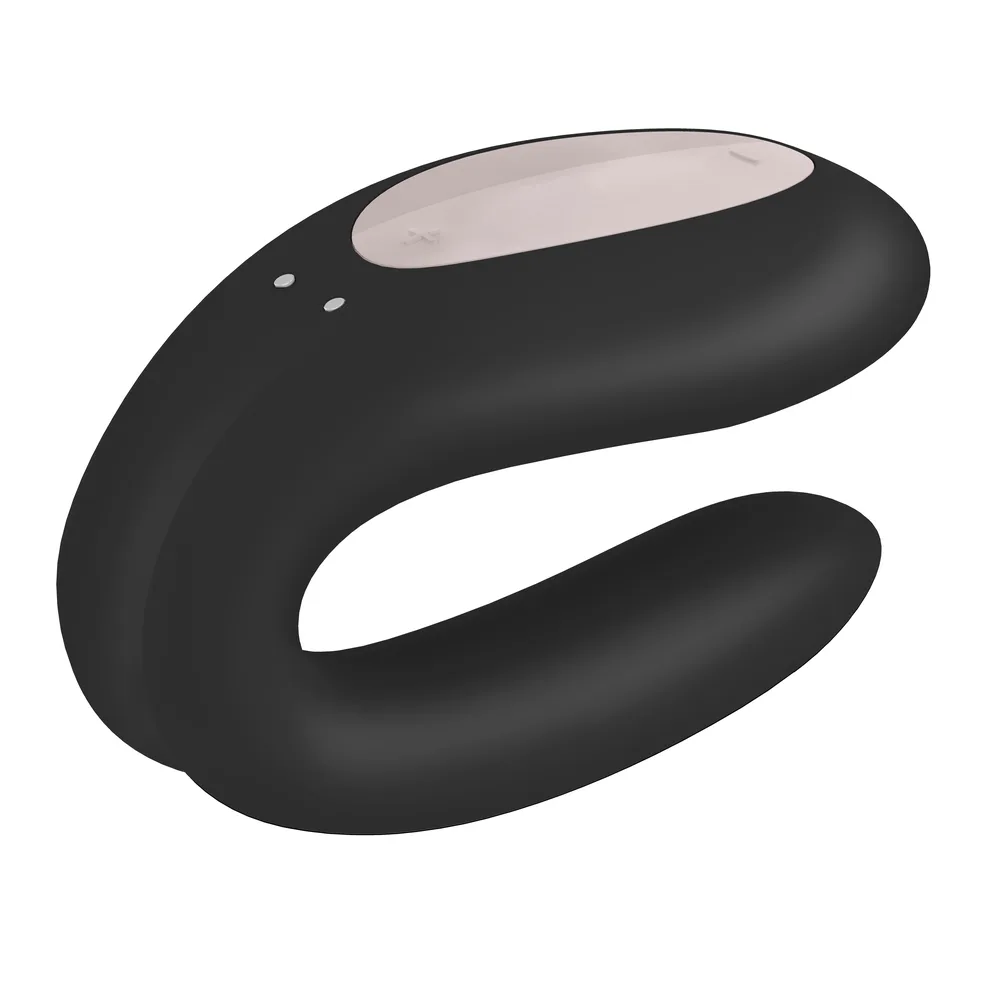
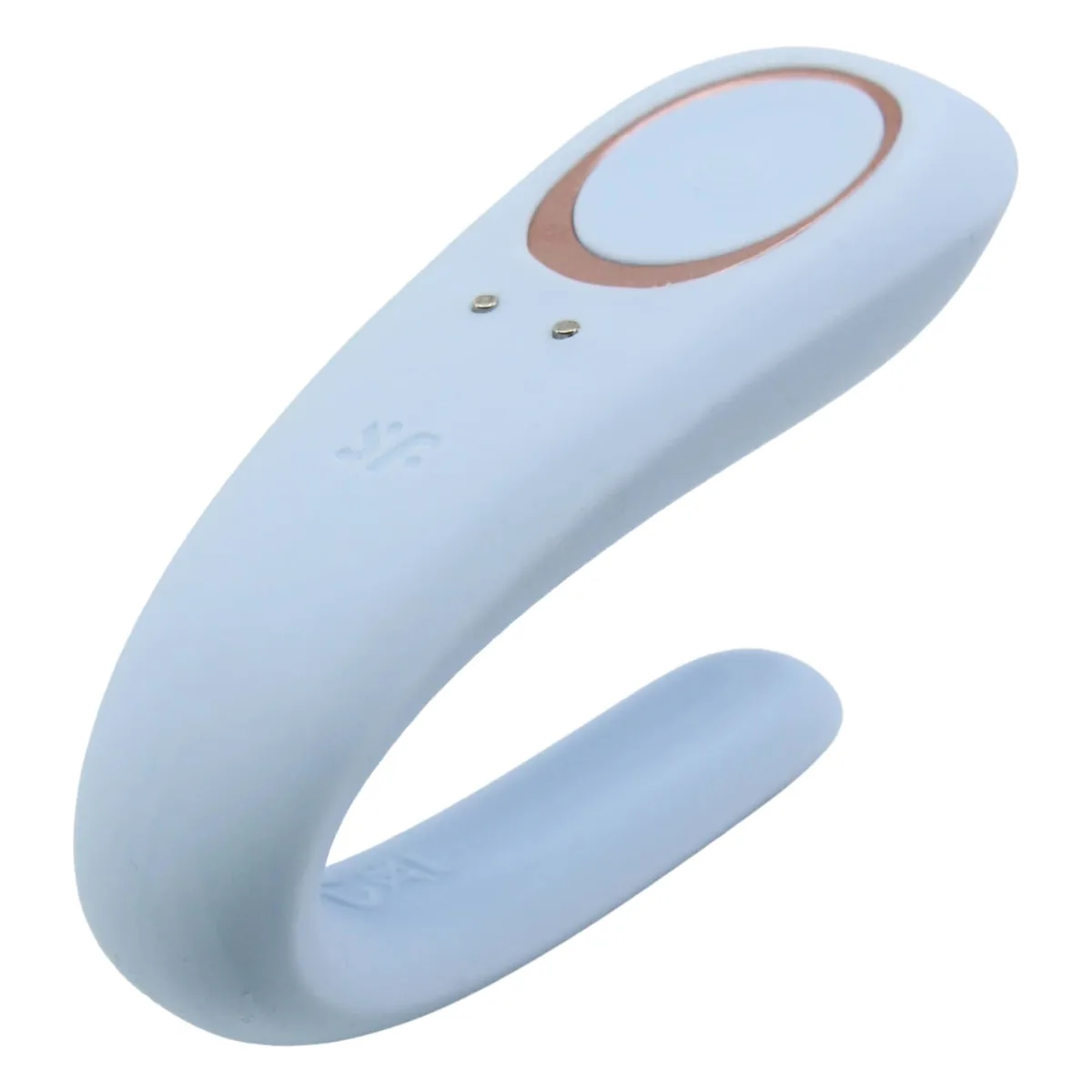
Satisfyer Partner Couples Vibrator is a C-shaped couple vibrator intended to be worn during intercourse. The narrower arm is inserted vaginally and rests against the G-spot area, while the wider arm with the control button lies on the outside against the clitoris. So the construction is not meant to be held in the hand, but to stay in place while penetration is taking place — and that is the only thing that really distinguishes this product category from a standard vibrator.
The specification is short and unambiguous. The manufacturer states the dimensions as 95 × 67 × 35 millimeters, a shaft length of 70 millimeters, a weight of 52 grams, the material ABS plastic and silicone, the IPX7 ingress protection rating, a rechargeable lithium-ion battery, ten vibration programs, and a fifteen-year warranty. The quick guide specifies the battery as 3.7 volts and 145 milliampere-hours, the charging time to about two hours, and the operating time to about sixty minutes. In Sweden, the item is sold by three stores at prices between 299 and 499 SEK, and two of them had it in stock when the price data was retrieved on September 12, 2026.
This review is exclusively about the light blue variant with EAN 4061504083711, the manufacturer’s item number SW10006.1. The model is available in two colors, light blue and violet, and the violet one has its own EAN — 4049369043286. Functionally, they are identical, but the number is worth checking if you compare prices, and that’s especially important here because the stores call the same item three different things.
The first thing a buyer encounters is a naming mess, and it’s worth sorting out before comparing prices. Satisfyer has renamed its entire G-spot vibrator series: what used to be called Partner is now called Double with the manufacturer. This model is therefore called Satisfyer Double Classic on satisfyer.com, while Swedish stores still sell it under the old name.
All three sell the same item. It can be verified, and that’s the whole point of working with EAN instead of product names: Taboo and Mshop both publish EAN 4061504083711 in the page source, and the same number is returned by the manufacturer’s own variant selector when you choose the light blue color. Vuxen publishes no EAN at all, only its own item number PART, but the description — curved G-spot vibrator, control button on the outside against the clitoris, insert piece aimed at the G-spot, a single motor with three speeds and seven pulsing modes — matches the manufacturer’s, point for point.
The final confirmation is in the manufacturer’s own regulatory documentation. Satisfyer’s EC declaration of conformity, which they publish on their compliance page under the entry "9043286 Double Classic", lists the brand Satisfyer Partner and the product name Satisfyer Partner classic in the heading fields. So the old and the new name appear on the same paperwork. The model number is given as J2008-2, and the document is issued against the item code 043286TO — the EAN tail of the violet variant. Satisfyer publishes no separate declaration for the light blue variant; it’s the same model, the same model number, and the same document.
The basic principle is simple, and at the same time it’s the hardest part of the product. The product is bent into a C or a U. The inner arm — the 70 millimeters that the manufacturer calls shaft length — is inserted into the vagina, the outer arm sits on the outside against the clitoris, and the space between the arms is where the penis or a dildo penetrates. The vibrations spread through the entire body and therefore reach both partners at the same time.
What the manufacturer highlights is that the inner arm provides a light pressure against the G-spot area, and that the amount of space taken up makes the vagina narrower, which should be felt for the penetrating partner. What can be established purely physically is that an insertion part that is 70 millimeters long with a diameter that the retailer Mshop lists as 30 millimeters occupies real space — it’s about one third of what an average G-spot vibrator is long, but it has to share the same space with a penis.
That’s also where this category’s well-known weakness lies. A portable G-spot vibrator has no strap, ring, or suction attachment — it stays in place only thanks to the body’s own counterpressure. This particular model also has a fixed, non-adjustable angle between the arms. In practice, that means the fit either works for you or it doesn’t, and there’s nothing to adjust if it doesn’t sit right. It’s a design characteristic, not a defect, but it’s crucial for whether the product is worth the money.
The material question is the only property of an intimate product that can’t be compensated for through experience or care, and it determines whether the product will still be hygienic after five years. The manufacturer lists two materials for this model: ABS plastic and silicone. The same information appears both in the product page’s feature table, in the quick guide’s specifications section, and printed on the back of the packaging.
The manufacturer describes the surface as super soft, skin-friendly, and medical-grade silicone, and it’s that surface that lies against the body. The ABS plastic is the hard inner construction that supports the motor, battery, and electronics. It’s the same material split as on Satisfyer’s other G-spot vibrators, and the same split as on most products in this price range.
Silicone is a non-porous material. A non-porous surface can be cleaned, because there aren’t microscopic cavities where residue can get trapped and remain. That’s the single most important property of a material that’s meant to lie against mucous membranes, and that’s why the material declaration carries more weight than almost all other lines in a specification. ABS is also non-porous, but it’s hard plastic and doesn’t sit against the skin.
What differentiates this design from an all-silicone product is that the silicone sits like a shell over a hard core. The consequence is that the product isn’t flexible in the way the pictures may suggest — it’s soft on the surface but dimensionally stable in the construction. That’s the explanation for why the angle between the arms can’t be changed, and it’s also the explanation for why the product weighs so little, at 52 grams, despite its volume.
Phthalates are a group of plasticizers used to make plastic—above all, flexible PVC—pliable. The Swedish Chemicals Agency (Kemikalieinspektionen) describes them as substances that can affect the endocrine system and make reproduction more difficult, and several of them are therefore restricted or banned within the EU in a large number of products. This product category is repeatedly the subject of regulatory oversight because it contains skin-contact flexible plastic.
Here there is a gap worth noting. Satisfyer does not publish an explicit phthalate, BPA, or latex declaration on the product page for this model—nor in the quick guide or on the packaging, which only states "Material: Silicone, ABS". However, the retailer Vuxen states in its quick facts that the product is body-safe and free from phthalates. This is a store claim, not a manufacturer declaration, and it should be read as such.
There is, however, a document that says more than the product page, and it’s not where you look for it. On Satisfyer’s product compliance page, an EC declaration of conformity is published for the model, and it states that the product meets the RoHS Directive 2011/65/EU with the amending directive (EU) 2015/863. That is relevant in this specific matter: the 2015 amending directive is the one that added four phthalates—DEHP, BBP, DBP and DIBP—among the substances that are restricted in electrical and electronic equipment. A RoHS declaration is therefore not a complete phthalate declaration, but it is significantly more than nothing, and it is signed by the manufacturer’s responsible person for product compliance.
The declaration contains two additional details that don’t appear anywhere else. The product’s model number is given as J2008-2, and the manufacturer and importer are listed as Triple A Import GmbH in Bielefeld—the same group as Satisfyer GmbH. One note belongs here: the document cites the Radio Equipment Directive 2014/53/EU despite the fact that the product has no radio transmitter, and the two standards listed under it, EN 55014-1:2017 and EN 55014-2:2015, are EMC standards for household appliances rather than radio standards. It’s an inconsistency in the manufacturer’s own document and not something that affects the product’s safety, but it’s worth noting for anyone reading the declaration as proof of quality.
Even so, compare it with We-Vibe, which for the Sync 2 plainly states on the product page that the silicone is manufactured without phthalates, BPA, and latex. The difference in how the information is presented doesn’t automatically mean that the materials are different—silicone doesn’t require phthalate plasticizers to become soft, since the softness comes from the polymer’s own structure. But someone who is allergic to latex and wants an explicit commitment will find it at We-Vibe and not at Satisfyer for this specific model.
The manufacturer states the length as 95 millimeters, the width as 67 millimeters, and the height as 35 millimeters, with a shaft length—i.e., the insertable arm—of 70 millimeters. The weight is given as 52 grams. That makes the product small: it fits in the palm of your hand, and 52 grams is light even for the category. Satisfyer’s own Double Joy weighs 78 grams and Double Plus Remote weighs 63 grams.
Here, the store details start to vary, and it’s worth laying them out because several of them get carried over in price comparisons. The manufacturer’s 52 grams is the only weight specification that comes from Satisfyer. Retailer Mshop lists 0.13 kilograms, i.e., 130 grams—but in the same table, Mshop also lists the package dimensions as 110 × 115 × 50 millimeters, which means that 130 grams is almost certainly a shipping weight that includes the cardboard, charging cable, and printed materials. Retailer Taboo lists 200 grams, which is hard to reconcile with either the product’s volume or the manufacturer’s stated figures, and should be treated as an incorrect entry in the store’s product data.
The same pattern applies to the length. The manufacturer states 95 millimeters for the entire product and 70 millimeters for the shaft. Mshop lists 8.00 centimeters as the product length and 3.00 centimeters as the diameter; Taboo lists 10 centimeters and about 3.5 centimeters. The measurement points clearly differ between stores—a C-shaped product can be measured straight across, along the curve, or only on the insertable part—and where the store and the manufacturer contradict each other, it is the manufacturer’s figures that apply. The diameter information has value anyway, because Satisfyer does not publish any diameter at all: the fact that two independent stores land on 30 and 35 millimeters, respectively, at least provides an order of magnitude for the insertable part’s circumference.
The interface is as simple as it can get. The product has a single button, the oval pad that sits on top of the outer arm’s upper side. The manufacturer’s quick guide describes the entire operation using two pictograms: one press starts the product and steps through the modes, and a press for two seconds turns it off. The number of modes is stated as ten.
There is no display, no app, no remote control, and no memory for the most recently used mode documented by the manufacturer. It’s a trade-off: you don’t have to learn anything, but you also can’t jump directly to the mode you like without pressing through the scale. On a product worn during intercourse, that makes a real practical difference versus models with a remote control, because the button is on the part that lies against the body.
The manufacturer is unusually clear here. The ten programs consist of three vibration intensities and seven vibration patterns. This means that only three out of ten settings deliver even, constant vibrations—while the rest are rhythms, pulses, and waves. Adult describes the same thing in its own text: the only motor provides three vibration speeds and seven different pulsing modes.
What can be established is that the distribution matters for who the product suits. Anyone who wants maximum, even strength in practice has three settings to choose from, only one of which is the strongest. Those who prefer variation and rhythm get seven. A comparison that only counts "ten programs" against a competitor's "ten intensity levels" is therefore misleading: We-Vibe lists ten steps on an intensity scale, which is something different from three strengths plus seven patterns.
It’s also worth noting that the manufacturer describes the motor as powerful and as a "whisper mode"—quiet as a whisper—but that neither of these two characteristics is provided with a measurement value anywhere in the manufacturer’s material.
Mshop's product name, Partner Single Engine, points to the most important design difference within Satisfyer’s own series. This model has one motor, positioned so that the vibrations spread throughout the entire body to both arms. Satisfyer Double Joy instead has two separate motors, one in each arm.
In practice, the difference is that a single-motor design can’t deliver different intensity to the clitoris and to the insertion part—it's the same signal everywhere, and the strength of the inner arm is determined by how well the vibration propagates through the silicone and the supporting ABS structure. A two-motor design can, in theory, balance the two zones against each other. What feels best can’t be determined from a specification, but what you pay for can: Double Joy costs 717,95 SEK from the manufacturer versus 415,95 for this model.
The simple design also has an advantage that is rarely mentioned. Fewer motors means fewer moving parts, fewer solder points, and fewer things that can break in a product that’s supposed to withstand water, body fluids, and pressure. For a product with a promised 15-year warranty, that’s not an insignificant argument.
The most honest thing that can be said about this product category is that the fit determines everything, and that it can’t be determined from the specifications. The manufacturer publishes customer reviews on its own product page that repeatedly address exactly that: several writers say the product slips out of position, one writer says it presses against their partner’s penis in a way that doesn’t work for them, and others write that the size is perfect and that it is noticeably quiet.
It’s unusual that the manufacturer itself publishes the criticism, and it makes the information usable as a basis. What can be said is that the spread in ratings is large specifically on the fit issue and small on the questions of sound level and build quality. That matches the design: a fixed angle without adjustment will fit some bodies and not others, while a quiet motor is quiet for everyone.
Practically, that means this product is a low-risk buy at 299 to 499 SEK, while the same uncertainty at a premium price is a completely different commitment. That speaks in favor of starting in this price range if you’ve never tried a wearable clitoral vibrator—and against going straight for a more expensive alternative before you even know whether the format works for you at all.
Satisfyer markets the model with the feature whisper mode, in Swedish “quiet as a whisper,” and it appears both in the product page’s features list and printed on the packaging. The question is what that means in numbers, and there the answer has to be honest: Satisfyer does not publish any measured decibel value for this model, either on the product page, in the quick guide, or on the packaging.
None of the three Swedish stores publishes any value either. Vuxen’s data model even has its own field for sound level in the quick facts, but the field is blank for this article. Information about the exact decibel levels for the product that appears on other sites therefore lacks support from the manufacturer.
What it does show, however, is that a small motor driving 52 grams of silicone-coated plastic doesn’t have much mass to set in motion, and that, according to the manufacturer, the product is driven by a single motor rather than two. A practical tip that applies regardless of model: place the product on a soft surface between uses. A hard tabletop acts as a resonance box and noticeably amplifies the sound.
The manufacturer classifies the product as IPX7. The information is listed on the product page’s features row “Waterproof (IPX7): yes,” in the function list of the packaging’s features, and printed on the back of the box along with the water-resistance icon. The classification comes from the international standard IEC 60529, and the number 7 in the second position means the product is tested for submersion in water to a depth of one meter for 30 minutes.
This is the clearest contradiction in the entire material, and it’s worth spelling out because it changes how the product may be used. The three Swedish stores say three different things about the exact same article number:
The difference between these classes isn’t cosmetic. IPX5 covers water jets from a nozzle, meaning showering and rinsing, but not immersion. Splash protection only covers drops. IPX7 covers immersion in one meter for half an hour. A product that is only splash-proof shouldn’t be taken in the bathtub; an IPX7-rated one can.
The manufacturer’s statement prevails, and it’s also printed on the packaging you receive. Satisfyer itself says that the product can be cleaned with water and soap, and describes it in its own product text as suitable for shower and bathtub. The two deviating store listings should be read as errors in the stores’ product data, not as new information about the product. The fact that they exist is, however, a reminder that store listings aren’t a source of technical data — only of price and stock status.
Rinse the product in lukewarm water after every use and use fragrance-free soap or a cleanser intended for intimate products — that’s exactly what the manufacturer specifies in its own product text. Since the product is IPX7-rated, the whole body can be rinsed without any caution regarding the button. Wipe it with a clean towel and let it air-dry before putting it away.
The lubricant question has a clear answer for silicone products: use water-based lubricant. A silicone-based lubricant breaks down the silicone surface over time and makes it porous, and a porous surface can no longer be cleaned properly — only replaced. Retailer Mshop gives the same advice in its own care instructions and adds that the toy must be completely dry before it’s charged. Oil-based products like coconut oil leave a film that’s hard to remove and also break down latex condoms.
The quick guide lists the storage temperature as −5 °C to +60 °C. The upper limit is the practically important one: boiling water and the dishwasher are therefore ruled out despite IPX7, because the lithium-ion battery can’t handle it. Store the product dry and in the dark, preferably in its own bag or box, so the silicone surface isn’t in contact with other products — silicone that touches certain other materials can become sticky over time.
This is the part of the specification where Satisfyer is unusually open, and where the product is also at its weakest. The quick guide lists a lithium-ion battery of 3.7 volts and 145 milliampere-hours, a charging voltage of 5 volts, a maximum charging current of 145 milliampere, a charging time of about two hours, an operating time of about sixty minutes, and the USB interface.
145 mAh is a small cell, and the figure describes a product built for short usage sessions between charges rather than for long runs. However, it is unusual and valuable that the capacity is published at all: without it, you can neither calculate operating time into power consumption nor compare how heavily the cell is loaded between models. We-Vibe, for example, publishes no capacity at all for Sync 2—only that the battery is of the lithium-ion type.
Two hours of charging for one hour of operation is a 2:1 ratio. For Sync 2, We-Vibe states up to 120 minutes of operation with up to 90 minutes of charging, i.e., the opposite ratio. This is the single biggest difference between the two products at the specification level, and it shows up in everyday life rather than during actual use: one hour is enough for one occasion, but the product must be charged after in principle every time or every other time.
With a magnetic charging cable that connects to USB. The cable is included in the package—this is stated both in the manufacturer’s specifications list and printed on the box—and it has two magnetic contacts that attach to the two metal points on the top of the product, just under the button. The quick guide says that a flashing light means the battery is charging and a steady light means fully charged, with two hours to 100 percent.
Magnetic charging is a trade-off, not a pure advantage. The benefit is that no opening in the casing is needed, which makes it easier to achieve IPX7 without a rubber plug. The downside is that the cable is product-specific: if you lose the charging cable, no regular USB-C cable works, so you’ll have to get a replacement. Satisfyer sells a separate USB charging cable in its own range, but that’s an extra cost and an extra order. That’s a real difference compared with, for example, the Satisfyer Pro 2 Next Generation, which charges with any USB-C cable.
Lithium-ion batteries lose capacity with the number of charge cycles. With a cell of 145 mAh and an operating time of one hour, that means many cycles per year even with moderate use, and the battery is built in—the manufacturer states no option to replace it, and the warranty explicitly stops applying if the product is opened.
And here is the detail that weighs heaviest in the entire warranty matter. Satisfyer's Swedish warranty terms expressly exclude the battery from the fifteen-year warranty. The wording is verbatim that “the battery included in the scope of delivery is explicitly excluded from the warranty.” On a product where the battery is built in, not replaceable, and the component that statistically dies first, that means the warranty does not cover the most likely cause of failure. Fifteen years sounds like a lot. Fifteen years without battery coverage on a product that, in practice, is used up when the cell is—something else entirely.
What applies generally also applies here: the product does best when it’s charged regularly rather than stored completely discharged, and it should not be left fully charged in a warm space for a long time. If you use it a couple of times a month, it’s reasonable to expect several years of use; with daily use, it’s the battery—not the silicone—that sets the limit.
We do not have price data from shops in your market yet.
Fifteen years of warranty sounds like a lot. Fifteen years that expressly do not cover the built-in battery, on a product that’s depleted once the cell is, is something else.
Four comparisons are relevant: versus the two more expensive couple vibrators in Satisfyer's own range, versus the battery-powered version of exactly the same model, and versus the brand that defined the category. All the information below comes from each manufacturer’s own specifications, and the list prices are the manufacturers’ own at the check date.
Satisfyer Double Plus Remote costs 623,95 SEK from the manufacturer, compared with 415,95 for this model — 208 SEK more. The specifications are close to each other: same material, same IPX7, same ten vibration programs, same lithium-ion battery, and the same magnetic USB charging cable. The shaft length is identical, 70 millimeters.
What the Double Plus Remote adds is the remote control, and it’s more relevant for this type of product than for most others. The button on a wearable couple vibrator sits, by definition, against the body during use—often under a partner. Being able to change position without reaching in and pressing is therefore a functional difference, not a comfort detail. Double Plus Remote is also slightly smaller in two of the three dimensions—88 × 53 × 28 millimeters versus 95 × 67 × 35—but weighs 63 grams versus 52.
The conclusion is simple: if you want to be able to control the product from outside, the money is well spent, because there’s no other way to get that function within this part of the range. If you don’t want it, you get the same number of programs, the same material, the same water resistance, and the same warranty for less money.
Satisfyer Double Joy Connect App costs 717.95 SEK from the manufacturer, which means it’s 302 SEK more. The differences are bigger here. Double Joy has two separate motors instead of one, app control via Satisfyer Connect, and the dimensions 91.4 × 41.8 × 57.4 millimeters at a weight of 78 grams. The number of vibration programs is the same, ten, but the app adds its own patterns on top.
What actually sets them apart are therefore two things: the ability to send different signals to the clitoris and the insert part, and the ability to control the product from a phone—including remotely. The first is a matter of feel that no specification can determine for you. The second is a feature you either want or you don’t: an app also means an account, a Bluetooth connection, and software that must keep working for fifteen years.
Anyone who wants the simplest possible product has an argument for the cheaper model that’s worth taking seriously. A single button can’t stop working just because the app stops getting updates.
We-Vibe Sync 2 is the reference point for the category. We-Vibe lists the retail price starting at 159 euro, which is a completely different price range than Satisfyer’s 415.95 SEK. It’s that comparison that most clearly shows what your money gets you.
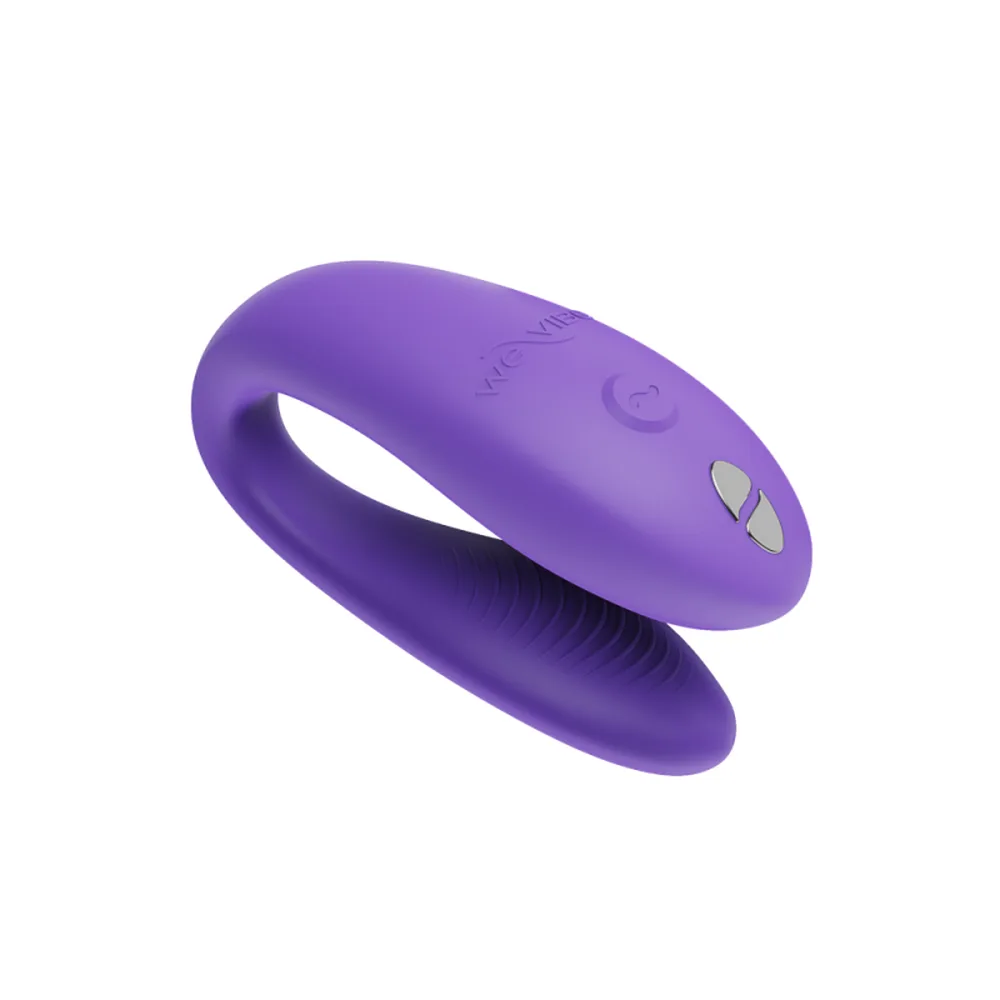
Sync 2 measures 41.7 × 74.8 millimeters, is made of body-friendly silicone that is explicitly stated to be manufactured without ftalates, BPA, and latex, is IPX7-rated, has a rechargeable lithium-ion battery via USB, ten intensity levels, app control, and a runtime of up to 120 minutes with up to 90 minutes of charging. The warranty period is two years. The decisive design difference is that Sync 2 is adjustable—the angle of the arms can be bent to fit different bodies—which is exactly the feature that Satisfyer’s fixed shape lacks.
Based on specifications, We-Vibe wins on runtime, charging conditions, material declaration, and adjustability. Satisfyer wins on price and on warranty period on paper—fifteen years versus two—even though the fifteen-year warranty has the limitations described further down. If you already know that the format works for you and you’re planning to use the product often, the price difference is justified. If you don’t know that, it’s a lot of money to invest in a fit you can’t try out in advance.
Satisfyer also sells a battery-powered version of the same model, Double Classic Battery Powered, at a list price of 280.95 SEK. It’s cheaper and has more programs—twelve versus ten—but the differences are bigger than the price suggests.
The battery version is powered by two AAA batteries instead of a built-in lithium-ion battery, and it is physically larger: 107 × 70 × 47 millimeters versus 95 × 67 × 35, with the same weight of 52 grams. The most important difference is water resistance. The battery version’s feature list states IPX4, meaning protection against water splashes from all directions but not against submersion. The property table on the same page simultaneously lists both IPX4 and IPX7, which is a contradiction in the manufacturer’s own material — but since a product with a battery compartment reasonably can’t handle submersion, IPX4 is the specification that matches the design.
Being able to avoid charging is a genuine advantage for someone who uses the product only occasionally; a built-in battery that has been drained for two years is often unusable, while a couple of new AAA batteries are always easy to buy. But the difference in water resistance and the bulkier shape mean that the rechargeable version is the more complete product for the 135 SEK it costs more.
Three Swedish stores sell the item with EAN 4061504083711. The cheapest is Taboo at 299 SEK, and the most expensive is Vuxen and Mshop at 499 SEK each. That’s a 200 SEK, or 67 percent, difference for the exact same item number, the same color, and the same packaging.
The stock situation completely changes the picture. Taboo, which has by far the lowest price, had the product sold out at the price check on September 12, 2026. The two stores that had it in stock—Vuxen and Mshop—are both at 499 SEK. That means the price you can actually buy it for right now is 499 SEK, not 299— and stores that list a product as sold out may keep an old price in the feed, a price that rarely ends up being what you pay when the item comes back in.
There’s a third figure that deserves a spot in your decision. Satisfyer sells the product itself for 415,95 SEK in its Swedish web shop, which is 83 SEK less than what the two stores that have it in stock charge. It’s unusual for a manufacturer to undercut the reseller chain like that, and it’s worth knowing before you pay 499 SEK. Shipping terms and delivery time obviously differ, and Mshop only states free shipping above 999 SEK.
The prices in the table above are updated when the stores’ product feeds are updated, but always check the final price at checkout. With only three stores for the item, the price picture is also more sensitive than for a mass-market product: one store stopping carrying the model can shift the entire range.
It fits you if you want to try the format of a caged couple vibrator without spending a premium amount on a fit you can’t test in advance. It’s for the person who wants the simplest possible operation—one button, ten settings, no app, no account, no pairing. It’s for the person who wants to be able to rinse off the entire product under running water and take it into the shower, and it’s also for someone who prefers a small and lightweight product: 52 grams is low even in this category.
It doesn’t fit you if you want to adjust the angle between the arms—then We-Vibe Sync 2 is the obvious option, with a completely different price tag. It doesn’t fit the person who wants to control the product based on what’s happening during use; then Double Plus Remote is the right model. It doesn’t fit the person who wants different intensity on the clitoris and the insertion part, because it requires two motors. And it doesn’t fit the person who wants long sessions without charging: one hour of operation on two hours of charging is short even for the price.
One more thing belongs in your decision. This product is built to be simple and cheap, and it succeeds at that. It isn’t built to be the last couple vibrator you buy. If you see it as a way to find out whether you like the format, it’s a well-considered purchase; if you see it as an investment for fifteen years, the specification—small cell, the exception being the battery, fixed angle—is more honest than the marketing.
Satisfyer offers a fifteen-year warranty on its products, and it’s the longest promised warranty period in the product category. However, the terms are worth reading before you count on them, since they differ from what most people mean by warranty.
First, the warranty under the terms only comes into effect once the statutory warranty period in the buyer’s country has expired—so in Sweden, after the three years under konsumentköplagen. Second the battery is expressly excluded, which on a product with a built-in, non-replaceable cell is a significant exception. Third, the warranty stops applying if the product is opened or taken apart, and it does not apply to normal wear and tear, accidents, or carelessness. Fourth, you pay the return shipping yourself, and according to the terms it isn’t reimbursed, and the product must be sent to a warehouse in Germany together with the original receipt. German law applies to the warranty, with Bielefeld as the jurisdiction.
What always applies instead are your statutory rights, and in practice those are the most important here. Under konsumentköplagen, you have three years’ right to complain about defects in the goods, regardless of what the manufacturer promises, and you direct the claim to the store you bought from—not to Satisfyer in Germany. For distance purchases, you also have a right of withdrawal for fourteen days under the law on distance contracts and contracts outside business premises.
Be aware that the right of withdrawal in practice is limited for hygiene products that have been removed from a sealed package. Satisfyer seals the carton with a printed hygiene seal and states directly on the packaging that exchange or returns are not permitted if it is opened. Mshop, on its part, states a 30-day right of return for unopened and unused items. However, the right to make a complaint regarding defects always applies, even with an opened package. If you have questions about what applies in your case, Konsumentverket will guide you via Hallå konsument.
Satisfyer Partner Couples Vibrator is ranked på plats 12 av 15 in couples vibrator best i test, where the entire category is compared against each other using five shared criteria. Guiden vinns av We-Vibe Sync O Petrol Green.
Every numerical piece of information in the text can be traced to one of the sources below. The links were checked manually on the specified date.
This page is machine-translated from Swedish. Read the Swedish original