

Review
Review: TOYJOY Magic Massager
Same manufacturer, 32 cm shaft — and an even thinner specification.
12 September 2026
Review · Wand vibrator · Massage wand with LED
ToyJoy’s small wand from the LUZ series was reviewed against the manufacturer’s own information and price data from three Swedish shops. The manufacturer’s dimension sketch gives 23 centimeters and a head of 4 centimeters; the packaging lists 100 percent silicone and six function symbols — but neither an enclosure rating, battery capacity, run time, nor warranty duration is published. Charging time and run time are only provided as a store listing.
A small, full-silicone-covered wand that’s 23 centimeters with a slim 4-centimeter head and a multi-colored LED in the handle — and a specification where more lines are missing than there are. The manufacturer publishes measurements and materials but neither an ingress protection rating, weight, battery capacity, charging time, operating time, sound level, nor warranty period. The only battery information available is the store text about approx. 60 minutes of operation on approx. 120 minutes of charging, and the only IP rating is a store listing stating IPX5. The design holds up; the base does not.
ToyJoy Luz Zenith is a wand vibrator, meaning a massage wand with a rounded head at one end and a tapered handle at the other. It belongs to the LUZ by ToyJoy series, which the manufacturer calls The Lovelight Collection, and what sets the series apart from the rest of ToyJoy’s range is a multi-colored LED mood-lighting feature built into the handle. The distributor describes the series as “light-up pleasure providers” and states that the light changes color with each function.
The specification that the manufacturer actually publishes is brief. The dimension sketch in the product gallery shows the total length as 23 centimeters, the head diameter as 4 centimeters, and the head section as 6.5 centimeters. The packaging print states “Made Of 100% Pure Silicone” as well as the same measurements in both centimeters and inches, and lists six symbols: body-safe, seven pulsing functions, five vibration speeds, quiet operation, USB charging, and water resistance. The product text on the manufacturer’s own product page, instead, talks about seven functions of vibration, pulsing, and escalation. Those are two different ways of counting, and I’ll come back to why the difference matters.
This review is exclusively about the black variant with EAN 8713221819253, the manufacturer’s variant designation 10236-BLACK. The model comes in two colors from the manufacturer — black and purple — and the purple variant has its own number, 8713221819246. Functionally, they are the same product, but check the barcode if you compare prices, because several stores mix colors and the names on the same page. The manufacturer’s own list price is 91.99 euro. In Sweden, the item is sold by three stores at prices between 819 and 899 SEK, and two of them had it in stock at the price check on 12 September 2026.
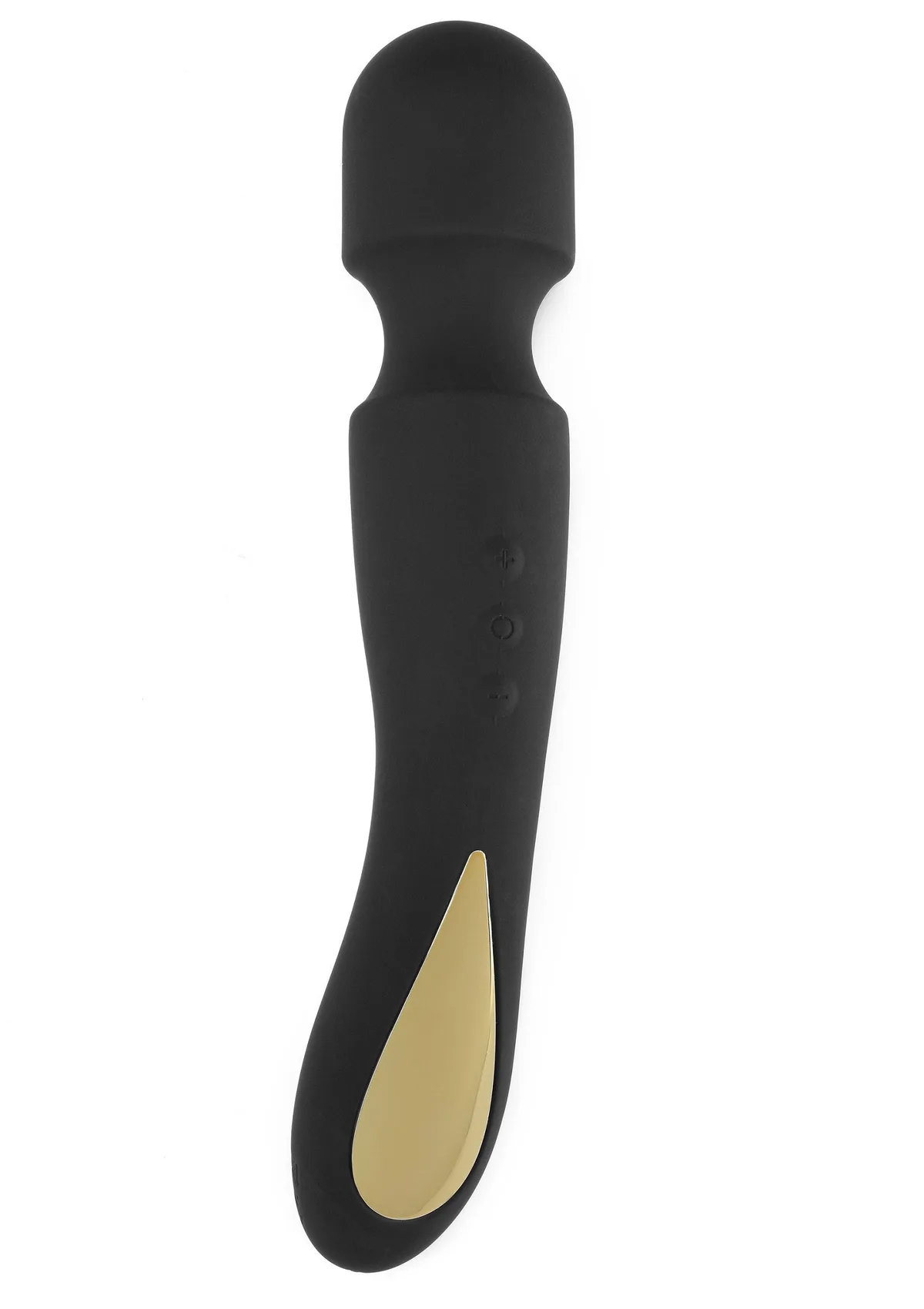
LUZ means light in Spanish, and that is the whole idea behind the series. In the lower part of the handle, there is a teardrop-shaped, gold-colored insert, which can be clearly seen against the black silicone in the manufacturer’s own main image. Behind it is the LED. The manufacturer states that the light is multi-colored and that it is located in the handle and base, and the distributor’s launch text specifies that the color changes with the selected function.
That means, in practice, two things. The first is aesthetic and completely subjective: the wand lights up in a dim room, which is more of a design idea than a technical feature. The second is actually functional. A wand handle rarely has any display, and when the head is against the body you can’t see the controls. A color-coded lamp then serves as feedback that tells you where you are in the program sequence without you needing to count button presses. It’s the same basic problem that other manufacturers solve with LED strips or vibrating pulses.
What the manufacturer doesn’t state is how many colors are included, in what order they appear, or whether the light can be turned off separately. This information is published neither on the product page, on the packaging, nor in the manuals that ToyJoy posts. So assume that the lamp lights up when the wand is on, and treat the color order as undocumented until the manufacturer publishes it.
The naming confusion around this item is bigger than usual, and it’s worth clearing up before you order. The manufacturer itself simply calls the product Zenith Massager and places it in the Luz collection. Swedish stores call it ToyJoy Luz Zenith, and one of them also calls it Light Zenith Wand Massager. All three names are for the same item number, 10236, and the same barcode.
A concrete example of how messy it gets at the store level: Sexonic has listed exactly the same barcode on two separate product pages, under the names “Toyjoy Zenith Massager Black” and “TOYJOY - LIGHT ZENITH WAND MASSAGER BLACK”, placed in two different categories and with the identical price. So it’s not two variants to choose from, but a duplicate. Anyone comparing prices should check the barcode instead of relying on the product name, and this applies to this item more than most.
The material issue is the only property of an intimate product that can’t be compensated for with experience or care, and it determines whether the product is still hygienic after a few years. Here, ToyJoy gives a clearer answer than the brand usually does: the package text states “Made Of 100% Pure Silicone,” and the product text on the manufacturer’s product page describes the construction as soft silicone of premium quality. Taboo also specifies silicone as the material.
Silicone is a non-porous material. A non-porous surface can be cleaned, because there are no microscopic cavities where residue can remain. This is the single most important property of a material that is meant to be placed against mucous membranes, and that’s why the material declaration carries more weight than almost all other lines in a specification.
That the entire body is covered in silicone — and not just the head, as on many cheaper wand vibrators — has two consequences. The first is tactile: a silicone-covered surface has higher friction than hard plastic, which is why grip security is usually better on full-silicone products when hands or the product are wet or have lubricant on them. The second is hygienic: there is no seam between a silicone head and a plastic shaft where dirt can collect.
A caveat belongs here. The manufacturer’s own product image shows a drop-shaped, gold-colored insert in the handle—i.e., the LED window—and by definition, such an insert is not silicone. The manufacturer does not state which material the insert is made of, and it also does not provide any material breakdown between the head, the handle, and the light window. The wording “100 % pure silicone” must therefore be read as a description of the product’s surface and body, not as a complete material list for every detail. That part of the specification is not published.
Phthalates are a group of plasticizers used to make plastic—above all, plasticized PVC—flexible. The Swedish Chemicals Agency, Kemikalieinspektionen, describes them as substances that can affect the hormone system and make reproduction more difficult, and several of them are therefore restricted or prohibited within the EU in a large number of products. This particular product category is regularly the subject of supervision, because it contains plasticized plastic against skin and mucous membranes.
Silicone does not require phthalate plasticizers to become soft. The softness comes from the polymer’s own structure. That is why a clear indication of silicone in itself is better information than almost any other material statement in a product specification, and significantly better than labels such as “TPE” or “jelly rubber,” which say nothing at all about which plasticizers are included.
However, you should note the difference in how thoroughly different manufacturers phrase things. ToyJoy sticks with the symbol “body-safe” on the packaging and the materials line “100% pure silicone.” The manufacturer does not state anywhere that the material is free from phthalates, BPA, or latex. We-Vibe states it explicitly for the Wand 2 and lists body-friendly silicone free from phthalates and BPA, made without latex. It is not proof that ToyJoy’s wand contains any of that—silicone usually doesn’t—but it is one less commitment to hold the manufacturer to, and for someone with a latex allergy, the absence of any latex claim is a real shortcoming.
The measurements are unusually well documented for a ToyJoy product, because the manufacturer has included a clean measurement sketch in the product gallery. It states a total length of 23 centimeters, 4 centimeters for the head’s diameter, and 6.5 centimeters for the head section. The same two main measurements are printed on the packaging as well, where they are also given in inches: 9.1 and 1.6 inch, respectively. Two independent manufacturer sources that say the same thing is more than you usually get in this category.
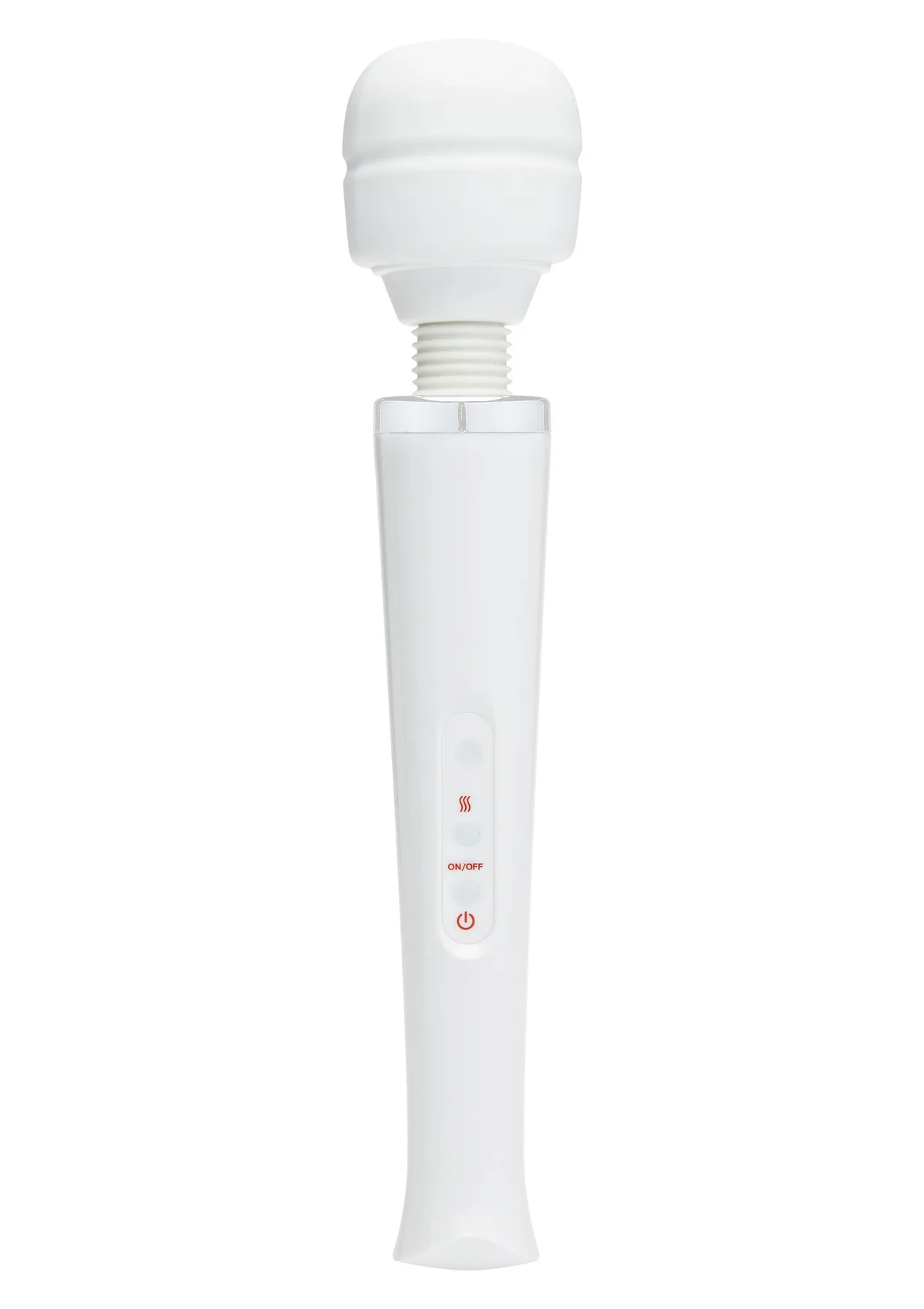
What those measurements mean in practice is that the Zenith is a small wand. The category is dominated by wands around 30 centimeters—ToyJoy’s own Magic Massager is one example, and the Lelo Smart Wand 2 Medium measures 210 × 85 × 45 millimeters. So Zenith is longer than Lelo’s mid model but significantly narrower in the head: 4 centimeters versus Lelo’s 8.5 centimeters in width. Those are two completely different tools. A wide wand head spreads the vibration over a large area, while a narrow head concentrates it. Zenith is closer to the latter, and that explains why the store texts describe it as suitable for precision stimulation rather than for massaging an entire muscle group.
The manufacturer does not publish any weight. The field is blank in the manufacturer’s own shop data, and neither the packaging nor the measurement sketch provides any value. The retailer Taboo states 300 grams. That figure is plausible for a silicone-coated wand of 23 centimeters with a built-in battery, but it is a store claim and should be read as such. For comparison, Lelo states 155 grams for the Smart Wand 2 Medium—a product that is thus shorter but wider and yet still significantly lighter, which suggests that Zenith has more mass in the handle than a direct length comparison would lead you to expect.
A second store description deserves a comment, because it is easily misunderstood. Taboo states “insertable length 6.5 cm”. In the manufacturer’s own dimension diagram, 6.5 centimeters is instead the measurement of the entire main section—i.e., from the tip of the shaft down to the waist before the handle. It’s the same number, but not necessarily the same claim: the manufacturer describes a shape, while the store describes a use. ToyJoy does not state anywhere that the product is intended to be inserted, and the general manual explicitly reminds that products intended for external stimulation should not be used internally. Treat 6.5 centimeters as a dimension for the shape, not as a manufacturer recommendation.
The interface is clearly visible in the manufacturer’s own main image: three controls embossed directly into the silicone on the top side of the handle. At the top a plus sign, in the middle a ring symbol for on and off, and at the bottom a minus sign. It’s the simplest possible layout for a wand—a single power button and a two-way stepping—and it’s an advantage when the buttons aren’t visible because the head is pressed against the body.
Embossed buttons in silicone also have a practical consequence that is seldom mentioned. Since the symbols are formed in the material instead of being printed on the surface, they can’t be worn off, and since there is no gap around the button, there is also no gap where dirt can collect. It’s the same construction logic that allows the entire body to be wrapped in silicone.
There is a real contradiction in the manufacturer’s own material, and it’s worth knowing before buying. The product text on ToyJoy’s product page states seven functions of vibration, pulsing, and escalation. Instead, the package’s own symbols indicate seven pulsing functions and five vibration speeds as two separate lines. The distributor’s launch text follows the product page and says seven functions.
These two readings produce different results. If you read the product page, the shaft has seven modes in total. If you read the package, it has five speeds for steady vibration plus seven pulsing programs—so twelve selectable settings. The Swedish store chain has chosen the first reading: both Lekosmek and Taboo state seven vibration modes with pulsation and escalation, and neither of them mentions the five speeds.
What can be established is that the print on the packaging is the source closest to the product, and that a plus-and-minus button is hard to justify if there is only a single list to step through. But the manufacturer does not resolve the contradiction anywhere, and ToyJoy does not publish a product-specific manual for item 10236 that could clarify which number applies. Count on at least seven settings, plan for the possibility that it is twelve, and don’t let the number of programs decide the purchase—in practice, most of them end up at three or four settings regardless of how many there are.
The word escalation appears in both the manufacturer’s and the stores’ texts, and it describes a program type rather than an intensity. An escalating program gradually increases the strength and starts over, unlike a pulsing program that turns on and off in a fixed pattern and from a steady vibration that stays at one level. The difference is most noticeable in how much you need to move at the buttons: an escalating program does the work for you, while a steady vibration requires you to step it up yourself.
What ToyJoy does not state is how long the cycles are, how many steps the ramp-up has, or whether the programs can be combined. Compare that with how We-Vibe presents the Wand 2, where ten intensity steps are listed separately from the patterns in the app—in that case, you know exactly what you’re buying. Here you get a program list without a map description.
The package bears a SILENT-labeled symbol, meaning quiet. That’s the whole basis. ToyJoy does not publish any measured decibel value for Zenith, either on the product page, on the packaging, or in any of the manuals that are available. A symbol is a marketing claim, not a measurement, and it should be read as the manufacturer believing that the product belongs to the quieter part of the range—nothing more.
What can generally be said about this product category is that wand vibrators with a large head and a powerful motor belong to the most audible sex toys, because the head functions as a resonating body. A narrower head of 4 centimeters has less volume to set in vibration than a wand head of 6 or 8 centimeters, which suggests that Zenith sits below the large bar-styled ones. But it’s a construction-based argument, not a number, and sites that state an exact decibel value for this model either present their own measurement or a value without a source.
A practical tip that applies regardless of the model: place the wand on a soft surface between uses and don’t hold it against a hard tabletop while it’s running. A tabletop acts as a resonance box and noticeably amplifies the sound.
This is the point where the sources most clearly diverge, and it is also the point that determines whether the wand can be taken along into the bathtub.
The manufacturer’s packaging carries a symbol labeled WATERPROOF, meaning waterproof, but it does not state an ingress protection (IP) rating. ToyJoy’s general safety manual explicitly refers to the packaging for the ingress protection (IP) rating of your product — “Refer to the packaging for the water resistance rating of your product” — and that specific information is therefore not there. The manual also adds a conditional statement: waterproof products may only be submerged in water when all charging ports, battery compartments, and protective covers are completely closed.
Instead, the retailer Taboo lists the line “Water-resistant IPx5: Yes.” That is a store statement, not a manufacturer statement, and it does not contradict the packaging, but rather specifies it to a class that means something other than submersion. Lekosmek and Sexonic publish no IP class at all.
The ingress protection (IP) ratings come from the international standard IEC 60529. The number in the second position describes protection against water, and the two levels that are relevant here differ more than the labels suggest. IPX5 means the product is tested against water jets from a nozzle — so it can be rinsed off and handles a shower. IPX7 means the product is tested for submersion in water to a depth of one meter for 30 minutes — so it can handle a bathtub.
The difference is practical, not academic. With IPX5, you can clean the wand under the tap, but you should not put it in a filled bathtub. With IPX7, it doesn’t matter. We-Vibe lists IPX7 for the Wand 2, and Lelo states that the Smart Wand 2 Medium is completely waterproof; both therefore provide a message that ToyJoy does not.
Therefore, the practical conclusion for this product is: treat Zenith as splash-proof and rinse it off, but do not put it in bathwater. A product whose manufacturer does not publish an ingress protection (IP) rating should never be assumed to handle submersion, and the absence of a rating is never a sign that the product would be approved. The fact that the packaging also has the word “waterproof” on it makes this conclusion frustrating, but it does not change anything.
ToyJoy’s own instructions are unambiguous where they do address it. Clean the product before and after each use with lukewarm water and mild soap or a cleanser intended for intimate products, rinse thoroughly, and let the product become completely dry before putting it away. Store it dry and dust-free, avoid direct sunlight, and store it separately from other products to prevent chemical reactions between materials — a storage pouch or a small box is enough.
The lubricant question is answered by the manufacturer just as clearly: use a water-based lubricant. According to ToyJoy’s manual, oil- and silicone-based lubricants can damage certain product materials. This is standard advice for silicone products, and there’s a physical reason for it—silicone-based lubricant breaks down the silicone surface over time and makes it porous, and a porous surface can no longer be cleaned properly; it can only be replaced. Oil-based products such as coconut oil also leave behind a film that’s difficult to remove.
The manual also mentions a temperature limit that rarely appears in store descriptions: the product must not be heated, frozen, or exposed to temperatures above 45 degrees. Boiling water and a dishwasher are therefore out of the question, and this applies regardless of how waterproof the wand is. Taboo also points out that lubricant is not included in the delivery—according to the manufacturer’s own printing, the package contains the product, a USB charging cable, and a printed user manual, and nothing else.
The manufacturer states that the product is USB rechargeable and that a USB cable is included in the packaging. It says both in the product text and printed on the carton, along with the USB RECHARGEABLE symbol. That’s where the manufacturer’s battery information ends.
With the included USB cable. Which plug type the cable has on the product end, the manufacturer does not publish, and none of the manufacturer’s product images shows the charging connector. This matters more than it sounds, because ToyJoy’s manual for rechargeable products explicitly states that only the included USB charging cable may be used and that using another cable can damage the product. If you lose the cable, you don’t know in advance whether a standard USB-C cable from the box will work—and in any case, the manufacturer advises against trying.
The other charging instructions in the manual are specific and worth following: charge fully before first use, charge only in a dry environment and never in or near water, never force the connector—fit it properly—unplug when the charging is finished, and don’t charge a damaged product. It also states that the product should not be used while it’s charging unless something else is explicitly stated, and that the battery does best when it’s charged regularly, including during periods when the product isn’t being used.
The manufacturer does not publish charging time and operating time. The retailer Lekosmek states about 120 minutes of charging time and about 60 minutes of continuous use. It’s a store claim, but it’s the only one available, and the relationship—double the charging time compared to the runtime—is unusually unfavorable. We-Vibe states up to 120 minutes of operation on up to 150 minutes of charging for the Wand 2, and Lelo states up to two hours of operation on two hours of charging for the Smart Wand 2 Medium. So both competitors provide roughly twice as much operating time per charging hour, and both provide their numbers themselves instead of leaving them to the stores.
ToyJoy does not publish the battery’s capacity in mAh, its voltage, or its type for the Zenith, either on the product page, on the packaging, or in the manuals. The general safety instructions refer to the packaging for the battery type and charging method, and the packaging printout contains no such information.
It’s worth noting because the competitors do: Lelo lists 520 mAh at 3.7 volts for the Smart Wand 2 Medium and specifies charging as two hours at 5.0 volts. We-Vibe lists a USB-charged lithium-ion polymer battery. Without the capacity, you can’t convert runtime into power consumption, and you can’t compare how heavily the cell is loaded between models.
What generally applies to rechargeable intimate products also applies here: the cell is fixed inside a one-piece molded silicone body, it is not intended to be replaced, and the capacity drops with the number of charging cycles. With use a couple of times per week, it’s the battery—rather than the silicone—that sets the limit for lifespan. ToyJoy’s manual also marks the product with the crossed-out wheeled bin symbol, which means that both the product and the battery are to be handed in for collection as electrical and electronic waste and not thrown away with household trash.
We do not have price data from shops in your market yet.
The manufacturer’s product page says seven functions. The manufacturer’s own packaging says seven pulsations plus five speeds. None of the sources explains which one applies.
Three comparisons are relevant: against the other ToyJoy wand in the lineup, against a mid-range wand, and against a premium-class wand. All the information below comes from each respective manufacturer’s own specifications, and when a figure comes from a store, it is printed out.
ToyJoy’s own Magic Massager, article 10353, is in the Classics collection and has the manufacturer’s list price of 56.99 euro, compared to Zenith’s 91.99 euro. It’s the cheaper way into the brand, but it’s not a smaller version of the same product—it’s a completely different design, significantly longer, and with a considerably larger head.
What Zenith brings within the brand is three things that can be substantiated: a published dimension sketch, a published material specification on the packaging, and the LED lighting. Magic Massager’s product page completely lacks dimensions, material, weight, battery information, and the enclosure rating. That Zenith even has a packaging print that includes dimensions and a material specification makes it the better-documented of the manufacturer’s two wands, which says something about the starting point rather than about the product.
In practice, the choice between them comes down to size and shape. If you want a large, soft wand head that covers a whole area, Magic Massager is the type of wand. If you want a narrower, more targeted wand that’s 23 centimeters and fits in a toiletry bag, that’s Zenith. The light in the handle is only on Zenith, and you pay roughly an extra 35 euro for it in the manufacturer’s own price list.
Lelo Smart Wand 2 Medium is the closest comparison in terms of size: 210 × 85 × 45 millimeters versus Zenith’s 23 centimeters and 4 centimeters in head diameter. So Lelo’s wand is a bit shorter, but twice as wide across the head, and it weighs 155 grams versus the 300 grams Taboo states for Zenith.
However, the difference in what’s reported is greater than the difference in the dimensions. Lelo lists material as body-friendly silicone and ABS plastic, a vibration frequency of 60 hertz, a lithium-ion battery of 520 mAh at 3.7 volts, charging for two hours at 5.0 volts, operating time up to two hours, standby up to 90 days, automatic shut-off after 20 minutes, ten settings, that the product is completely waterproof, and that it includes a satin pouch and a USB cable. The warranty is listed as two years plus a ten-year quality warranty.
If you place the two lists next to each other, the picture is unambiguous. Lelo publishes seven technical values that ToyJoy doesn’t publish at all: frequency, battery capacity, battery voltage, charging voltage, standby time, automatic shut-off, and warranty period. Zenith, on the other hand, has an all-silicone body where Lelo’s is silicone plus ABS, and it has the LED lighting. If you’re choosing based on documentation, Lelo wins by a wide margin. If you’re choosing based on the material surface and design, Zenith is a reasonable choice — but then you’re buying a product whose operating time you only know from Swedish shop text.
We-Vibe Wand 2 costs 159 euro according to the manufacturer, so clearly more than Zenith’s 91.99 euro. This comparison is about what happens when you pay more as you move up the category.
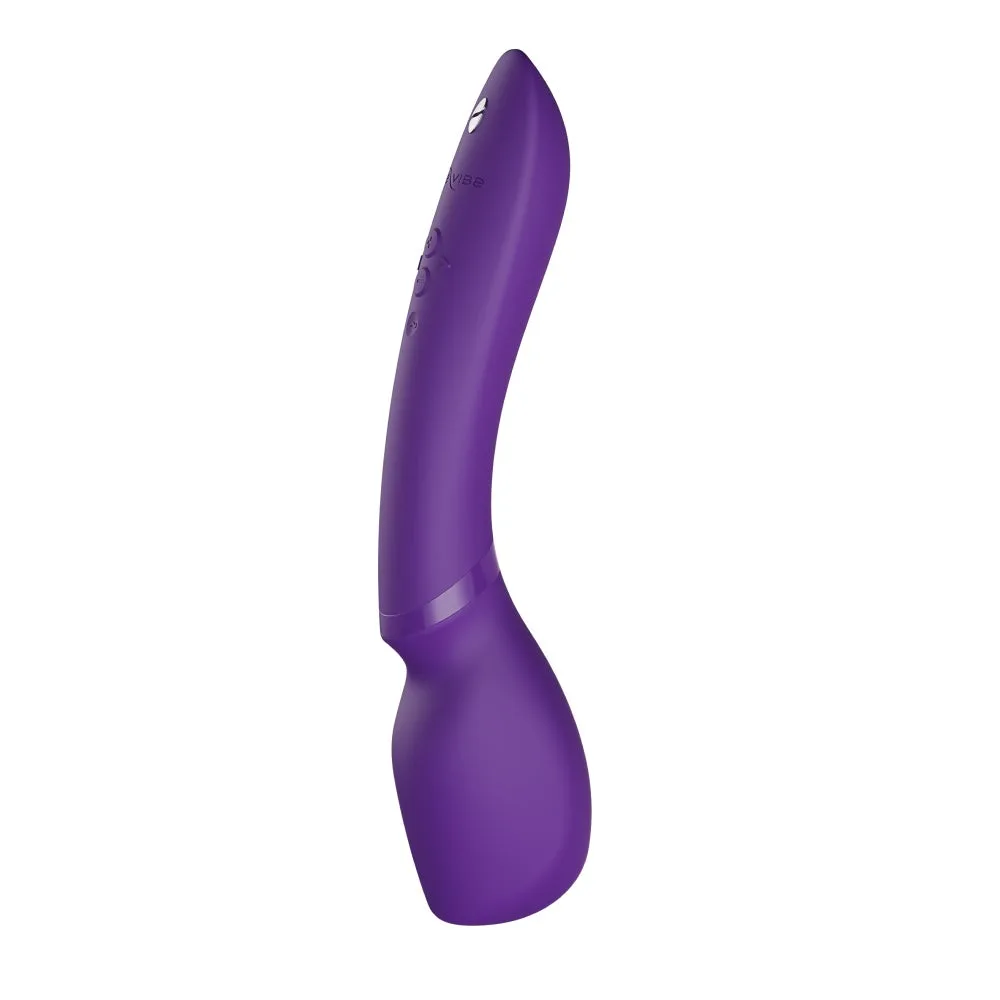
We-Vibe offers ten intensity levels with additional patterns via the app, app control over Bluetooth, an IPX7 enclosure rating, a runtime of up to 120 minutes, a charging time of up to 150 minutes, a USB-charged lithium-ion polymer battery, Smart Silence, which makes the wand start only upon skin contact, body-friendly silicone free from phthalates and BPA and made without latex, as well as a two-year warranty.
The differences that actually matter: Wand 2 has a published enclosure rating that allows submersion, twice the runtime as the store listing for Zenith, an explicit materials declaration, and a stated warranty period. Zenith has a lower price, an all-silicone body, and the LED light. If you’re looking for a wand that can handle the bathtub and that you can trust when it comes to the figures, the price difference is justified. If you want a stylish wand for a third of the price, and you can live with several lines in the specification being blank, Zenith is a perfectly reasonable buy — but it should be a deliberate choice.
Three Swedish stores sell the item with EAN 8713221819253, but it appears on four product pages because Sexonic has uploaded the same barcode twice. Cheapest in the feed is Sexonic at 819 SEK, and the most expensive are Lekosmek and Taboo at 899 SEK each. That’s an 80 SEK difference, or just under ten percent, for the exact same item number and the same color — an unusually consolidated price picture in this category.
However, the stock situation matters more than the price spread here. Both Sexonic listings were marked as sold out in the feed at the price check on September 12, 2026, which means the price you can actually buy at is 899 SEK at Lekosmek or Taboo. Stores that list a product as sold out can keep an old price in the feed, and that price is rarely what you end up paying when the item comes in again.
Sexonic’s own product page shows 74.51 euros discounted from 91.99 euros, meaning the manufacturer’s list price with a nineteen percent discount. That the store also runs two product pages with the same barcode is worth keeping in mind if you find it via a price comparison service: it looks like two offers, but it’s one.
The two Swedish stores that had the item in stock both list it at 899 SEK and both state free shipping over 699 SEK, which in practice makes shipping costs a non-issue in this price range. Still, always check the final price at checkout. The prices in the table above are updated when the stores’ product feeds are updated.
It fits you if you want a wand in the smaller format, with a 4-centimeter head that directs the vibration to a single point instead of spreading it across an entire surface. It fits you if you want silicone all over your body rather than just in the contact area, if you prefer an interface with three embossed buttons in front of an app, and if you think that a light in the handle adds something to the mood. 23 centimeters and 300 grams according to Taboo also make it a wand that actually fits in a pouch, unlike most in the category.
It doesn’t fit you if you want to put the wand in the bathtub. The manufacturer uses the word waterproof but provides no IP rating, and the only class mentioned anywhere is a store listing about IPX5 — meaning splash-proof, not submersible. It doesn’t fit you if you need a long runtime: the only information available is a store text about roughly 60 minutes of use on about 120 minutes of charging, which is half of what both We-Vibe and Lelo state for their comparable wands. And it doesn’t fit you if you require published technical data before purchase, since the manufacturer does not publish battery capacity, weight, sound level, charging connector, or warranty period.
One more thing belongs in the decision. Zenith is a product where the design is the argument and the documentation is the weakness. It’s a fully legitimate purchase as long as you know what you’re not getting: you get a nice-looking, full-silicone-wrapped wand with a light in the handle, and you can take the stores’ word for how long it runs on a charge and how much water it can handle. Anyone who doesn’t accept that should put their money on a model where the manufacturer itself stands behind the numbers.
ToyJoy does not provide its own manufacturer warranty with a stated duration. Instead, both manuals state that the statutory warranty applies, that it covers material and manufacturing defects during normal use, and that normal wear and tear, accidents, improper use, lack of maintenance, unauthorized changes, and damage resulting from not following the instructions fall outside the warranty. A receipt is required for a claim. The manufacturer behind the brand is SCALA 2.0 B.V. in Wijchen in the Netherlands.
That means it’s Swedish consumer law that determines what you’re entitled to, not a promise from the manufacturer. Under the Consumer Sales Act (konsumentköplagen), you have three years of complaint rights for defects in the product, and it applies regardless of what a manufacturer promises or fails to promise. For distance purchases, you also have a right of withdrawal for fourteen days under the Act on Distance Contracts and Contracts Outside Business Premises (lagen om distansavtal och avtal utanför affärslokaler). Be aware that, in practice, the right of withdrawal is limited for hygiene products that have been removed from a sealed package — however, the right to complain about defects always applies. If you have questions about what applies in your case, Konsumentverket guides you via Hallå konsument.
Two store policies are worth knowing about in addition to the law. Lekosmek states its own two-year product warranty on the product page. It is the store’s commitment and not the manufacturer’s, but in practice it is the only warranty promise tied to this item in Sweden—and it should be factored in if the price is the same at the two stores that have the item in stock.
One final note on compliance with regulations. ToyJoy’s general safety instructions refer to the address www.TOYJOY.eu/compliance for the EU declaration of conformity. We have not found any published declaration for article 10236 there, and the English version of the same document does not provide any working link at all—only a reference back to the manual page. This does not affect your rights as a consumer, but it does fit the picture of how much documentation actually makes it out from this manufacturer.
ToyJoy Luz Zenith isn’t included in any ranking yet. In best i test guides, the entire categories are compared against each other using five shared criteria, with what was left out shown.
Every numerical piece of information in the text can be traced to one of the sources below. The links were checked manually on the specified date.
This page is machine-translated from Swedish. Read the Swedish original