

Review
Review: We-Vibe Touch X Green Velvet
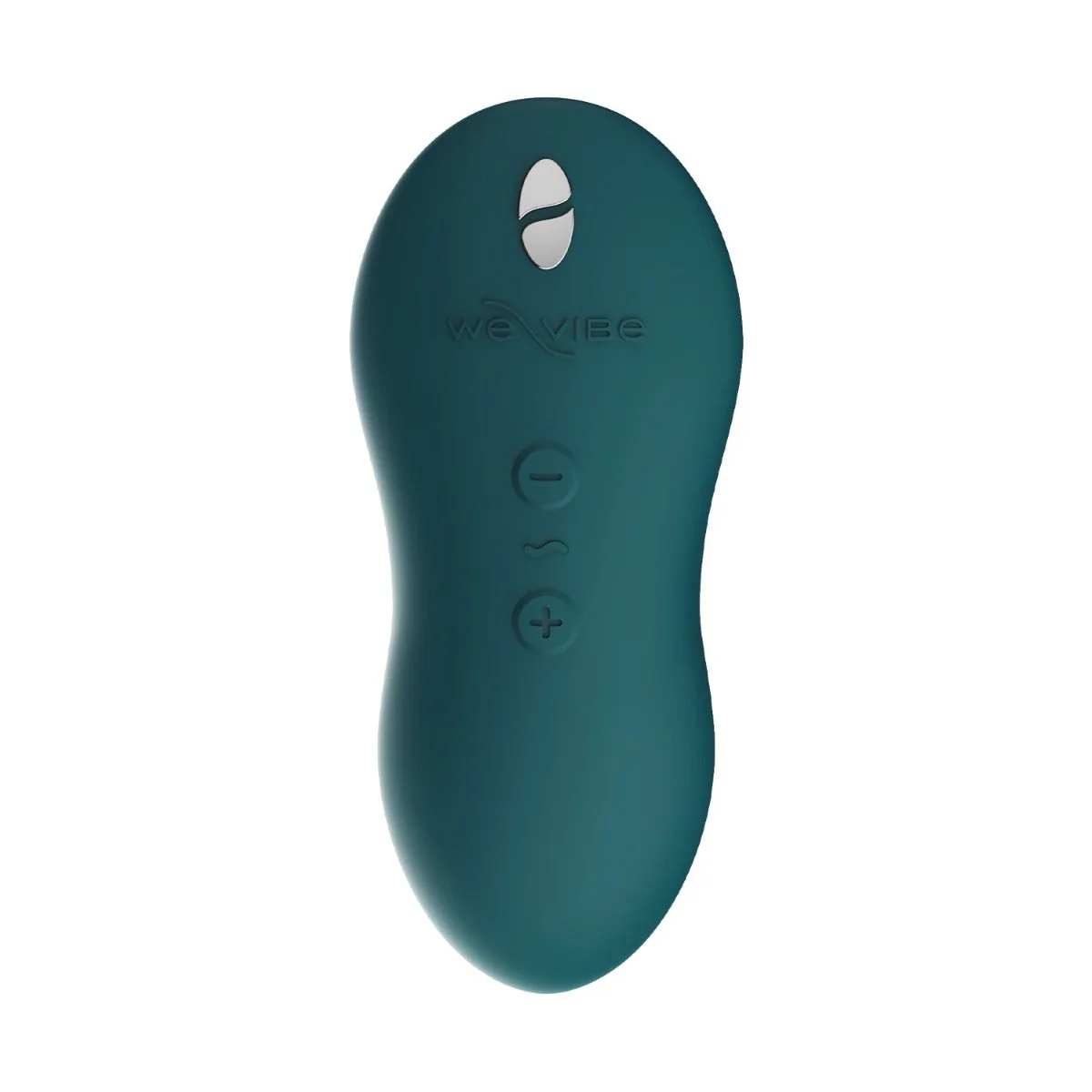
Same format without temperature—two hours of operating time and published dimensions.
29 July 2026
 Author's pick
Review · Lay-on vibrator · Heat and cold
We-Vibe’s only product with both heat and cold, reviewed against the manufacturer’s own specifications and price data from seven Swedish stores. Temperature plate that goes from 20 to 38 degrees, three intensities and three patterns, body-friendly silicone, IPX7 according to IEC 60529, and two years’ warranty — but one specification where the manufacturer neither publishes dimensions, weight, or battery capacity, and where the product page and the manual state two different run times for the same product. The dimensions 9,7 × 6,6 cm come from the stores, not from We-Vibe.
The only product in the comparison that can be both warm and cold: the manufacturer states 20 degrees in the cooling mode and 38 degrees in the heating mode, controlled from two separate buttons independently of the vibration. The material is body-friendly silicone and the rating is IPX7. What you pay for is a thin specification — the manufacturer does not publish any dimensions, weight, battery capacity, sound level, or heating time, and the product page and manual list two different operating times for the same product. The dimensions 9.7 × 6.6 cm can be obtained from the retailers, and their weight details differ by more than 200 grams.
We-Vibe Temp is the model where the brand leaves its usual footprint. Nearly all of We-Vibe’s range is about vibration, app control, and couples play. Temp does something different: it adds temperature as its own dimension. The manufacturer describes the product plainly as a lay-on vibrator with heating and cooling technology, and it’s that description that determines whether the product is interesting to you or not.
The specification is short, and that in itself is a point in its favor. We-Vibe lists three vibration intensities, three pattern modes, a temperature plate that goes down to 20 degrees and up to 38 degrees, body-friendly silicone, the IPX7 enclosure rating, a USB-charged lithium-ion polymer battery, and a two-year warranty. In Sweden, the item is sold by seven stores at prices between 795 and 1 119 SEK, and all seven had it in stock at the price check. On the manufacturer’s own European web shop, it is listed at 99 euro.
This overview is exclusively about the Lavender Blue variant with EAN 4251460632775, the manufacturer’s item number SNHS1SGE. We-Vibe sells Temp in two colors — Lavender Blue and Tangerine — and the orange variant has its own number, 4251460632782, with item number SNHS1SGA. Functionally they are identical, but several Swedish stores list the colors on the same product page, so check the item number if you compare prices.
This is the only function that really distinguishes Temp from the rest of We-Vibe’s range, and the manufacturer’s manual is unusually specific about it. The product has a temperature plate. Press the snowflake button to lower the plate’s temperature to 20 degrees. Press the flame button to raise it to 38 degrees. Both functions are turned off by holding the button pressed.
What can be established from the two figures is how the interval relates to the body. Normal skin temperature on the torso is below the body’s core temperature, and 38 degrees is therefore just above what you carry with you all the time — it’s warm but clearly below the 45 degrees that the manufacturer itself states as the absolute maximum temperature for the product and its battery. On the other hand, 20 degrees is roughly room temperature, so it’s not icy, just cool. The range between the two settings is 18 degrees, and that is the total contrast the product can create.
It’s worth being clear about what the specification does not say. We-Vibe does not publish any information about how long it takes for the pad to reach 20 and 38 degrees, either on the product page or in the manual, and it also doesn’t state how long the temperature is held or how much power the temperature function draws from the battery. We reviewed all seven Swedish stores that sell the item, and none of them fills in the missing piece either — Mshop writes that the transition between heat and cold "happens quickly", which isn’t a time specification. Heating and cooling are the single most energy-demanding things a handheld product can do, and the fact that that figure is missing from all sources is the biggest gap in the entire specification.
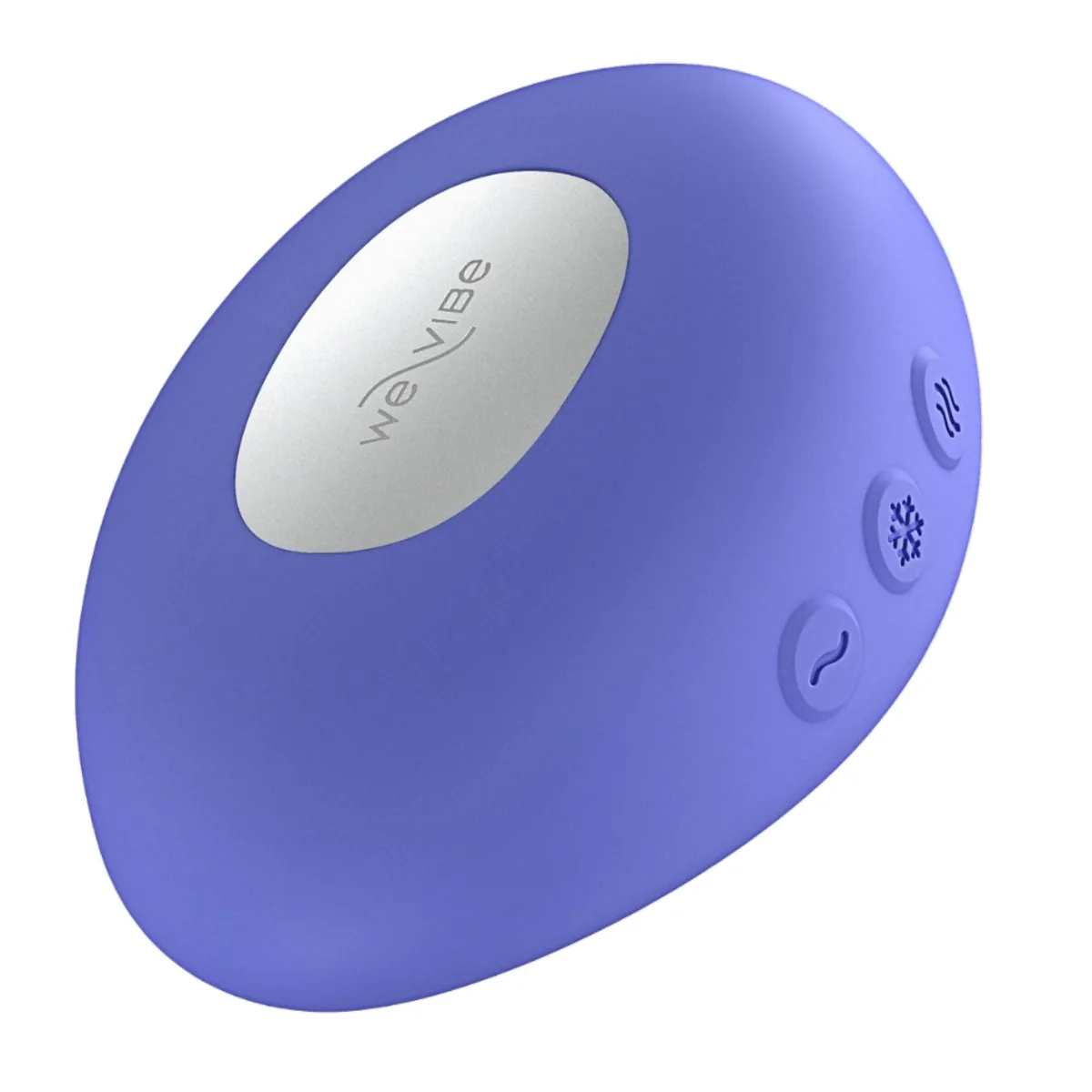
The temperature pad is clearly visible on the product: the oval metal area with the We-Vibe logo on the top side. The rest of the housing is silicone. The fact that the contact surface for heat and cold is metal follows from physics — silicone conducts heat poorly, which is exactly the wrong property for a surface that needs to transfer a temperature to the skin in a short time.
Temp comes in two colors and no other variants. It’s simple compared with how the brand’s other models are built, but Temp is still mixed up with three other We-Vibe products in Swedish stores.
The difference between Temp and Touch X is therefore the temperature — not the format, not the material class, and not the warranty. The difference between Temp and Melt is the driving technology itself. If you want touch-free clitoral stimulation with air pressure, Temp is the wrong product no matter how interesting the heat function sounds, and it’s the most common risk of making the wrong purchase in this part of the range.
The material issue is the only property of an intimate product that can’t be compensated for with experience or care, and it determines whether the product is still hygienic after five years. We-Vibe states a single material for Temp: body-friendly silicone, free from phthalates and BPA, and manufactured without latex.
Silicone is a non-porous material. A non-porous surface can be cleaned, because there are no microscopic cavities where residue can remain. It is the single most important property of a material that should lie against the mucous membrane, and that is why the material declaration weighs more heavily than almost every other line in a specification.
That the housing is coated with silicone has two consequences. The first is tactile: the surface is soft and matte instead of slippery plastic, which provides better grip when hands are wet or have lubricant on them. The second is hygienic: an even silicone surface without seams does not collect dirt in the same way as a joint between two materials.
Here, however, there is a clarification that the manufacturer does not make itself. The temperature plate is not silicone, and We-Vibe does not state what material it is actually made of. In the product photos, it is a glossy, light-colored metal surface, and it makes up a significant part of the area that lies against the body. The material declaration "body-friendly silicone" therefore describes the housing, not the entire contact area. It is not remarkable in itself—metal is an excellent material against skin, non-porous and easy to clean—but it is a task that should be stated in the specification, and one that isn’t.
Phthalates are a group of plasticizers used to make plastic—above all, flexible PVC—pliable. The Swedish Chemicals Agency (Kemikalieinspektionen) describes them as substances that can affect the endocrine system and make reproduction more difficult, and several of them are therefore restricted or prohibited within the EU in a large number of products. This product category in particular is subject to recurring supervision because it contains flexible plastic against the skin.
We-Vibe explicitly states that the material in Temp is free from phthalates and BPA and manufactured without latex. It is a clear-cut declaration, unlike terms such as "TPE" or "jelly rubber," which say nothing at all about which plasticizers are included. Silicone does not require phthalate plasticizers to become soft—its softness comes from the polymer’s own structure—so listing silicone as the material in itself is better information than almost any other item in a product specification.
The latex information is relevant for anyone with a latex allergy. Latex allergy causes reactions on the mucous membranes faster than on normal skin, so an intimate product is precisely the kind of use where this information matters. The fact that the manufacturer states it is a plus, and the wording is also the same as the one We-Vibe uses for Touch X and Melt, which makes it comparable within the range.
Here’s the gap that’s easiest to notice when you read the product page. We-Vibe does not publish length, width, height, or weight for Temp. The specification table on the product page contains six rows—model, colors, battery, runtime, charging time, material, and warranty—but no measurements at all. The same check on the manufacturer’s UK and global versions of the product page gives the same result.
What makes the absence noteworthy is that We-Vibe does the opposite on its other models. Touch X is listed as 10,22 × 4,33 × 3,43 centimeters and Melt as 126 × 24 × 10 millimeters—both in the same table format on the same type of page. So the measurements row isn’t something the manufacturer has stopped doing—it has been removed specifically for Temp.
The measurements, however, can be found with the retailers, and the figures are consistent. The manufacturer publishes no measurements. The retailers Joyland (store) and Lekosmek (store) both list 9.7 × 6.6 centimeters, Taboo (store) lists the same two figures in its specification table, but with the labels length and width swapped, and Vuxen (store) writes 9.66 × 6.57 centimeters. So four stores selling the exact same item number come up with the same two measurements, which makes this information useful as a size guide: a product that roughly covers the palm of your hand. Note that there are two measurements, not three—none of the stores provides any thickness, so you still can’t tell anywhere how tall the product is.
Weight is a different story, and that’s where the information doesn’t hold up. The manufacturer publishes no weight, and the shops contradict each other: Lekosmek lists 168 grams, Taboo 250 grams, and Vuxen 385 grams for the same EAN. Mshop lists 0,38 kilograms but explicitly labels its figure as the package’s weight, which explains Vuxen’s number—it’s reasonably the cardboard’s weight and not the product’s. With three incompatible figures and no manufacturer value to verify against, the weight can’t be presented as a value. We’d rather leave it blank than choose one of the numbers.
The packaging is the only thing that’s unambiguous: Mshop lists the box as 15,95 × 9,70 × 7,15 centimeters. That’s a store listing and says nothing about the product itself, but it’s relevant if you need to know what will fit through a mailbox slot.
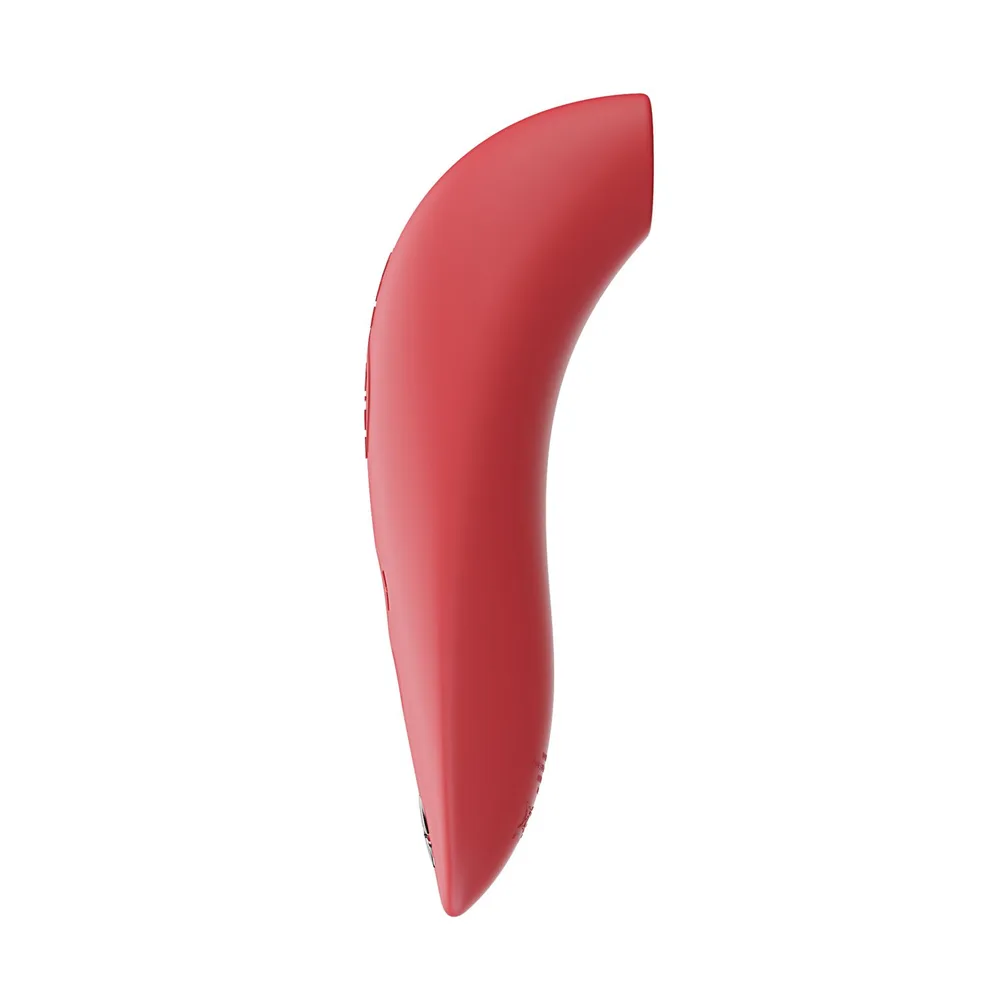
The shape is shown instead in the pictures: a symmetrical, teardrop-shaped body with a curved top side where the temperature pad sits, and three buttons along one of the long sides. There is no handle and no insertion part. The product is designed to be placed against the body — which is what the “lay-on” designation means — and the grip is achieved with the entire palm over the top side rather than with the fingers on a shaft.
A note about the delivery contents belongs here. The manufacturer’s own list includes four items: the product, a USB cable, an illustrated quick guide, and safety information. In addition, the product photo that the Swedish shops use shows a cotton storage pouch. The storage pouch is not included in the manufacturer’s list of contents for Temp, even though it is explicitly listed for both Touch X and Melt. So don’t count on it until you have the package in front of you.
The interface on the We-Vibe Temp is the simplest in the brand’s lineup. Three buttons are placed along one side of the housing: a flame button for heat, a snowflake button for cold, and a We-Vibe button for vibration. There is no display, no app, and no remote control — which is unusual for We-Vibe, which has built a large part of its brand on app control.
The manual describes the controls in three steps. You start the product by holding down the We-Vibe button for two seconds. After that, each individual press steps through three vibration intensity levels and three pattern modes. A double-press stops the vibration.
The temperature is controlled separately and independently of the vibration. Pressing the snowflake button pulls the temperature pad down to 20 degrees, pressing the flame button drives it toward 38 degrees, and both functions are turned off by holding in the respective button. That heat, cold, and vibration each have their own button is the single most important ergonomic detail: you can turn on the cold in the middle of a vibration mode without losing the setting, and you can switch between hot and cold without touching the vibration at all.
The downside of a button-controlled sequence without a display is that you can’t see where you are in the list. With six vibration steps total — three intensities plus three patterns — it’s manageable, but it’s also the whole reason why more modes wouldn’t automatically be better for this particular product.
This is a question the manufacturer doesn’t answer. We-Vibe specifies no warm-up time, no cool-down time, and no information about how long a temperature is maintained. The manual only describes what the buttons do and which two temperatures the pad moves toward.
What can be established is the principle. A plate that needs to be both heated and cooled cannot be driven by a normal heating element, because an element can only supply heat. Being able to go both directions requires moving heat—that is, the plate is cooled by conducting the heat away in the other direction. It’s a process that costs significantly more energy than pure heating, and it’s the technical explanation for why a product with both heat and cooling is more difficult to build small and long-lasting than a pure vibrator.
Practically speaking, that means two things. Expect that the switch between 20 and 38 degrees takes time—the plate has to pass through the entire range—and expect the battery to take more of a hit when the temperature function is on than when only the vibration is running. How much more We-Vibe doesn’t publish—and that’s why the runtime further down in this text is hard to interpret.
Six vibration modes are few compared with the category overall. Lelo states there are ten built-in modes for the Sona 3, and air-pressure products in this price range are often at eleven to fourteen intensity steps. That’s a real difference, and it shouldn’t be talked away.
At the same time, the number of modes is the most overestimated figure in the entire product category. The pattern is that the lowest steps are clearly separated, while the top ones are closer together, and that most people in practice end up returning to two or three settings. What makes Temp interesting isn’t how many vibration steps it has, but that each step can be combined with three temperature states—warm, cold, or none. That gives eighteen combinations of vibration and temperature, versus six pure vibration modes.
Of course, the arithmetic is the manufacturer’s logic, not an independent assessment. The point is that a comparison based only on the number of vibration programs misses what the entire product is all about. If you want adjustable, fine-tuned vibration, Temp isn’t the right product. If you want temperature, then in practice it has no competition in its price range.
We-Vibe describes Temp’s vibrations as "powerful yet quiet" in its feature list. The question is what that means in numbers, and the answer has to be honest: We-Vibe publishes no measured decibel value for Temp, either on the product page or in the manual. None of the seven Swedish stores that sell the item list any decibel figure either. Joyland does have a row for sound level in its specification table, but it fills it with the word "låg"—a store’s wording, not a measured value. The manufacturer also doesn’t provide any frequency information or any comparison chart of the kind that other brands sometimes include.
Electrical specs exist, however, and we found them in a place that’s easy to miss: at the end of the manufacturer’s online manual, under the heading Electrical Rating. We-Vibe lists the model designation TMP10A, 3.7 V and 1.5 A for the built-in lithium-ion battery, and 5 V and 0.5 A when charging via USB. These are the manufacturer’s own figures, and they say something about how the product is electrically rated, but they are just the stated specs—not a measured power draw for the motor or for the heating pad. No watt figure for either vibration or heating is published.
For comparison, Lelo lists both a frequency of 63 Hz and a maximum sound level under 60 dB for the Sona 3. It says something about how unevenly the information is distributed in this category: two products in the same price range, and only one of them can be compared using measurement values. Sites that provide an exact decibel value for the We-Vibe Temp report either their own measurement or a value without a source.
A practical tip that applies regardless of the model: place the product on a soft surface between uses. A hard tabletop works as a resonance box and noticeably amplifies the sound.
We-Vibe Temp is rated IPX7, and the manufacturer states plainly that the product can be used in a bath or shower. The rating comes from the international standard IEC 60529, which defines enclosure classes for electrical equipment. The number 7 in the second position means the product is tested for submersion in water to a depth of one meter for 30 minutes.
The difference compared with a splash-proof product is greater than the wording suggests. Splash protection covers water droplets and, at best, water jets, but not submersion. Such a product can handle a damp cloth and possibly a shower, but not a bathtub, and it should not be held under running water—use some common sense about the buttons and the charging contact.
With IPX7, the entire product can be rinsed off without being careful. The fact that Temp is charged via magnetic pins rather than an exposed connection ties into this rating: without openings in the housing, there is no point where water can get in, and there is no rubber plug that can be forgotten. If a product has no IPX rating at all, it should be treated as not water-resistant—the absence of a rating is never a sign that the product is approved for water exposure.
A caveat that applies specifically to this product: the manufacturer states that the product and its battery must not be exposed to temperatures above 45 degrees. A hot bath is normally below that limit, but boiling water and a dishwasher are out of the question despite IPX7—and it applies even more to a product that already has an active heating function.
We-Vibes cleaning instructions are short: rinse Temp with warm water and wipe dry with a lint-free cloth. The manufacturer also recommends an intimate-product cleaning agent for best results. Since the product is molded in one piece without removable parts, there are no seams or crevices to get to, which makes cleaning easier than on models with removable stimulation tips.
The question of lubricant is clearly addressed in the manual: use a water-based lubricant, and do not use fragranced or alcohol-based lubricants, gels, or massage oils. Silicone-based lubricant should not be used on silicone products — it breaks down the silicone surface over time and makes it porous, and a porous surface can no longer be cleaned properly; it can only be replaced. Oil-based products such as coconut oil leave a film that is difficult to remove.
The manual also covers three things that rarely appear in store texts. The product contains magnets, which means it should not be used directly over a pacemaker and that cards with a magnetic stripe should be kept away from it. Temp is explicitly not designed for anal use. And the manufacturer advises against placing the product’s soft side against an absorbent surface, because it can cause stains — a detail that’s easy to miss and impossible to fix afterwards. Storage should be done in a dry place and without direct sunlight.
We-Vibe states that Temp has a USB-charged lithium-ion polymer battery and that, according to the manual, it is not replaceable. Charging takes place via magnetic charging pins on the underside of the product — the same principle as on Melt, and the same principle that makes IPX7 possible without a rubber plug.
With a magnetic charging cable that connects to USB. The manufacturer states that a USB cable is included in the package but that a USB adapter is not — so you charge either from a USB port or from a wall adapter you already have.
Magnetic charging is a trade-off, not a pure advantage. The advantage is the tight fit and that the cable can’t be plugged in the wrong way. The downside is that the cable is product-specific: tappar du laddkabeln fungerar ingen vanlig USB-C-kabel, so you have to get a replacement from the manufacturer. It’s a real difference compared to cheaper models that charge with the same cable as your phone, and it’s a cost that falls outside the warranty.
A piece of advice from the manual that’s easy to overlook: charge the product regularly even when it’s not being used. Lithium-ion cells don’t do well when they’re left completely discharged for a long time, and since the battery is not replaceable, the product is practically used up once the cell is completely discharged.
Here there is a problem worth stopping to consider, because it affects how you should read the entire specification. We-Vibe lists two different operating times and two different charging times for the same product.
The product page’s specification table states runtime of up to 120 minutes and charge time of up to 90 minutes. The manufacturer’s own online manual for the same model instead lists up to 60 minutes of play per charge and a 120-minute charging time. So this is not a small rounding difference: the product page promises twice the length of operating time and a third shorter charging time than the manual.
Which figure applies cannot be determined from published sources. The most reasonable explanation—though it is an interpretation, not a documented fact—is that the two numbers refer to different usage: 120 minutes with only vibration and 60 minutes when the temperature function is used. That would fit with how much energy heating and cooling require. But because the manufacturer doesn’t write that anywhere, the only honest thing is to present both pieces of information and treat 60 minutes as the value you should plan around.
Even the lower figure needs to be put into context. Both Touch X and Melt are listed by the same manufacturer as up to two hours of operating time, and Lelo lists up to two hours for the Sona 3. So if Temp in real use with temperature is at one hour, then it’s the shortest operating time of the four compared models—and it comes with the longest charging time. The voltage can be found if you look far enough down in the manual. Under the Electrical Rating heading, We-Vibe lists 3.7 V and 1.5 A for the built-in lithium-ion battery, and 5 V and 0.5 A when the product is charged via USB. The same section names the TMP10A model. These are the manufacturer’s own details, and they place the cell in the usual single-cell class for lithium-ion.
The capacity in mAh is not published, however, either by We-Vibe or by any of the seven shops that sell the item, and without it you can’t convert the operating time into consumption or compare how heavily the cell is loaded in other models. Lelo publishes both 520 mAh and 3.7 volts for the Sona 3, so the information is not impossible to disclose in this industry. We-Vibe therefore has half the information in place and omits the other half.
We do not have price data from shops in your market yet.
The product page states 120 minutes of operating time. The manufacturer’s own manual for the same model states 60. Plan based on the lower figure.
Three comparisons are relevant: against the brand’s own lay-on model without temperature, against the brand’s air pressure model in the same price range, and against the premium competitor that publishes the most data. All the information below comes from the respective manufacturers’ own specifications, and all prices come from the shops’ product feeds on July 29, 2026.
We-Vibe Touch X starts at 722 SEK, so it’s 73 SEK less than Temp at its cheapest. It’s the most direct comparison that exists, because both are lay-on models from the same manufacturer with the same warranty and the same material philosophy.
Touch X measures 10.22 × 4.33 × 3.43 centimeters, is stated to last up to two hours per charge with a 90-minute charging time, and is made of ABS and body-friendly silicone—so not full silicone like Temp. A storage pouch is included, which it is not in Temp’s listed shipping contents. Both have a two-year warranty.
The conclusion is unusually clear. For 73 SEK more, you get the temperature function and a published materials declaration without ABS. You pay for run time—Touch X is stated as two hours versus Temp’s 60 to 120 depending on which of the manufacturer’s own figures you read—and for a thinner specification, because Touch X has a dimensional measurement from the manufacturer while Temp’s measurements are only available from retailers. They state 9.7 × 6.6 centimeters, which makes Temp wider and shorter than Touch X. If you don’t want temperature, there’s no argument for Temp over Touch X.
We-Vibe Melt starts at 1 101 SEK, so it’s 306 SEK more than Temp. The price difference isn’t the interesting part here—the technology is. Melt is an air-pressure simulator that works with pressure waves in a closed chamber over the clitoris, while Temp transfers mechanical vibration and temperature through a surface to the skin. These are two completely different types of stimulation, and one is not an upgrade of the other.
On the specs level: Melt measures 126 × 24 × 10 millimeters, has a lithium polymer battery with up to two hours of runtime and 90 minutes of charging time, charges with a magnetic USB cable, and is made of body-friendly silicone without phthalates, BPA, or latex. Two-year warranty, just like Temp. The package also includes a storage pouch and a two-milliliter sample of the manufacturer’s own lube.
The practical conclusion: buy Melt if you know that air-pressure technology works for you and want targeted clitoral stimulation. Buy Temp if you want broader stimulation across a larger area—nipples, inner thighs, genital area—and especially if that temperature change is what you’re after. Melt can’t do what Temp does, and Temp can’t do what Melt does.
Lelo Sona 3 costs from 1 490 SEK, so it’s 695 SEK more than Temp. It’s in a different price class, but it’s worth the comparison precisely because Lelo publishes almost everything that We-Vibe leaves out.
Lelo lists dimensions as 112 × 51 × 55 millimeters, weight 128 grams, a lithium-ion battery of 520 mAh and 3.7 volts, charging time and operating time up to two hours each, 90 days of standby time, frequency 63 Hz, maximum sound level under 60 dB, three buttons, and a two-year warranty. The material is stated as body-friendly silicone and ABS plastic.
Put the two lists side by side and the difference becomes obvious: for Sona 3 you can count, compare, and control. For Temp you get seven rows and two temperatures. If you choose based on the data shown, Lelo wins without discussion. If you choose based on the function, then it’s still Temp that is the only one of the four that can get warm or cold—and in the end, that’s the whole question. A cheaper reference point is Satisfyer Pro 2 Next Generation, which is sold from 279 SEK and therefore costs less than half of Temp, but it is a pure air-pressure product with neither temperature nor vibration against the surface.
Seven Swedish stores sell the item with EAN 4251460632775. The cheapest are Blush Me and SexleksakerOutlet, both at 795 SEK. The most expensive is Mshop at 1 119 SEK. It’s a 324 SEK difference—41 percent—for the exact same item number, same color, and same packaging.
The inventory situation is unusually favorable for this type of product. All seven stores had it in stock during the price check, which means the price comparison is actually useful—the usual situation is otherwise that the cheapest items in a stream are sold out and the lowest figure is therefore theoretical. Here you can buy at the lowest price directly, and there are two stores that are at the same level.
The price spread isn’t because any store sells a different variant. Five of the seven list the item directly under EAN 4251460632775, and the other two under their own item number tied to the same Lavender Blue variant. So it’s simply the stores’ own margin-setting. For comparison, the manufacturer’s own European list price is 99 euro, which means that the Swedish stores in the lower part of the range clearly sit below the manufacturer’s recommended level.
The prices in the table above are updated when the stores’ product feeds are updated, but always check the final price at checkout. Shipping cost is added at most stores under a certain order value, and at this price level several stores are right around the threshold for free shipping—which can eat up part of the 324 kronor.
It’s for you if you’re curious about temperature as stimulation and don’t want to use ice cubes and hot water. It’s for you if you want a simple product with three buttons and no app, if you want to be able to rinse off the entire product under running water, and if you want something that works over larger areas of skin rather than only against the clitoris. Also, the fact that all seven stores have it in stock from 795 SEK keeps the entry cost low for a product that’s alone in its niche.
It’s not for you if you want many vibration modes—three intensities and three patterns are on the low side for the price range. It’s not for you if you want app control or remote play, which is otherwise We-Vibe’s trademark. It’s not for you if you require a complete specification before buying, because the manufacturer does not publish dimensions, weight, battery capacity, sound level, or warm-up time—the measurements are only given as a store listing, and the weight details from the stores contradict each other. And it’s not for you if you need long operating time, because the manufacturer’s own figures range from 60 to 120 minutes, and the lower number is what you should plan for.
One last thing belongs in the decision. Temp is a complementary product, not a main product. It does one thing no other product in this price range does, and it does it with an interface simple enough to work with in two hands. But it doesn’t replace an air-pressure stimulator for someone who wants targeted clitoral stimulation, and it doesn’t replace a vibrator with finely adjustable intensity. If you see it as an add-on to something you already have, 795 SEK seems reasonable. If you see it as your only product, you’ll probably miss something.
We-Vibe states a two-year warranty on Temp, and the same two-year period is stated in the manufacturer’s general terms and conditions, where the warranty period is counted from the delivery of the product.
There’s one detail that’s often mixed up in store texts, and it’s worth clearing up. The manufacturer’s terms also include a voluntary manufacturer’s warranty of 60 months—i.e. five years— with a replacement product and paid shipping. According to the wording of the terms, the five-year warranty expressly applies to Womanizer-branded products, not We-Vibe. Womanizer and We-Vibe have the same owner and the same web store platform, which explains the mix-up—but if you buy a We-Vibe Temp, it’s the two years that apply, not five. If you read a store text that promises five years for this product, it’s wrong.
The 100-day guarantee applies, however, explicitly to We-Vibe products as well, but with three conditions that change the picture: it applies only to purchases made directly from the manufacturer, you get a value check to shop for in the same store instead of a refund, and it can be used for one product per order. If you buy from any of the seven Swedish stores listed above, you are therefore not covered by it.
What always applies, on the other hand, is your statutory rights. Under the Swedish Consumer Sales Act (konsumentköplagen), you have a right to complain for defects for three years, regardless of what the manufacturer promises—so it’s one year longer than We-Vibe’s own guarantee. For distance purchases, you also have a right of withdrawal for fourteen days under the Act on Distance Contracts and Contracts Outside Business Premises. Note that in practice the right of withdrawal is limited for hygiene products that have been taken out of a sealed package—however, the right to complain about defects always applies. If you have questions about what applies in your case, Konsumentverket guides you via Hallå konsument.
We-Vibe Temp isn’t included in any ranking yet. In best i test guides, the entire categories are compared against each other using five shared criteria, with what was left out shown.
Every numerical piece of information in the text can be traced to one of the sources below. The links were checked manually on the specified date.
This page is machine-translated from Swedish. Read the Swedish original