

Review
Review: Womanizer Next
The same fourteen steps plus three depth levels — in a larger body.
13 September 2026
Review · Clitoral stimulator · Air pressure technology
Womanizer’s compact premium model is reviewed against the manufacturer’s own specifications, the PDF manual, and price data from nine Swedish stores. Fourteen intensity steps, body-friendly silicone in both the housing and the head, IPX7 according to IEC 60529, 240 minutes of runtime, and a five-year warranty — at a price where the difference is about 45 percent between the cheapest and the most expensive store.
The compact full-silicone model in Womanizer’s lineup: fourteen intensity levels, 240 minutes of operating time, IPX7, and two stimulation heads in the package, in a body measuring 155 × 50 × 35 millimeters and 141.4 grams. What you pay for is a magnetic charging cable that can’t be replaced with a regular USB cable, the absence of both depth controls and an app, and a specification where neither battery capacity nor sound level is published.
Womanizer Premium 2 is the brand’s most expensive dedicated clitoral stimulator with the original Pleasure Air technology. The manufacturer describes it as its most exclusive design, and the specifications support the positioning in the points that can be checked: body-friendly silicone over the entire body, fourteen intensity levels, 240 minutes of operating time, enclosure class IPX7 and a five-year manufacturer’s warranty.
The dimensions are 155 × 50 × 35 millimeters and the weight is stated as 141.4 grams. The charging time is 120 minutes; charging is done via magnetic charging pins to a USB cable, and two stimulation heads in different sizes are included in the package along with a cotton pouch, quick guide and safety information. In Sweden, the item is sold by nine stores at prices between 1,348 and 1,949 SEK, and six of them had it in stock at the price check on 12 September 2026.
This review is exclusively about the black variant with a gold trim and EAN 4251460615525, the manufacturer’s item number WZ212SG9. The number has been taken from the source page on Womanizer’s own product page, where it is linked to the color specification Black, and it is also confirmed by two Swedish stores that publish the EAN number in their own specification tables. Check the number when comparing prices, since several stores sell all colors under one and the same product page.
One detail worth noting right here is that the manufacturer’s own color list doesn’t match the manufacturer’s own variant table. The specifications box lists five colors — black, bordeaux, gray, blueberry, and raspberry — while the variant table on the same page lists six article numbers, which also includes purple. So Womanizer publishes two different color assortments on the same product page. Functionally, the colors are identical, but each color has its own EAN number, and it is the EAN number that determines whether you’re comparing the correct item between stores.
Air pressure technology is based on a pump creating alternating under-pressure and over-pressure in a sealed chamber that is placed over the clitoris. The chamber never touches the clitoris directly. Stimulation happens through pressure waves in the air inside the head, and that’s the whole reason this product category is described as touch-free clitoral stimulation. Womanizer calls its version Pleasure Air Technology and describes it as mild air vibrations that suction and massage at the same time.
The difference compared with a regular vibrator is fundamental. A vibrator transfers mechanical motion from a motor through the material to the skin. An air pressure product transfers changes in pressure through air. In practice, that means two things: the contact surface against the body is smaller because the stimulation happens inside the chamber, and the sensation is described by the manufacturer as suctioning rather than vibrating. If you think regular vibrators are too intense for your skin, that’s the decisive difference between the categories.
What you can determine purely from a technical standpoint about Premium 2 is that it belongs to the generation before Womanizer’s 3D variant. Here, you control only how strong the pulse is, in fourteen steps. There is no control for how deep the pressure wave feels — that function was introduced by Womanizer first with Next, where three depth levels called Climax Control are layered on top of the same fourteen intensity steps. If you want to express it in terms of number of settings, Premium 2 has fourteen combinations, while Next has fourteen times three.
Womanizer’s lineup is easier to get an overview of than many competitors’, but three models are close enough to be mixed up in Swedish store texts. This is how the three differ according to the manufacturer’s own specifications.
The difference between Premium 2 and Classic 2 is therefore not the number of modes, which several store texts suggest. The difference is in the material, the runtime, and what’s included in the package. The difference between Premium 2 and Next is also not the number of intensity levels — both have fourteen — but the depth control and the size. Premium 2 is the compact one of the two food-grade silicone models, and that’s an argument that carries more weight than you’d think when the product needs to fit in a toiletry bag.
The material issue is the only feature of an intimate product that can’t be compensated for with experience or care, and it determines whether the product will still be hygienic after five years. Womanizer states a single material for Premium 2: body-friendly silicone, expressly made without phthalates, BPA, or latex. The declaration applies to both the stimulation head and the housing itself, and it’s a real difference compared with both cheaper competitors and the brand’s own Classic 2, where the material specification reads ABS and body-friendly silicone.
Silicone is a non-porous material. A non-porous surface can be cleaned, because there are no microscopic cavities where residue can get trapped. It’s the single most important characteristic of a material that’s meant to lie against mucous membrane, and that’s why the material declaration weighs more heavily than almost any other line in a specification.
Having the entire housing covered in silicone has two consequences. The first is tactile: the surface feels soft in the hand instead of hard plastic, which also provides better grip when your hands are wet or have lubricant on them. Swedish shops describe the surface as a Full Soft Touch surface, and that’s a store phrasing rather than a technical term — but it describes the same thing as the manufacturer’s material specification. The second consequence is hygienic: there’s no seam between a silicone head and a plastic handle where dirt can collect.
The stimulation head is also removable, and the manufacturer states that two sizes come with each package. Womanizer’s own fact image in the product gallery calls them S and M. It matters for two reasons. The fit against the clitoris determines how tightly the pressure chamber seals, and a chamber that doesn’t seal tightly doesn’t deliver the pressure that the specification promises. And a removable head can be rinsed out internally, which isn’t possible on a model with a fixed head — there, the inside of the chamber is, in practice, inaccessible.
Phthalates are a group of softeners used to make plastic, especially flexible PVC. The Swedish Chemicals Agency (Kemikalieinspektionen) describes them as substances that can affect the hormone system and make reproduction more difficult, and several of them are therefore restricted or prohibited within the EU in a large number of products. This particular product category is a recurring subject of supervision, because it contains flexible plastic in contact with the skin and mucous membranes.
Womanizer prints the material declaration in two places: in the product page’s specification box and on its warranty page, where the same commitment is repeated for the entire range. It is an unambiguous declaration, unlike labels such as "TPE" or "jellygummi", which say nothing at all about which softeners are included. Silicone does not require phthalate softeners to become soft—the softness comes from the polymer’s own structure—and therefore silicone as a material specification in itself is better information than almost any other item in a product specification.
There is, however, one deviation to report. The retailer Joyland lists the material as silicone and ABS plastic, while the manufacturer lists only body-friendly silicone. The manufacturer’s statement carries the most weight, and it is the one that should apply. The explanation for the shop’s deviation is likely that Womanizer’s own Classic 2 actually is an ABS-and-silicone construction, and that the information has followed when the store posted the models under the same brand page. The latex information in the manufacturer’s declaration is, incidentally, truly relevant: a latex allergy causes reactions in the mucous membranes faster than on ordinary skin, and an intimate product is precisely the type of use where the information matters.
Womanizer lists the length as 155 millimeters, the width as 50 millimeters, and the height as 35 millimeters, with a weight of 141.4 grams. This makes Premium 2 a compact product that fits in a small pouch without taking up much space. For comparison, Womanizer lists 171 × 54 × 57 millimeters for Next and Lelo 112 × 51 × 55 millimeters for Sona 3 Cruise. Premium 2 is therefore longer but significantly flatter than Lelo’s model, and in height it is only 35 millimeters versus Next’s 57 millimeters.
The shops confirm the measurements but with certain deviations that are worth noting. Mshop lists a length of 15.5 centimeters, a width of 5.00 centimeters, and a height of 3.5 centimeters, which are exactly the same measurements as the manufacturer’s. Lekosmek instead lists 16 centimeters in length and 3.5 centimeters in diameter, and Taboo lists the weight as 135 grams in its bullet-point list. The deviations are small, but they are real, and where the manufacturer and a shop contradict each other, the manufacturer’s 155 millimeters and 141.4 grams apply.
The packaging dimensions are not published by Womanizer. Mshop states them as 18.10 × 19.60 × 7.30 centimeters and the shipping weight as 0.57 kilos, and Taboo lists 574 grams in its specifications table — two shops that, independently of each other, end up in the same order of magnitude. So it’s the shipping weight including the cardboard, charging cable, extra head, and bag—not the product itself. The difference between 141.4 grams and 574 grams is exactly the kind of mix-up that makes weight information in this category so often look unreasonable.
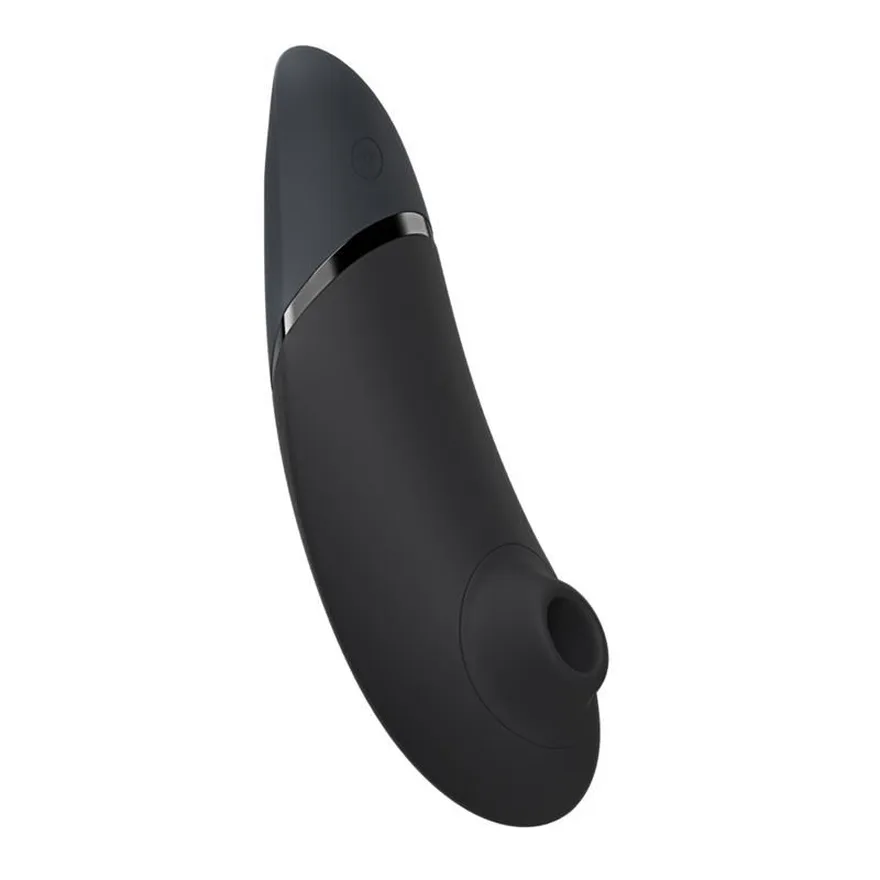
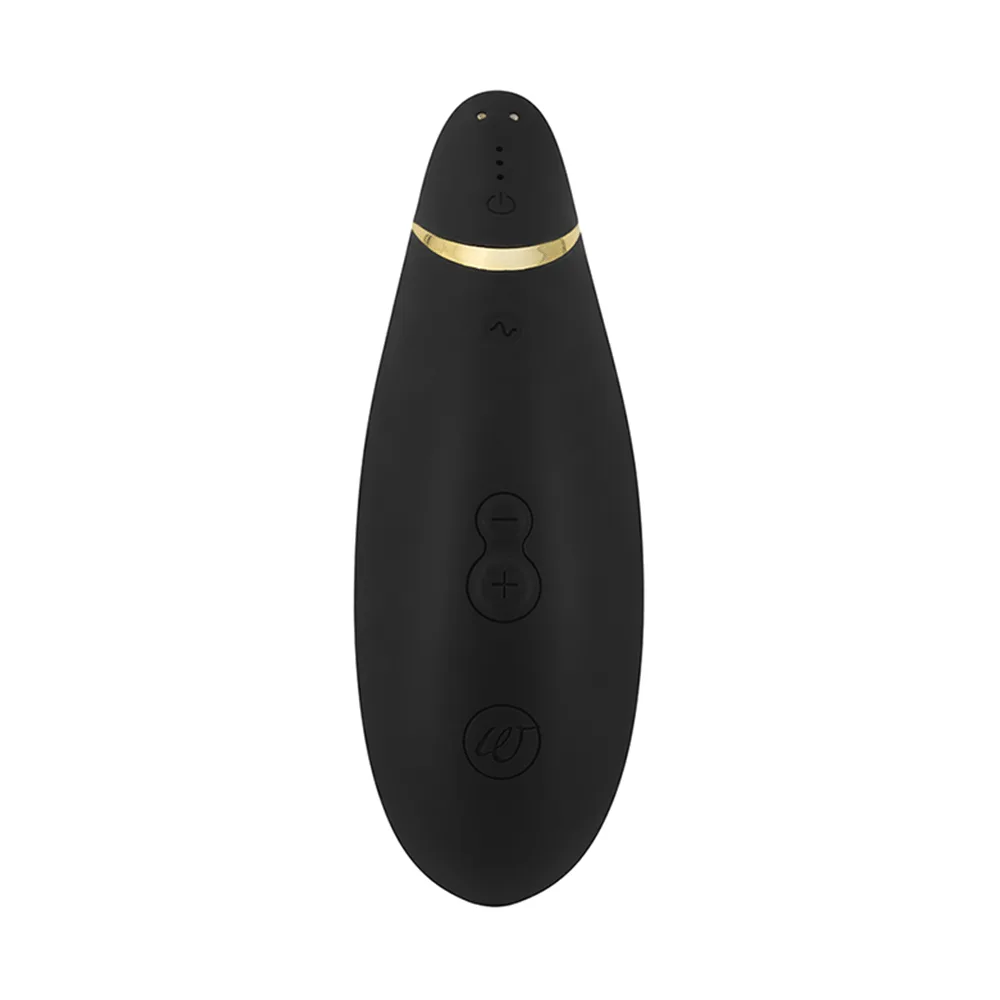
The shape is asymmetrical, with a wide, rounded section where the stimulation head sits, and a tapering grip upward. The angle between the grip and the head is fixed, which means you control the angle toward the body with your wrist. The black version has a gold-colored stripe running across the housing—that’s the detail that gave the article the name Black Gold at Swedish shops, while the manufacturer itself simply calls the color Black.
The interface on the Womanizer Premium 2 consists of four buttons on the top side of the housing. The manufacturer’s manual names them: a power on/off button at the very top with LEDs that show the charge level and the Autopilot mode, an Autopilot button, a rocker switch with plus and minus that steps between the fourteen intensity levels, and the Smart Silence button that bears the Womanizer logo. All four are visible in the manufacturer’s own product image of the back of the housing.
According to the manual, the product is started by holding down the power on/off button for two seconds, and the LEDs then show that the product is on. Turning it off is done the same way: a two-second press. The intensity is stepped up and down with short presses of plus and minus, respectively. Autopilot is turned on and off with a two-second press, and switching between Autopilot modes is done with a short press on the same button. Smart Silence is turned on and off with a two-second press of the fourth button.
So the logic is consistent all the way through: a long press switches modes, and a short press adjusts. In practice, that means you don’t need to look at the buttons to find the right one—which matters exactly because they’re on the top side while the head rests against your body. The manual also states that the product provides both haptic and visual feedback when Autopilot is switched on or off—so you feel in your hand that the mode has changed.
Four buttons are more than on a simple air pressure product. Satisfyer Pro 2 Generation 2 gets by with two, and Lelo lists three for the Sona 3 Cruise. That’s the direct cost of Autopilot and Smart Silence: two extra functions require two extra buttons. For someone who only wants one button and a sensation, that’s a downside rather than a feature, and it’s worth factoring in before you pay the premium price.
Autopilot is the manufacturer’s automatic mode, and the manual states exactly what the three modes do—significantly clearer than what most manufacturers describe their automatic functions as. In soft mode it works between intensity steps 1 and 6, in the middle mode between 6 and 11, and in intense mode between 9 and 14. The LEDs show which mode is active: in soft mode, the first LED pulses, in middle mode two LEDs, and in intense mode all of them.
It’s a description worth reading before buying, because it says something concrete about what the automation can actually do. If you choose intense mode, the product will never go below step 9. If you choose soft mode, it will never go above step 6. The modes also overlap—step 6 is present in both soft and middle mode, and steps 9 to 11 are in both middle and intense mode—which means the transition between the modes isn’t a jump, but a sliding motion.
The manufacturer describes Autopilot as an upgraded version developed based on feedback from testers, which is marketing rather than specifications. What can be established is that the function automatically switches intensity within a defined range, and that the ranges are published. The latter is unusual enough to deserve a note in itself.
Smart Silence means the product only starts when the head is almost touching the skin. The function is turned on from the factory, and the manual explicitly points out that you should not hold the stimulation head when you turn on the product, because then the sensor interprets your hand as skin and the function can’t be guaranteed. In practice, that means the product is quiet in your hand as it moves toward your body—it simply doesn’t make any sound until it’s supposed to.
The manual also includes a troubleshooting tip that’s hard to find anywhere else: if Smart Silence doesn’t work, you turn off the product, connect the charging cable for a few seconds, and then turn it back on. That resets the product. This kind of instruction is usually completely missing in this product category, and it’s worth knowing before you file a complaint about a product that works.
Here, however, there’s information where the shops contradict each other without the manufacturer giving any answers. Lekosmek states that the product turns off automatically after about 10 minutes, while Vuxenkul states 5–10 minutes depending on battery level. Womanizer publishes no time for the automatic shut-off—the product page only mentions that the product goes into standby mode when it isn’t being used. Assume the function exists, but treat the minute figures as store information until the manufacturer specifies them.
Fourteen steps are more than most people use. The pattern in this product category is that the lowest steps are clearly separated, while the top steps are closer together, because the pressure difference per step decreases as the pump approaches its maximum output. Womanizer says themselves that the steps are balanced to offer the right setting for every mood, which is a phrasing with no measurable content.
What can be established is that fourteen steps provide finer resolution than eleven, which is what Satisfyer states for Pro 2 Generation 2, and that the Autopilot intervals in the manual show that the manufacturer itself divides the scale into three practical zones: 1–6, 6–11, and 9–14. That breakdown says more about how the steps are intended to be used than any marketing wording does. Rely on the fact that in practice you’ll end up using three or four steps.
Womanizer markets Premium 2 as quiet and highlights Smart Silence as one of the reasons—the feature makes the product make no sound at all when it isn’t touching the body. The question is what “quiet” means in numbers, and there the answer has to be honest: Womanizer publishes no measured decibel value for Premium 2, either on the product page or in the manual.
On the other hand, one of the stores does. The retailer Joyland states that the product, at under 40 dB, is very quiet. That’s a retailer claim with no stated measurement method, and you should read it as exactly that. Without information on measurement distance, measurement surface, and which intensity step the measurement refers to, a decibel figure in this category tells you very little. For comparison, Lelo lists a maximum sound level under 60 dB for Sona 3 Cruise—a published figure from a manufacturer that still leaves the same questions unanswered.
What can generally be established is that air-pressure products as a category are quieter than vibrators with a rotating eccentric motor, because the sound comes from a pump rather than an unbalanced weight. A practical tip that applies regardless of model: place the product on a soft surface between uses. A hard tabletop works like a resonator box and noticeably amplifies the sound.
Womanizer Premium 2 is rated IPX7. The rating comes from the international standard IEC 60529, which defines enclosure classes for electrical equipment. The number 7 in the second position means that the product is tested for immersion in water to a depth of one meter for 30 minutes. The manufacturer’s manual spells out the consequence directly in its cleaning section: wash under water, use toy cleaning agents, dry.
Here is the clearest contradiction between the sources in this entire review. The retailer Taboo states the water-resistance rating as IPX5 on its product page, both in the specification table and in the bullet list, while the manufacturer states IPX7. Blush Me states IPX7 in accordance with the manufacturer, and Mshop writes "100% waterproof" without a rating designation.
The difference between the classes is not cosmetic. IPX5 means protection against water jets from all directions — that is, showering and rinsing off, but not submersion. IPX7 means protection against submersion for one meter for 30 minutes, meaning a bathtub. A product that were only IPX5 would not withstand being placed in a bathtub, and it would also not be possible to rinse it out internally without careful thought. The manufacturer’s statement applies, and the manufacturer states IPX7. But if you’ve read IPX5 at a store and wondered why the information doesn’t match — that’s the explanation.
The general rule is worth repeating: if a product completely lacks an IPX rating, it should be treated as not waterproof. The absence of a rating is never a sign that the product would be approved for water.
The manual is brief but unambiguous: rinse under water, use a cleaning product intended for toys, dry. The manufacturer also emphasizes that the product must be cleaned thoroughly both before the first use and after each use in order to reduce the risk of infection. Remove the stimulation head and rinse the inside of the chamber separately — it’s the only part where water and residue can be left standing, and it’s also the only part you can access thanks to the head being removable.
The manufacturer has nothing to say about the lubricant question in just this manual, but the retailer Joyland recommends a water-based lubricant, and the material gives the same answer. Silicone-based lubricant should not be used on silicone products — it breaks down the silicone surface over time and makes it porous, and a porous surface can no longer be cleaned properly; it can only be replaced. Oil-based products such as coconut oil leave a film that is difficult to remove.
The storage instruction in the manual is simple: store in a safe, dry place protected from direct sunlight. The cotton bag included in the package is intended for exactly that. The manual also points out that the product contains a lithium-ion battery and that neither electronics nor batteries may be disposed of in household waste — an instruction that is rarely found in store texts, but that applies once the product has been used up.
Womanizer states a run time of 240 minutes and a charging time of 120 minutes. Four hours of operation is in the upper part of the category — Lelo indicates up to two hours for the Sona 3 Cruise, and Womanizer’s own Classic 2 is listed as 180 minutes — and it’s one of the most concrete advantages in the Premium 2 specs. Blush Me gives the same figures as the manufacturer: a 120-minute charge and a 240-minute battery life, and Joyland puts it as saying that two hours of charging provides four hours of use.
However, there’s yet another store discrepancy to report. Taboo lists the charging time as approximately 300 minutes and the usage time as approximately 90 to 120 minutes — alltså more than twice as long charging and less than half the operating time compared with the manufacturer’s specification. The manufacturer’s figures apply, but the discrepancy is large enough to deserve a note, especially since the same shop page also states the wrong enclosure rating.
Charging is done via magnetic charging pins on the top side of the product that connect to a USB cable. In its product description, the manual explicitly names the pins as "magnetic charging pins" and states that charging happens via a USB port. The manufacturer’s own packshot of what’s included in the box shows the cable: a USB cable with a round magnetic charging puck on the end. A power adapter is not included, which both the manual and the product page state.
Magnetic charging is a trade-off, not a pure advantage. The advantage is that you don’t need an opening in the housing, which makes it easier to achieve IPX7 without a rubber plug. The downside is that the cable is product-specific: tappar du laddkabeln fungerar ingen vanlig USB-C-kabel, so you have to get a replacement from the manufacturer. It’s a real difference compared with, for example, the Satisfyer Pro 2 Generation 2, and Womanizer’s warranty terms also expressly exclude accessories such as charging cables from the warranty — so a broken cable is always your own cost.
The manual also states the product’s electrical data. The power class is 100–240 volts at 50/60 hertz and the output is 5 volts 1 ampere according to the Swedish language section. Here the manufacturer’s manual contradicts itself: the English language section in the same PDF states instead 5 volts 0.75 ampere and the model number WZ08B, whereas the Swedish one and eleven other language sections state 5 volts 1 ampere and the model number WZ09B. Eleven out of twelve language sections point in the same direction. It’s worth knowing if you read the manual in English and get confused about the model designation.
Womanizer does not publish either the battery’s capacity in mAh or its voltage for Premium 2, either on the product page or in the manual. What is stated is that the product contains a rechargeable lithium-ion battery, that the operating time is 240 minutes, and that the charging time is 120 minutes. It’s worth noting because the competitors do it differently: Lelo states 520 mAh and 3.7 volts for Sona 3 Cruise, along with both input and output power.
Without the capacity, you can’t convert the operating time into power consumption, and you can’t compare how heavily the cell is stressed between models. What generally applies to lithium-ion batteries applies here too: capacity drops with the number of charge cycles, and the product is best served by being charged regularly rather than being stored fully discharged. The manufacturer itself writes in the manual that the product should be charged regularly for the battery to last longer.
Womanizer also does not state whether the battery is replaceable. The manual describes no cover, no tool, and no service procedure, and the only information about the battery in the disposal section is that it must not be thrown away with household waste. With use a couple of times a week, it’s likely the battery—not the silicone—that sets the limit for lifespan.
We do not have price data from shops in your market yet.
The manufacturer states IPX7 and a charging time of 120 minutes. One of the stores lists IPX5 and 300 minutes. Same item number, same packaging — and three digits apart.
Four comparisons are relevant: against the brand’s own entry-level model, against the brand’s newer generation, against the other premium brand in the category, and against the cheapest entry into air pressure technology. All the information below comes from the respective manufacturers’ own specifications.
Womanizer Classic 2 uses the same basic technology in a simpler body. The dimensions are 148 × 48 × 35 millimeters and the weight is 117.9 grams, meaning it is both shorter, narrower, and lighter than Premium 2. The enclosure class is the same IPX7, the charging time is the same 120 minutes, and the warranty is the same five years.
Two differences are crucial. The first is the material: Classic 2 is listed as ABS and body-friendly silicone, meaning the silicone sits in the head and the ABS plastic is in the housing, while Premium 2 is all-silicone all the way through. The second is the operating time: 180 minutes versus 240, so one hour less on a charge. Add to that that Premium 2 has Autopilot and Smart Silence and that two stimulation heads are included.
The conclusion is that Classic 2 is the right choice if you want Womanizer’s air pressure technology as cheaply and as compactly as possible, and that Premium 2 is the right choice if the material difference between all-silicone and ABS matters to you. It’s that difference, not the number of modes, that justifies the price increase within the brand.
Womanizer Next is the newer generation, and the difference is less than the name change suggests. Both have fourteen intensity levels, both state 240 minutes of operating time and 120 minutes of charging time, both are IPX7, both are full silicone without phthalates, BPA, or latex, both have Smart Silence and Autopilot, both have two stimulation heads in the package, and both come with a five-year warranty.
What Next adds is Climax Control: three depth levels that control how deep each pressure wave feels, on top of the fourteen intensity levels. That gives forty-two combinations instead of fourteen. What the Premium 2 adds is size and weight: 155 × 50 × 35 millimeters versus Next’s 171 × 54 × 57 millimeters. Premium 2 is therefore shorter, narrower, and above all 22 millimeters lower—and it’s the height measurement that determines whether the product feels compact in the hand or not.
The conclusion is simple: if you want the depth control, there is no other way to get it within the brand than with Next. If you don’t want it, you get the same number of steps, the same operating time, the same water resistance, the same material, and the same warranty in a substantially smaller body by choosing Premium 2.
Lelo Sona 3 Cruise measures 112 × 51 × 55 millimeters and weighs 128 grams. So it is significantly shorter and a bit lighter, but higher than Premium 2. Lelo lists ten built-in modes that can be expanded to twelve via the app, a lithium-ion battery of 520 mAh and 3.7 volts, charging up to two hours at 5 volts and 520 milliamperes, an operating time of up to two hours, and a maximum sound level below 60 dB. The material is stated as body-friendly silicone and ABS plastic, so not full silicone.
The differences that actually matter: Premium 2 has twice the operating time, full silicone across the entire body, fourteen levels versus ten, and a five-year warranty versus Lelo’s two years plus a ten-year quality warranty. Lelo, for its part, has a significantly smaller product, app control that Premium 2 completely lacks, and—last but not least—a specification in which both battery capacity, power data, frequency, and sound level are actually published.
If you choose based on the presented data and on size, Lelo wins. If you choose based on operating time, material, and the number of intensity levels, Premium 2 wins. It’s one of the few comparisons in this category where both products have a clear and justifiable argument.
Satisfyer Pro 2 Generation 2 measures 165 × 46 × 65 millimeters and weighs 174.7 grams. So it is longer, narrower, and heavier than Premium 2, and significantly higher. Both are air-pressure products for clitoral stimulation, both are IPX7, and both work according to the same basic principle.
Satisfyer has eleven intensity levels out of fourteen, ABS plastic and silicone instead of full silicone, and a fixed head without alternative sizes. In return, it has a 15-year manufacturer warranty, i.e. three times as long as Womanizer’s five years, and it’s in a completely different price class.
If you’re unsure whether air pressure technology works for you at all, Satisfyer is an inexpensive way to find out. If you already know that the technology suits you, and you want full silicone, two head sizes, fourteen levels and four hours of operation, Premium 2 is the product that delivers that—but the price difference is large enough that it should be a deliberate choice, not an assumption that more expensive is better.
Nine Swedish stores sell the item with EAN 4251460615525. The cheapest is Lekosmek at 1,348 SEK, and the most expensive is Lustly at 1,949 SEK. That’s 601 SEK, or about a 45 percent difference for exactly the same item number, the same color, and the same packaging.
The stock situation is unusually good in this case. Six of the nine stores had the product in stock at the price check: Lekosmek at 1,348 SEK, Taboo at 1,379, Vuxen at 1,436, Blush Me at 1,495, Joyland at 1,499 and Lustly at 1,949. The three that lacked stock were Mshop at 1,363 SEK, Sexonic at 1,772, and Vuxenkul at 1,899. That means that the cheapest store is also one of the ones that can actually deliver—which isn’t always the case in this category.
The difference between the cheapest and the second-cheapest available store is 31 SEK, and between the cheapest and the fifth-cheapest available 151 SEK. Only with Lustly does the spread become dramatic. That makes shipping costs worth calculating: in this price range, several stores are above the threshold for free shipping, and a shipping fee can easily swallow up the thirties of kronor in the price difference between the five cheapest.
The price spread doesn’t depend on one store selling a different variant. Two of the stores publish the EAN number in plain text on their product page, and all nine list the item under a separate item number that’s linked specifically to the black Premium 2. It’s therefore about the stores’ own margin setting for a model that has been in the range for several years—and that’s exactly the situation where it pays most to compare before you pay. The prices in the table above are updated when the stores’ product flows are updated, but always check the final price at checkout.
It’s for you if you want Womanizer’s air pressure technology in full silicone without the product becoming bulky. The combination of 155 × 50 × 35 millimeters, 141.4 grams, and silicone over the entire body is unique within the brand: Classic 2 is smaller but has an ABS housing, Next is full silicone but significantly larger. It’s for you if you want to be able to change the tip size to get the right fit, for you if you want to be able to rinse off the entire product and the inside of the comb under running water, and for you if you don’t want to think about charging between uses—four hours of runtime goes a long way.
It’s also for you if you want an automation function with published intervals. The Autopilot modes 1–6, 6–11, and 9–14 are unusually clearly documented, and that makes the feature possible to assess before buying instead of after.
It’s not for you if you want depth settings—within the brand, Next is the only way. It’s not for you if you want app control, which Premium 2 completely lacks but which Lelo offers in the same price range. It’s not for you if you require published battery capacity and measured sound level before purchase, because Womanizer does not publish either for this model. And it’s not for you if you want to be able to charge with the same cable as your phone—the magnetic charging cable is product-specific and excluded from the warranty.
One more thing belongs in the decision. Premium 2 is designed as a main product, but unlike Next it’s small enough to also work as a travel companion. What speaks against traveling is the charging cable: if you lose it, the product won’t work until you’ve ordered a new one from the manufacturer, and that cost is outside the warranty.
Womanizer provides five years of voluntary manufacturer’s warranty on Premium 2, and the terms specify the warranty period as 60 months from delivery. The warranty covers material, manufacturing, and construction defects, and in that case the manufacturer replaces the product with an identical or equivalent new product and covers the shipping cost. In exceptional cases, Womanizer may instead choose to refund the purchase amount provided the product is returned.
Read the exceptions before you count on the warranty. It does not cover minor faults that do not affect usability, wear parts such as stimulation heads, and accessories such as charging cables. It also does not apply in the event of intentional damage, normal wear and tear, incorrect commissioning, or your own repair attempts. In practice, that means that the two parts most likely to break first—the head and the cable—are excluded from the warranty.
Here is yet another store note that deviates. The retailer Lekosmek states “2 years of product warranty” on its product page, while the manufacturer states five years. The manufacturer’s warranty is a voluntary commitment that applies regardless of where you purchased, and you can assert it directly against Womanizer. The store’s shorter notice does not limit that right.
Womanizer’s 100-day satisfaction guarantee is also worth a clarification, since it is often cited in store texts. According to the manufacturer, it applies only to purchases in Womanizer’s own web shop, it provides a value voucher to spend in the same store rather than a refund of money, and it can be used for one item per order. So if you buy from any of the nine Swedish stores listed above, you are not covered by it.
What always applies, on the other hand, is your statutory rights. Under the Swedish Sale of Goods Act (konsumentköplagen), you have three years’ right to complain in the event of defects in the product, regardless of what the manufacturer commits to. For distance purchases, you also have a right of withdrawal for fourteen days under the Act on distance contracts and contracts outside business premises (lagen om distansavtal och avtal utanför affärslokaler). Be aware that in practice, the right of withdrawal is limited for hygiene items that have been removed from a sealed package. The right to complain about defects, however, always applies. If you have questions about what applies in your case, Konsumentverket guides you via Hallå konsument.
Womanizer Premium 2 Black Gold is ranked på plats 2 av 32 in clitoral stimulator best i test, where the entire category is compared against each other using five shared criteria. Guiden vinns av Womanizer Premium 2 Red Gold.
Every numerical piece of information in the text can be traced to one of the sources below. The links were checked manually on the specified date.
This page is machine-translated from Swedish. Read the Swedish original