

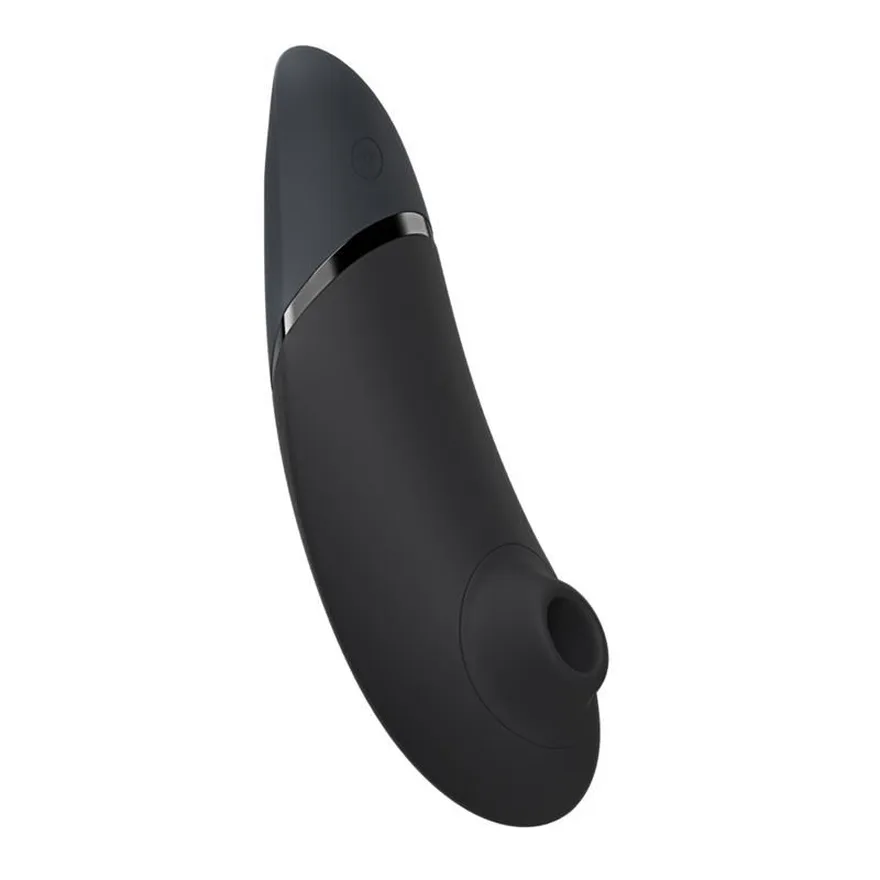
Review
Review: Womanizer Next
The brand’s most adjustable clitoral stimulator — 14 steps times 3 depth levels.
29 July 2026
 Author's pick
Review · G-spot vibrator · Pleasure Air air pressure
Womanizer’s only model that directs the air pressure inward, reviewed against the manufacturer’s own specifications, the official manual, and price data from seven Swedish shops. Twelve Pleasure Air intensities and three vibration levels, body-friendly silicone all over the body, IPX7 according to IEC 60529, 152 grams, and a five-year warranty — at a price where the difference between the cheapest and the most expensive shop is 126 percent.
The only product in Womanizer’s range that directs Pleasure Air inward toward the G-spot, and one of very few on the market at all. Twelve intensity steps and three vibration levels are controlled independently of each other; the whole body is covered with silicone, and the weight of 152 grams is low for an insertable product. What you pay for is the run time of 120 minutes, a stimulation head that can’t be removed or replaced, the lack of an automatic mode, and a specification where neither battery capacity nor sound level is published.
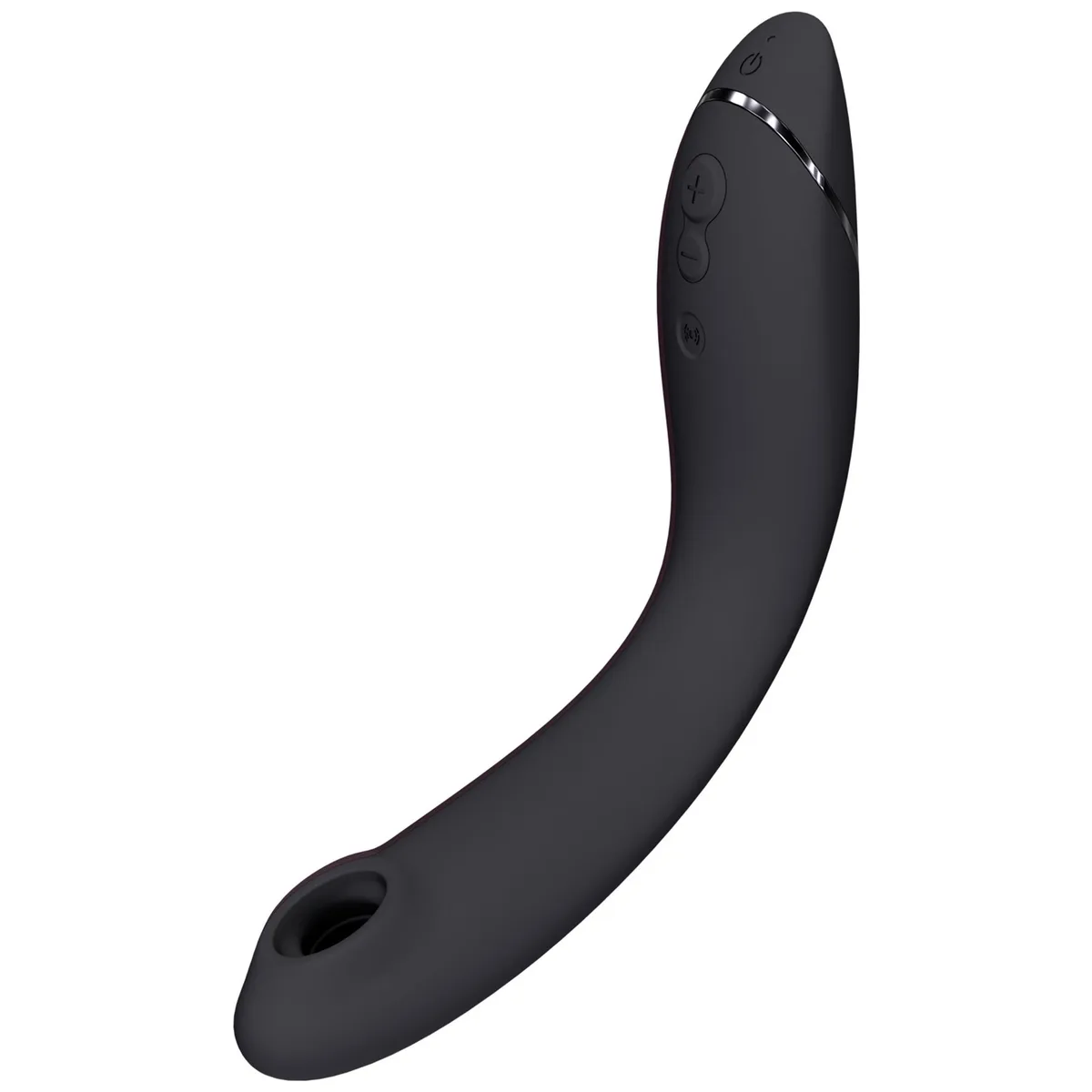
Womanizer OG is the model in which the brand moved its air-pressure technology from the outside to the inside. All other Womanizer products press the pressure chamber against the clitoris from the outside. OG is shaped to be inserted and to direct the same Pleasure Air technology toward the G-spot, with a curved silicone body and vibrations in addition. The manufacturer describes it as Pleasure Air for the G-spot for the first time ever, and that’s exactly what sets the model apart from the rest of the category: there are plenty of air-pressure products for the clitoris, and almost none for the G-spot.
The specification looks like this: twelve Pleasure Air intensity steps, three vibration levels, body-friendly silicone over the entire housing, an IPX7 enclosure rating, 120 minutes of operating time, 100 minutes of charging time, and a five-year manufacturer’s warranty. The dimensions are 176 × 113 × 39 millimeters and the weight is 152 grams. The product model number is TES10A. In Sweden, the item is sold by seven stores at prices between 928 and 2,095 SEK, and four of them have it in stock.
This review is exclusively about the variant with EAN 4251460616263, the manufacturer’s item number WZ171SG5. Womanizer sells OG in three colors—Dark Gray, Aubergine, and Lilac—and each color has its own EAN. Aubergine is 4251460603652 and Lilac is 4251460616256. Here is a pitfall worth a warning: several Swedish stores sell EAN 4251460616263 under the names "Black" and "Slate", even though the manufacturer’s own variant table links the number to Dark Gray. It’s the same article, the same item number, and the same packaging—but the stores’ color names can’t be trusted when you compare prices. Check the EAN, not the color label.
Classic air pressure technology is based on a pump that creates alternating under- and overpressure in a closed chamber that is placed over the clitoris. The chamber never touches the skin directly. The stimulation happens through pressure waves in the air inside the head, and that is the whole reason why this product class is usually described as touch-free. The difference from a regular vibrator is fundamental: a vibrator transfers mechanical motion from a motor through the material to the skin, while an air pressure product transfers pressure changes through air.
Applying that principle to the G-spot isn’t trivial, and that’s why OG looks the way it does. The pressure chamber isn’t positioned at the very tip; instead, it sits on the top side of the curved end—the surface that faces the front vaginal wall when the product is inserted. The manufacturer describes the shape as body-adapted, with a flexible arm for an individual fit, and places the vibrations so that they complement the air pressure rather than competing with it. What can be determined from the design alone is that the chamber must be held against the tissue by the product’s own shape, because you can’t press it into place with your hand in the same way as with an external model. That’s why the curve and the flexible arm aren’t just cosmetic; they are the function itself.
The manufacturer’s own manual is unusually clear about how the product is intended to be used, and it’s worth reading before buying. The instructions are to first use Pleasure Air externally against the clitoris, apply water-based lubricant to the product’s body, and only then insert it and find the G-spot. The manual also explains why: the G-spot area lies behind the front vaginal wall and is therefore less sensitive than the outer clitoris, and it takes longer before it becomes receptive to stimulation. OG is therefore not designed as a product you pick up and are done with in two minutes, and the manufacturer says so outright.
Womanizer’s naming is simpler than in many competing brands, but three models sit close together in the range and are regularly mixed up in Swedish shop texts.
The decisive difference between OG and DUO 2 is where the air pressure ends up. On DUO 2, the pressure chamber sits on the outside, against the clitoris, while the insert part only vibrates. On OG, the pressure chamber is on the insert part, aimed at the G-spot. If you want Pleasure Air inside, OG is the only model in the range that offers it. If you want both at the same time, DUO 2 is the right product — and it costs from 1,305 SEK, while OG costs from 928.
The material question is the only feature of an intimate product that can’t be compensated for with experience or care, and it determines whether the product is still hygienic after five years. Womanizer lists a single material for OG: body-friendly silicone. This applies to the entire product, which is a real difference both compared with cheaper models where only the contact surface is silicone and the rest is hard ABS plastic — and compared with the brand’s own DUO 2, whose material declaration explicitly lists ABS along with silicone.
Silicone is a non-porous material. A non-porous surface can be cleaned, because there are no microscopic cavities where residue can get stuck. It’s the single most important property of a material that should sit against mucous membranes, and for an insert product it matters more than for an external one — the contact is more extensive and lasts longer.
That the entire house is coated with silicone has two consequences. The first is tactile: the surface is soft in your hand instead of slippery plastic, which also provides better grip when your hands are wet or have lubricant on them. The second is hygienic: there is no seam between a silicone head and a plastic handle where dirt can collect. The opposite of this advantage is that the stimulation head on OG is not removable. The manufacturer’s delivery list does not mention any replaceable head and no alternative top sizes, unlike Premium 2 and DUO 2, both of which are delivered with two stimulation heads. The inside of the comb therefore has to be cleaned on site, and it cannot be replaced once the membrane is worn out.
Phthalates are a group of plasticizers used to make plastic — above all soft PVC — flexible. Kemikalieinspektionen describes them as substances that can affect the hormone system and make reproduction more difficult, and several of them are therefore restricted or banned within the EU in a large number of products. This particular product category is repeatedly the subject of supervision because it contains soft plastic against the skin and mucous membranes.
Womanizer explicitly states that OG is manufactured without phthalates, BPA, and latex, and it repeats the same commitment for the entire range on its warranty page. It’s an unambiguous declaration, unlike labels such as "TPE" or "jelly rubber", which say nothing at all about which plasticizers are included. Silicone does not require phthalate plasticizers to become soft — the softness comes from the polymer’s own structure — and that’s why a silicone material specification, in itself, is better information than almost any other item in a product specification.
The latex information is relevant for anyone who is allergic to latex. Latex allergy causes reactions in the mucous membrane faster than on normal skin, and an insert product is therefore exactly the use case where the information matters. Having the manufacturer state it is a plus.
The dimensions need an explanation, because it looks bigger than the product actually is. Womanizer states 176 × 113 × 39 millimeters. The first number is the product’s length measured straight, the last is the thickness — and 113 millimeters is the width of the arc that the strong bend creates, not how wide the product is for insertion. With 39 millimeters as the maximum thickness, OG is in the narrower half of the G-spot products, even though the list looks bulky.
The weight of 152 grams, however, is a straight number, and it is low in context. Compare it with the Womanizer DUO 2, which is listed as weighing 263 grams, i.e. 73 percent more, or with the Womanizer Next whose specifications state 480 grams. A low weight means more in an insert product than in an external one: you hold it in a longer, more extended grip, often at an angle where the wrist does the work. Here, 152 grams is a concrete advantage that you can actually trace back to the specifications.
The packaging measures 235 × 206 × 49 millimeters, making it a noticeably wide cardboard box in relation to the product. It only matters in two situations: if you think you’ll save the packaging for storage, and if you need to assess the package size at delivery. A cotton bag is included, and that’s the one intended for storage.
Womanizer markets the curved arm as flexible, intended to provide an individual fit. What can be established from the manufacturer’s materials is that the arm is bendable and that the shape is meant to be adjustable to the body. How much it can be bent, with what force, and whether it retains its shape after bending, Womanizer does not publish anywhere — neither on the product page nor in the manual. That’s a task that would have been relevant, because in practice the difference between an arm that returns to its original position and one that stays at the angle you set it to is significant.
What you can say something about, though, is the consequence of the arm being bendable at all. A rigid shaft forces the body to adapt to the product; a bendable shaft shifts the adaptation to the product. On a G-spot product, where the angle toward the front vaginal wall determines whether the air-pressure chamber lands correctly or not, it’s a meaningful design — no matter how many degrees the manufacturer happens to leave unspecified.
The interface on the Womanizer OG consists of three buttons plus one LED, and the manufacturer’s manual names them all. At the top there is the on/off button with the LED next to it. Under it sits a rocker switch with plus and minus that steps between the twelve Pleasure Air intensities. At the bottom there is a separate vibration button. It’s a simpler interface than on Womanizer’s more expensive models, and for a product that’s meant to be controlled with one hand at an awkward angle, it’s more of an advantage than a drawback.
The manual states exactly what each press does. You start the product by holding the on/off button for two seconds, and you turn it off in the same way. The plus button steps the intensity up by one step per short press, and the minus button steps it down. The vibration button is activated with a short press and then continues through the three levels in a loop — if you press once more after the highest level, it starts again.
The practical value of having its own button for the vibrations is that air pressure and vibration are two independent controls. You can run high Pleasure Air intensity without any vibration at all, or low intensity with full vibration, and it’s two completely different settings. It also means that a comparison based on “number of modes” is misleading: OG doesn’t have twelve modes; it has twelve intensities combined with four vibration states — off, low, medium, and high.
One thing is missing compared with the rest of the range, and it’s worth noting before you buy: OG has no Autopilot. The manufacturer’s specifications list Smart Silence and Afterglow, but nothing like an automatic mode that varies the intensity on its own. It’s available on Premium 2 and on Next. If you want the product to switch for you, OG is the wrong model.
Smart Silence means the product only starts when the stimulation head is close to the skin. The function is enabled from the factory. According to the manual, you turn it off or on by holding the plus and minus buttons pressed at the same time for two seconds. When the product isn’t in use, it goes into standby.
The manual also covers a limitation that rarely appears in the store texts, and that is specific to a plug-in product: Smart Silence can stop working if the stimulation head is wet. The manufacturer therefore explicitly urges you not to apply lubricant in the air pressure chamber itself. It’s a real practical consequence. The instruction is to lubricate the product’s body, not the chamber—and since OG is intended to be inserted, lubricant is hardly optional. There’s a concrete sequence of actions to learn, and it’s stated in the manual rather than on the packaging.
Womanizer does not state how long it takes before OG turns itself off into standby mode. On the closely related Next, the manufacturer lists 30 minutes, but no corresponding figure for OG is published, either on the product page or in the manual. So don’t assume a known shutdown time.
Afterglow is an end-of-session function, and on OG it’s described more concretely than on several other Womanizer models. The manual says you hold the minus button for one second, after which the product returns to intensity level 1. So it isn’t a gradual fade over time; it’s a direct jump straight down to the lowest setting with a single press.
The difference is worth understanding. The point is to avoid having to press minus eleven times, or to turn it off completely, when the clitoris or G-spot area is overly sensitive right after orgasm. It’s a small feature, but it solves a real problem, and it’s free in the sense that it doesn’t require any extra button.
Twelve intensity steps are more than most people use. The pattern in this product category is that the lowest steps are clearly separated, while the top ones are closer together, because the pressure difference per step decreases as the pump approaches its maximum output. Add three vibration levels plus the mode with zero vibration, and you have 48 possible combinations. Expect that, in practice, you end up using three or four of them.
What actually matters is not the number, but that the two scales are independent of each other. Where a product with twelve pre-programmed patterns forces you to accept the full package in every setting, with OG you can keep an intensity you like and just change the vibration—or vice versa. It’s a simpler form of adjustability than the one Womanizer Next offers with its three depth levels, but it’s cheaper and easier to get an overview of.
Womanizer markets Pleasure Air products as silent, and Smart Silence builds on the same argument: the product doesn’t make noise until it’s supposed to. The question is what that means in numbers, and there the answer has to be honest: Womanizer does not publish a measured decibel value for OG, either on the product page or in the manual. Websites that list an exact number of decibels for this model either report their own measurement or a value without a source from the manufacturer.
What can, however, be established is that air-pressure products as a category are quieter than rotating eccentric motors, because the main sound comes from a pump rather than from an unbalanced weight. On OG, though, there are both sound sources: the pump that drives Pleasure Air and the separate vibration motor. In practice, that means the sound profile changes depending on which vibration level you’ve chosen, and that a single decibel value would still have been an oversimplification—but it doesn’t justify publishing no number at all.
A practical tip that applies regardless of the model: place the product on a soft surface between uses. A hard desktop surface works like a resonance box and noticeably amplifies the sound.
Womanizer OG is rated IPX7. The rating comes from the international standard IEC 60529, which defines enclosure classes for electrical equipment. The number 7 in the second position means the product is tested for immersion in water to a depth of one meter for 30 minutes. The manufacturer’s manual states the consequence plainly: wash under running water, apply cleaning products for intimate products, and dry carefully.
The difference versus a splash-proof product is greater than the wording suggests. Splash protection covers water droplets and, at best, water jets, but not submersion. Such a product can handle a damp cloth and possibly a shower, but not a bathtub, and it should not be held under running water without giving due thought to the buttons and the charging contact.
With IPX7, the entire product can be rinsed off without taking precautions, and for a plug-in product it is not a convenience but a requirement. If a product has no IPX rating at all, it should be treated as not waterproof. The absence of a rating is never a sign that the product would be approved.
Rinse the product in lukewarm water after each use and use a cleaning agent intended for intimate products. The manual includes an instruction that is specific to Pleasure Air products and is easy to miss: gently wipe and do not press hard against the membrane in the pressure chamber. The membrane is the moving part that creates the pressure waves, and it is the single most sensitive component in the entire product. Since the head is not detachable, it cannot be replaced either if it is damaged. Wipe it off with a clean towel and let it air-dry before putting the product away in the included cotton bag.
Womanizer’s own instructions are clear on the lubricant question: use a water-based lubricant, and do not use fragranced or alcohol-based lubricants, gels, or massage oils. Silicone-based lubricants should not be used on silicone products—they break down the silicone surface over time and make it porous, and a porous surface can no longer be cleaned properly; it can only be replaced. Oil-based products such as coconut oil leave a film that is hard to remove. For OG, the already-mentioned rule also applies: the lubricant should go on the body, not in the chamber.
The manual also covers three things that rarely appear in store texts. The product and its battery must not be exposed to temperatures above 45 degrees—so boiling water and the dishwasher are out of the question despite IPX7. The product contains magnets, which means it should not be used directly over a pacemaker, and cards with a magnetic stripe should be kept away from it. And OG is explicitly not designed for anal use, which is worth emphasizing because it’s a plug-in product without a base plate.
Womanizer states the operating time as 120 minutes and the charging time as 100 minutes. Two hours of operation is in the middle of the category, but it’s half of what the brand’s own Premium 2 and Next list—both are at 240 minutes. This is OG’s clearest concession in its specifications, and it is reasonably because the product drives both a pump and a vibration motor from the same cell in a smaller housing.
Charging takes place via the included USB charging cable. The manufacturer’s delivery list explicitly states that no mains adapter is included, so you need either a USB port or your own adapter. The manual specifies the electrical rating as 5 V and 0.5 A for USB charging, and points out that only the included cable should be used.
The cable connects magnetically. The manufacturer’s packaging text states “Magic magnetic charging,” and the stores’ product images show the round magnetic connector against the top side of the product. It’s worth noting that the product page’s specification table only says “USB rechargeable” and doesn’t mention the magnetic solution at all — the information comes from the packaging and from the resellers’ images, not from the specification. The manual’s warnings about magnetic fields and magnetic belt cards point in the same direction.
Magnetic charging is a trade-off, not a pure advantage. The advantage is that no opening in the housing is needed, which makes it easier to achieve IPX7 without a rubber plug — especially important on a product that is meant to be inserted. The disadvantage is that the cable is product-specific: if you lose the charging cable, no standard USB-C cable works, so you must get a replacement from the manufacturer. Womanizer’s warranty terms also expressly exclude accessories such as charging cables from the warranty, so a broken cable is always at your expense.
Womanizer does not publish the battery’s capacity in mAh for OG, either on the product page or in the manual. What’s provided is voltage and current: the manual’s electrical rating states 3.7 V and 0.62 A for the built-in cell. Without the capacity, you can’t convert operating time into power consumption, and you can’t compare how heavily the cell is loaded between models.
There’s also a contradiction in the manufacturer’s own material that’s worth spelling out. The product page’s specification table states a lithium-ion battery, while the manual’s electrical rating states a Li-Polymer cell. The two are not the same thing — lithium polymer is a variant with a polymer electrolyte and a different casing — and it’s not possible to determine from the manufacturer’s published material which of the two pieces of information is correct. It doesn’t change anything in practical use, but it’s an example that a specification table isn’t always the most reliable source, even from the manufacturer themselves.
What generally applies to rechargeable lithium cells also applies here: capacity decreases with the number of charging cycles, the battery is not replaceable according to the manual, and the product does best when it is charged regularly instead of being stored fully discharged. The manufacturer also writes in the manual itself that the product should be charged regularly even when it’s not being used. Used a couple of times a week, it’s the battery—not the silicone—that sets the limit for lifespan—and since the cell is permanently mounted, the product is, in practice, used up once it is.
We do not have price data from shops in your market yet.
There are plenty of air-pressure products for the clitoris and almost none for the G-spot. That's the whole argument for OG—and it applies regardless of what the specification says otherwise.
Three comparisons are relevant, and all three fall within the same brand. That in itself is a signal about the category: there are almost no direct competitors to a plug-in product with air pressure aimed at the G-spot. All information below comes from each product page’s own specifications, and all prices come from the shops’ product feeds on 29 July 2026.
Womanizer DUO 2 costs from 1,305 SEK, i.e. 377 SEK more than the OG at its cheapest. This is the most closely related comparison in the range, and the decisive difference isn’t about price—it’s about where the air pressure ends up.
DUO 2 places Pleasure Air on top, against the clitoris, and stimulates the G-spot with a vibrating insert part. OG does the opposite: the air pressure sits on the insert part and is directed toward the G-spot. In numbers, DUO 2 has fourteen intensity levels versus OG’s twelve, ten vibration patterns versus OG’s three levels, and two stimulation heads in the packaging versus OG’s fixed head. Both state 120 minutes of operating time, both are IPX7, and both have a five-year warranty. DUO 2 has a 120-minute charging time versus OG’s 100.
What OG adds is size and weight. DUO 2 measures 88 × 203 × 58 millimeters and weighs 263 grams, versus OG at 176 × 113 × 39 millimeters and 152 grams. The difference of 111 grams is significant on a product you hold outstretched. DUO 2’s material declaration also lists ABS together with silicone, while OG is stated as only body-friendly silicone. The conclusion is simple: if you want air pressure against the clitoris and something inside at the same time, DUO 2 is the right product. If you want air pressure inside, in a lighter body fully covered in silicone, there’s only OG.
Womanizer Next costs from 1,495 SEK, i.e. 567 SEK more than OG. Next is the brand’s most advanced clitoral stimulator, with fourteen intensity levels, three adjustable depth levels, and 240 minutes of operating time—double that of OG. It’s IPX7 and has a five-year warranty, just like OG.
But the comparison is, at its core, unfair both ways, because the products solve different problems. Next has no insertion piece at all. OG has no deep adjustment and no automatic mode. If you calculate based on specifications alone, Next wins on runtime and number of settings, but Next weighs 480 grams according to the manufacturer’s information, compared with OG’s 152, and costs 61 percent more.
The practical takeaway: if you know you want external clitoral stimulation, buy Next or — significantly cheaper — Premium 2. If you know you want to reach the G-spot with air pressure, then Next is not an option at all, regardless of the price tag.
Womanizer Premium 2 costs from 1 164 SEK, so that’s 236 SEK more than OG. It’s the cheapest way into Womanizer’s Pleasure Air, and a model many people compare to OG when they compare price rather than function.
Premium 2 measures 155 × 50 × 35 millimeters and weighs 141.4 grams; it states 240 minutes of runtime and 120 minutes of charging time; it has fourteen intensity levels; two stimulation heads in the package; Autopilot; and a five-year warranty. The material is listed as body-friendly silicone without phthalates, BPA, or latex, just like on OG.
When you break it down point by point, Premium 2 therefore has longer runtime, more intensity levels, automatic mode, and interchangeable heads — for 236 SEK more. That sounds like a bad deal for OG, until you notice that Premium 2 can’t be inserted and does nothing at all for the G-spot. That’s where the whole decision lies. If air pressure inside doesn’t matter to you, Premium 2 is the more complete product. If that’s the whole reason you’re looking at OG, the comparison is irrelevant. As a reference at the very cheapest end, a Satisfyer Pro+ G-Spot Rabbit costs from 325 SEK, but that’s a rabbit model with air pressure against the clitoris — not air pressure against the G-spot.
Seven Swedish stores sell the item with EAN 4251460616263. Cheapest is Mshop at 928 SEK, most expensive is Lustly at 2 095 SEK. That’s 1 167 SEK, or a 126 percent difference, for the exact same item number and the same packaging — one of the biggest price spreads we see in this category.
Fyra av de sju butikerna hade produkten i lager vid priskontrollen: Mshop at 928 SEK, Blush Me at 995 SEK, Joyland at 1 016 SEK, and Lustly at 2 095 SEK. The difference between the cheapest and the second-cheapest store that can actually deliver is therefore 67 SEK. The three sold-out ones are at 995, 1 095, and 1 399 SEK. Stores that list a product as sold out may leave an old price in the feed, and that price is rarely what you actually end up paying when the item comes in again.
That Lustly costs 2 095 SEK—more than double compared to Mshop—is worth a comment, because it’s about the same EAN and the same variant. The price spread isn’t because any shop sells a different model. It depends on each shop’s own margin pricing, and this product appears to be a clear example of an article where some shops still stay close to the list price, while others have pushed it down. That’s exactly the situation where it pays off the most to compare before you pay.
One last thing about the shops’ color names. Mshop lists the item as "Slate", Blush Me, SexleksakerOutlet and Joyland as "Black" or "svart", and Lustly as "Dark Gray". All four refer to the same EAN, and the manufacturer calls the color Dark Gray. The prices in the table above are updated when the shops’ product feeds are updated, but always check the final price at checkout—and check the EAN, not the color label.
It’s for you if you want air pressure directed at the G-spot and you already know that G-spot stimulation works for you. It’s for you if you want silicone all over the product rather than just in the contact area, if you prefer a lightweight product—152 grams is low in this context—and if you want to be able to rinse off the entire product under running water. It’s also for you if you want a simple interface: three buttons, two independent scales, no app, and no learning curve.
It’s not for you if you’re looking for external clitoral stimulation—there, both Premium 2 and Next are better, and Premium 2 is also only 236 SEK more expensive. It’s not for you if you want maximum runtime, since 120 minutes is half of what the brand’s other models state. It’s not for you if you want to be able to change the stimulation head, because OG’s head is neither removable nor available in multiple sizes. It’s not for you if you want to have an automatic mode, because Autopilot is missing. And it’s not for you if you want to charge with the same cable as your phone—the magnetic charging cable is product-specific and excluded from the warranty.
One more thing belongs in the decision. OG is a product with a clearly stated order of use, and the manufacturer describes it itself as something that takes time: warm it up externally first, lubricate the body but not the chamber, insert and find the right angle. Anyone who wants a product they can pick up and be done with in five minutes will likely be disappointed—not because the product is bad, but because it isn’t designed for that.
Womanizer provides a five-year voluntary manufacturer’s warranty on the OG, and the terms state the warranty period as 60 months from delivery. The warranty covers material, manufacturing, and construction defects, and in that case the manufacturer replaces the product with an identical or equivalent new product and covers the shipping cost. The product is manufactured and distributed by WOW Tech Europe GmbH in Berlin, and the manual states that it is designed in Germany and manufactured in China.
Read the exclusions before you rely on the warranty. It does not cover minor defects that do not affect usability, wear parts, or accessories such as charging cables. It also does not apply in the event of intentional damage, normal wear and tear, improper commissioning, or your own repair attempts. For OG specifically, that means two things in practice: the magnetic charging cable is outside the warranty, and the membrane in the pressure chamber — the part most likely to fail — cannot be replaced or claimed as a wear part after the warranty period ends.
Womanizer’s 100-day satisfaction guarantee is also worth a clarification, since it is often cited in store texts. According to the manufacturer, it applies only to purchases in Womanizer’s own web store, and it provides a value check so you can shop for it in the same store rather than getting a refund in money. If you shop at any of the seven Swedish stores listed above, then you are therefore not covered by it.
What does, however, always apply is your statutory rights. Under konsumentköplagen, you have a three-year right to complain about defects in the goods, regardless of what the manufacturer promises. For distance purchases, you also have a right of withdrawal within fourteen days under lagen om distansavtal och avtal utanför affärslokaler. Be aware that, in practice, the right of withdrawal is limited for hygiene products that have been taken out of a sealed package — but the right to complain about defects always applies. If you have questions about what applies in your case, Konsumentverket will guide you via Hallå konsument.
Womanizer OG is ranked etta av 12 in g-spot vibrator best i test, where the entire category is compared against each other using five shared criteria.
Every numerical piece of information in the text can be traced to one of the sources below. The links were checked manually on the specified date.
This page is machine-translated from Swedish. Read the Swedish original