

Review
Review: Satisfyer Pro 2 Next Generation
Cheapest among the broadly sold — 219 SEK and a 15-year warranty.
29 July 2026
Review · Rabbit vibrator · Double stimulation
Lelo’s best-selling rabbit vibrator reviewed against the manufacturer’s own specifications and price data from five Swedish stores. Ten vibration modes, body-friendly silicone and ABS, 200 × 65 × 45 millimeters, 150 grams, up to two hours of operating time, and a two-year warranty — but without a published IPX rating, without a measured sound level, and with two different battery capacities in the manufacturer’s own material.
A well-built and simple double vibrator: ten modes with separate controls for pattern and intensity, silicone over the entire body-conforming part, 150 grams, and up to two hours of operation. What pulls the rating down is the documentation rather than the product — Lelo publishes no IPX rating, no decibel value, and lists the battery as 500 mAh on the product page but 520 mAh in its own manual. Add a product-specific DC charging port and a ten-year warranty that is actually a discount coupon, and it’s clear what you’re paying for and what you don’t get.
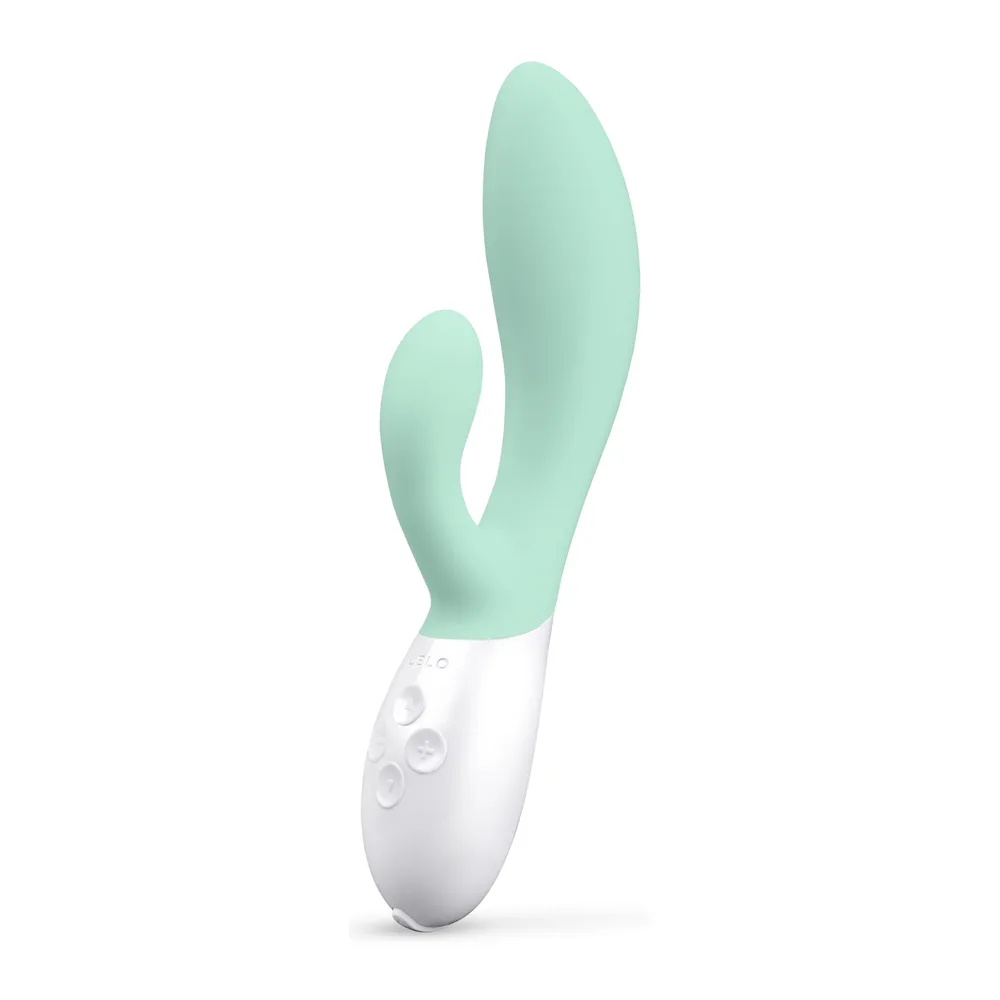
Lelo Ina 3 is the third generation of the brand’s best-selling rabbit vibrator. The shape is the same as before: a curved, insertable arm for the G-spot and a shorter, standalone arm that rests on the outside against the clitoris, with two motors that work simultaneously. The manufacturer calls the construction a double-acting massager rod, and it’s this simultaneity that’s the whole point of the product category.
The specification looks like this according to Lelo: body-friendly silicone and ABS plastic, dimensions 200 × 65 × 45 millimeters, insertable length 110 millimeters, diameter 37.09 millimeters, weight 150 grams, ten vibration settings, one interface with four buttons, frequency 60 hertz, a 3.7 volt lithium-ion battery, two hours charging time, up to two hours of operating time and up to 90 days of standby. The product is stated to be 100 percent waterproof and switches off automatically after 20 minutes without any button press. In Sweden, the item is sold by five stores at prices between 1,259 and 1,695 SEK, and two of them had it in stock at the price check on July 29, 2026.
This review is exclusively about the light green variant with EAN 7350075028304, the color Lelo calls Seaweed. The model is manufactured in three colors, and each color has its own EAN: Coral is 7350075028298, Seaweed is 7350075028304, and Seafoam is 7350075028311. The mapping between the numbers and the colors can be read from the variant tables on both Lekosmek and Taboo, and Sexonic lists the same number in its EAN13 field on the Seaweed page. Functionally, the colors are identical, but several Swedish stores sell all three under the same product page, so check the number before comparing prices.
A rabbit vibrator is a two-part product: an insertable part that is directed toward the front vaginal wall and an outer arm that rests against the clitoris. The name comes from the fact that the outer arm on the earliest models was shaped like a rabbit head with two ears. The point is that both areas are stimulated at the same time without you needing to hold two products, and that is also why the fit is crucial in a way that it isn’t for a simple wand: if the spacing between the arms doesn’t match your anatomy, it won’t help more vibration modes.
What sets Ina 3 apart from a generic rabbit is primarily three things that can be substantiated in the manufacturer’s own information. The first is that the arms are fixed relative to each other—there is no joint or adjustment; instead, the angle is molded. The second is that the handle is made of ABS plastic while the entire body-hugging part is silicone, which gives you a stiff base to hold onto and a soft top. The third is that Lelo states 30 percent more power than the predecessor and that the number of modes has been increased to ten, which is the only commitment the manufacturer makes about whether the generation change is actually noticeable.
What can be established about the power claim in particular is that it is relative, not absolute. Thirty percent more than Ina 2 says nothing about how the product compares to a competitor, because Lelo does not publish any measurement of amplitude, motor power, or vibration strength either on the product page or in the manual. The frequency of 60 hertz is the only technical figure about the vibration itself that the manufacturer states, and that number says something about the character of the vibration—60 hertz is a comparatively fast, superficial vibration rather than a slow, deep rumble—but nothing about how hard it strikes.
Lelo’s naming for the Ina series is confusing in a way that costs money if you get it wrong, since two of the models have exactly the same outer dimensions and almost the same price.
So the difference between Ina 3 and Ina Wave 2 is not the size, not the material, and not the battery—Lelo lists the same charging time, the same operating time, and the same standby for both. The difference is that the Wave model adds mechanical motion in addition to the vibration. If you just want vibration in two directions, Ina 3 is the simpler and cheaper route to get there. If you want motion, don’t buy Ina 3 and then be disappointed.
The material issue is the only characteristic of an intimate product that can’t be compensated for with experience or care, and it determines whether the product is still hygienic after five years. Lelo lists two materials for Ina 3: body-friendly silicone and ABS plastic. That’s a more honest job than the only material line that several retailers print, but it requires a clarification to be useful.
The manufacturer does not break down the materials piece by piece in its specifications, but the breakdown can be read directly from Lelo’s own product images: the colored part—the entire insertable arm and the entire clitoris arm—is silicone, while the white, tapering grip with the four buttons is hard plastic. That means that everything intended to rest against mucous membranes is silicone, and that the plastic is where the hand holds it.
It’s a more important distinction than it sounds. Silicone is a non-porous material, and a non-porous surface can be cleaned because there are no microscopic cavities where residue can get trapped. ABS is also non-porous, but it’s hard and doesn’t absorb body heat in the same way. In practice, the part that’s meant to feel soft does, while the grip keeps its shape when you press—this is what the design is built around. The comparison is straightforward with the We-Vibe Nova 2, which is made entirely of silicone and is therefore soft even in the grip: softer in the hand, but at the same time without the rigid base that lets you press a fixed angle against the body.
The seam between the silicone and the plastic is the only point in the construction that deserves attention when cleaning. The transition is molded and sits a bit above the buttons, and that’s where traces of lubricant collect if the product is just wiped off instead of being rinsed. Since the entire product is waterproof according to the manufacturer, it’s not a practical limitation—just a reminder of where to look.
Phthalates are a group of plasticizers used to make plastic—above all, soft PVC—pliable. The Chemicals Agency (Kemikalieinspektionen) describes them as substances that can affect the endocrine system and make reproduction more difficult, and several of them are therefore restricted or banned within the EU in a large number of products. The category of sex toys is a recurring subject of oversight precisely because it contains soft plastic that stays in contact with skin and mucous membranes.
Here, the information has to be precise. Lelo doesn’t state the words “phthalate-free,” “BPA-free,” or “latex-free” on the product page for the Ina 3, and not in the online manual either. What the manufacturer does state is, on the one hand, that the material is body-friendly silicone and ABS plastic, and on the other hand that the product meets the international standard ISO 3533, which Lelo describes as a guarantee that the production materials are safe for contact with genitalia. This is a different kind of commitment than a materials declaration: it refers to a standard instead of listing excluded substances.
The retailer Vuxen goes further than the manufacturer and states the material as “100% Premium Silicone,” as well as “body-safe and free from phthalates.” So that wording is said by the store, not by Lelo, and it’s also incomplete on one point: the manufacturer explicitly lists two materials, silicone and ABS plastic—not one hundred percent silicone. Objectively speaking, though, the store is still on the right track regarding the phthalate issue itself: silicone doesn’t require phthalate plasticizers to be soft, because the softness comes from the polymer’s own structure, and ABS is a hard thermoplastic that isn’t softened with phthalates either. But if you want it in black and white from Lelo, you’ll have to settle for the reference to ISO 3533.
Lelo states the outer dimensions as 200 × 65 × 45 millimeters, an insertable length of 110 millimeters, and a diameter of 37.09 millimeters. The weight is listed as 150 grams, and the manual specifies it to weight (only product) — meaning the product by itself, without packaging, cable, and pouch. This is a welcome clarification; many manufacturers provide a weight figure without stating what is included, and the difference between product weight and shipping weight can be several hundred grams.
What those measurements mean in practice can be calculated. A diameter of 37.09 millimeters corresponds to a circumference of roughly 116 millimeters, which places the insertable arm in the upper half of the category but far from the extremes. Eleven centimeters of insertable length is a medium length chosen to reach the front vaginal wall rather than for deep penetration — it’s a G-spot product, not a length product. At the same time, the total length of 20 centimeters means that about nine centimeters are always outside the body, and that’s where both the clitoral arm and the grip are meant to fit.
The width of 65 millimeters is the measurement between the outer edges of the two arms, and it’s that figure that determines whether the product fits. If the distance is wrong for your anatomy, the clitoral arm will either sit too high or be pushed out when the insertable part is in place. There’s no adjustment on Ina 3, and that’s by far the biggest risk when buying a rabbit vibrator without being able to try it out.
Looking at it from a comparison perspective puts the dimensions into context. Lelo Ina Wave 2 has exactly the same outer dimensions and the same insertable length, but it weighs 176 grams, i.e. 26 grams more, which is the weight of the extra mechanism. We-Vibe Nova 2 measures 217 × 85 × 39 millimeters, so it’s both longer and noticeably wider between the arms, but it’s a bit thinner. That Nova 2 is 20 millimeters wider isn’t a minor detail—it’s the entire difference in who the product will suit.
The interface on Ina 3 consists of four buttons on the white grip, and the manufacturer’s manual names them: a plus button and a minus button for intensity, as well as two arrow buttons for stepping between the ten vibration patterns. There’s no separate on/off button — the plus button does that job. Four buttons is one step simpler than the sibling model Ina Wave 2, which has five, and one step more advanced than the two-button products that dominate the cheaper end of the category.
The product is delivered locked for transport. According to the manual, you unlock it by holding down plus and minus at the same time for three seconds until the light turns on, or alternatively by connecting the charger. After that, you start it with a press of the plus button, increase the intensity with more presses of the same button, reduce it with the minus button, and turn it off by holding the minus button pressed. The arrow buttons switch between the ten patterns.
Here there’s a discrepancy in the manufacturer’s own material that’s worth knowing before you get irritated with the product. The section “Getting Started” states three seconds to unlock the interface, while the troubleshooting section further back in the same manual says you should hold down plus and minus for five seconds if the interface is locked. So the manual indicates two different times for the same action. The practical advice is simple: keep the buttons pressed until the light responds, not for a specific number of seconds.
The transport lock itself is a well thought-out detail that more manufacturers should have. A product that can’t start on its own in a bag is both quieter and more power-efficient, and Lelo has also added automatic shut-off after 20 minutes without a button press. That limit is short—shorter than the stated operating time of two hours—and it’s intentional: 20 minutes is a safety shut-off against the product being forgotten turned on, not a usage limit, since every button press resets the counter.
Ten modes sound like a lot, and it’s more than most people use. Lelo describes the range as an interval from a teasing hum to a satisfying pulse, but it doesn’t publish a table of what each individual mode does—there’s no listing of which ones are steady vibrations, which are pulsing, and which are rising, either on the product page or in the manual.
What you can confirm is the structure: intensity and patterns are two independent controls. You choose patterns with the arrow buttons and strength with plus and minus, and that means the number of combinations is more than ten. It’s a better solution than the usual one-button design where each press changes both the pattern and the intensity at the same time, because you can keep a pattern you like and only turn it up. In this product category, the standard pattern is that the steady vibrations are used the most, and that the pulsing programs are tried once and then rarely again.
One more thing belongs here. Ina 3 has two motors, one in each arm, but the interface controls them together. There’s no way to run the clitoral arm at high strength and the insertable one at low, which is a real functional limitation compared with the more expensive products that have separate controls. If you want that kind of control, Ina 3 isn’t the product.
The question of how quiet a vibrator is is among the most common concerns before buying, and that’s where the answer has to be honest: Lelo publishes no measured decibel value for Ina 3, either on the product page or in the online manual. The only figure that relates to sound at all is the frequency of 60 hertz, and it describes the vibration’s rhythm, not how much sound it produces.
The retailer Lekosmek describes the motor as quiet in its product text, but it’s a shop phrasing with no measurement behind it, and it shouldn’t be read as a specification. Websites that state an exact decibel value for Ina 3 either present their own measurement or a value with no source from the manufacturer.
What you can, however, discuss is the design. A dual vibrator with two motors in one housing where one half is hard plastic has more sound paths than a single silicone wand, because plastic conducts sound better than silicone. At the same time, both motors are inside the silicone body and not in the plastic part, which seems to go the other way. Without a measurement, that’s speculation, and that’s why this line is left blank in the specification table instead of being filled with a number.
A practical tip that applies regardless of model: place the product on a soft surface between uses, and avoid letting it sit and vibrate on a hard tabletop. The tabletop acts as a resonance box and amplifies the sound significantly more than the difference between two models does.
Lelo states that Ina 3 is 100 percent waterproof, and the manual repeats it with the addition that the product is therefore easy to clean: rinse off, spray with a cleaning agent for intimate products, rinse again, and let it dry. The manufacturer also writes that the silicone can be washed with warm water and antibacterial soap.
The wording “100 percent waterproof” is marketing language, not a technical classification. Lelo provides no IP rating for Ina 3 — neither IPX7 nor any other value — on either the product page or in the manual. This is a real difference compared with, for example, We-Vibe Nova 2, which is explicitly stated to be IPX7-rated, because an IP rating according to the standard IEC 60529 is tied to a specific test: IPX7 means immersion to a depth of one meter for 30 minutes, while IPX5 only means protection against water jets.
The difference between the two is decisive in practice. IPX5 covers showers and rinsing off but not bathtubs. IPX7 covers immersion. The fact that a manufacturer writes “completely waterproof” without stating a class doesn’t mean the product is worse, but it does mean that the promise can’t be checked against a test — and that’s exactly the kind of information a comparison should present as missing instead of guessing.
The question is made even more complicated by the fact that one of the Swedish shops states a rating on its own. Taboo writes “Water-resistant IPx5: Yes” in its specification table. That information comes from the shop, not from Lelo, and it is stricter than the manufacturer’s own wording. If you go by the shop, the product shouldn’t be submerged in a bathtub; if you go by the manufacturer, it doesn’t matter. In a conflict like this, the manufacturer wins, but the discrepancy is worth knowing if you specifically want to use the product in the bath.
The manual’s instructions are unusually specific and are worth quoting. Rinse off the product and spray it with a cleaning agent intended for intimate products, rinse again and let it dry. Alternatively, the silicone is washed with warm water and antibacterial soap, rinsed with clean hot water and dried with a lint-free cloth. Lelo explicitly states that cleaning agents containing alcohol, gasoline, or acetone must never be used.
The lubricant question is answered just as clearly. The manufacturer writes that hand creams and silicone-based lubricants can make the silicone permanently sticky. That’s exactly what happens: silicone-based lubricant attacks the silicone surface over time and makes it sticky and, eventually, porous, and a porous surface can no longer be cleaned properly—only replaced. Water-based lubricant is the only one that doesn’t affect the material. Oil-based products such as coconut oil also leave a film that’s difficult to remove.
For storage, Lelo states that the product should be kept away from direct sunlight, never exposed to extreme heat, and stored dust-free and separately from products of other materials. The last point isn’t a formality: silicone that rests against certain soft plastics can react and become sticky at the contact surface. The satin pouch included in the packaging solves the problem and is the reason it’s there.
The manual also covers two safety points that are rarely found in store texts. Anyone who is pregnant, has a pacemaker, diabetes, phlebitis, thrombosis, or any other condition should consult healthcare about the risk of blood clots before a massage product is used. And according to the manual, the product should only be powered with protective low voltage—that is, via the included charger and not via improvised power supplies.
Lelo lists the operating time as up to two hours and the charging time as two hours at 5.0 volt and 500 milliampere. Standby time is given as up to 90 days, which is the figure that practically determines whether the product is charged when you want to use it. Two hours of operation is in the middle of the category: We-Vibe lists 120 minutes for Nova 2 and charges it in 90 minutes, meaning the same operating time but charging that’s half an hour faster.
Charging is done via the included USB cable that ends in a round DC connector. The manual describes the procedure: you insert the DC connector into the DC port at the bottom of the product, after which the LED on the interface pulses while charging and stays on with a steady glow when the product is fully charged after about two hours. When the battery starts to run out, the LED flashes red. The manufacturer explicitly states that only the original charger from Lelo may be used.
The charging solution is the clearest weakness in the design in terms of everyday use. Ina 3 is not charged via USB-C or a magnetic contact, but with a product-specific DC plug, and that means three things. First, there is a physical opening in the housing, unlike magnet-charged competitors. Second, no regular phone cable works as a replacement—if you lose the cable, you have to get a new one from the manufacturer. Third, the charging cable is a consumable part, which according to Lelo’s warranty terms falls under the wear-and-tear exception rather than under the warranty. For comparison, We-Vibe Nova 2 charges with a USB cable that fits any USB port or any standard power adapter.
There is a discrepancy in Lelo’s own material that deserves to be pointed out. The product page for Ina 3 lists the battery as Li-ion 500 mAh 3.7 V. The online manual for the same product lists Li-Ion 520 mAh 3.7 V. So there are two different capacities from the same manufacturer for the same model, and both documents are published by Lelo themselves.
The difference of 20 milliampere-hours is four percent and has no practical significance for runtime, but it says something about how specifications in this industry should be read. An indication of which value is the correct one: the sibling model Ina Wave 2, which shares the body with Ina 3 down to the millimeter, is listed by Lelo as 520 mAh on its product page. Since the manual and the near-identical model say 520 while the product page says 500, it is reasonable to assume that 500 is a rounding or a typing error—but since the manufacturer has not corrected either of them, both values are shown in the specification table below.
What generally applies to lithium-ion batteries also applies here: capacity decreases with the number of charging cycles, and the product does best when it is charged regularly rather than stored completely discharged. The stand-by time of 90 days means that one charge every three months is enough for the product to always be ready. Lelo does not state whether the battery is replaceable, and the manual also states that any attempt to open the product voids the warranty—which in practice means that the cell should be considered permanently installed, and that the product’s lifespan is the battery’s lifespan.
We do not have price data from shops in your market yet.
The product page says 500 mAh. The manufacturer’s own manual says 520. Both are published by Lelo, and neither of them has been corrected.
Two comparisons are relevant: against Lelo’s own more expensive sibling model and against the best-selling rabbit vibrator from a competing premium brand. All information below comes from the respective manufacturers’ own specifications.
Ina Wave 2 is the closest competitor, and it comes from the same manufacturer. The dimensions are identical down to the decimal point: 200 × 65 × 45 millimeters, 110 millimeters insertable and 37.09 millimeters in diameter. The materials are the same — body-friendly silicone and ABS plastic — and the frequency is the same, 60 hertz. Charging time is stated as two hours for both, operating time as up to two hours for both, and standby time as 90 days for both. What’s included in the delivery is the same: the product, USB charging cable, satin pouch, warranty card, and user manual.
According to the manufacturer, three things set them apart. Ina Wave 2 has an insertable arm that moves in a wave motion toward the front vaginal wall — a function Lelo calls WaveMotion — in addition to the vibration. It has twelve modes instead of ten and a five-button interface instead of four. And it weighs 176 grams versus 150, so 26 grams more, which is the mechanical weight. The battery is also stated as 520 mAh on Wave 2’s product page, the same figure that Ina 3’s manual states but not the same as Ina 3’s product page states.
The conclusion is more straightforward than in most model comparisons. If it’s the motion you’re after, there’s no shortcut — that function is only available on the Wave model, and Ina 3 will never become that product. If it’s not the motion you’re after, you get the same body, same material, same battery life, and the same water-tightness assurance in the simpler model, with two modes and one fewer button.
We-Vibe Nova 2 is the rabbit vibrator most often compared to Ina 3 in the premium segment, and the two differ in a way that makes the choice quite clear.
Nova 2 measures 217 × 85 × 39 millimeters. So it is 17 millimeters longer and a full 20 millimeters wider between the arms than Ina 3, but 6 millimeters thinner. The material is listed as body-friendly silicone made without phthalates, BPA, and latex — meaning both all-silicone and an explicit declaration of excluded substances, two things Lelo does not state for Ina 3. The enclosure class is stated as IPX7, which is a test value that can be verified rather than the wording “100 percent waterproof.” Operating time is stated as up to 120 minutes and charging time as up to 90 minutes, meaning the same operating time as Ina 3 but faster charging, and charging is done with a USB cable that fits any USB port. Nova 2 also has app control via We-Vibe’s own app, including remote control. The warranty is two years, the same as Lelo’s.
What the Ina 3 has that Nova 2 doesn’t is the smaller and narrower body, the rigid plastic base that provides a firm grip, a published battery capacity in mAh, and a published vibration frequency. What Nova 2 has that Ina 3 doesn’t is a flexible clitoral arm that moves with you, a verifiable IPX rating, a complete materials declaration, app control, and a standard USB charging. If you choose based on the reported data and charging convenience, We-Vibe wins. If you choose based on size, ease of use, and not having to use an app, Lelo wins.
This is the product in its price range where the information from Swedish stores diverges the most, and because conflicting information in itself is a result, it is presented here instead of being washed away. The rule is simple: if one store goes against the manufacturer, the manufacturer wins, but the deviation is noted.
Taboo states in its specification table the weight 348 grams, the charging time about 300 minutes, the usage time about 90–120 minutes, and the enclosure rating IPx5. Three of the four pieces of information deviate from Lelo, which states 150 grams, a 120-minute charging time, and up to 120 minutes of operating time without an IP rating. The weight figure of 348 grams is likely a shipping weight or a weight including packaging—Lelo’s manual specifies its 150 grams to apply only to the product—and the charging time of 300 minutes has no equivalent in the manufacturer’s materials.
Lekosmek writes that the charging time is 120 minutes, which matches the manufacturer, but that the usage time is about 90 minutes, which is half an hour shorter than Lelo’s “up to 2 h”. The shop also states its own item number K8441H.
Vuxen is closest to the manufacturer and writes that two hours of charging gives two hours of use, but at the same time leaves out a materials detail that Lelo does not: “100 % Premium Silicone” and “phthalate-free.” The shop lists the item number L8441 and confirms that the USB charging cable, storage pouch, and user manual are included.
Joyme reproduces Lelo’s specifications list closest to verbatim in Swedish, including 500 mAh, 60 hertz, and a 37.09 millimeter diameter, and is therefore the shop whose product page is the most useful as source material. Sexonic does not publish a specification table but provides EAN13 7350075028304 in its data field, which is the check that links the article to the correct color.
The conclusion for you as a buyer: read the specification from Joyme or from Lelo, not from the shop that happens to have the lowest price. The difference between 150 and 348 grams is not a detail but the difference between a product you hold with two fingers and one you hold with your whole hand—and in this case, it’s the lower figure that’s correct.
Five Swedish stores list the item with EAN 7350075028304. The lowest price is Lekosmek at 1,259 SEK, and the highest is Vuxen at 1,695 SEK. That’s a difference of 436 SEK, or 35 percent, for exactly the same item number, the same color, and the same packaging.
The stock situation is at least as important as the price spread here. Only two of the five stores had the product in stock at the price check on July 29, 2026: Joyme at 1,599 SEK and Vuxen at 1,695 SEK. This means that the difference between the cheapest and the second-cheapest actually available copies is 96 SEK, not 436. The three lower prices at Lekosmek, Taboo, and Sexonic remain in the price feeds for items that were out of stock, and a price in a feed for an out-of-stock item is rarely the price that applies when the item is back in again.
The price spread is not because one store sells a different variant. All five list the item either under EAN 7350075028304 or under their own item number tied specifically to Seaweed—Lekosmek uses K8441H, Vuxen uses L8441, and Sexonic uses the EAN number directly. That comes down to each store’s own margin setting, and in this price range it’s worth a few minutes of comparison before you pay.
The prices in the table above are updated when the stores’ product feeds are updated, but always check the final price at checkout. Shipping costs are added at most stores under a certain order value, and in this price range both of the stores that have the item in stock are likely over the threshold for free shipping—which makes the 96 SEK the entire difference.
It’s for you if you want simultaneous stimulation of the G-spot and the clitoris in a product that’s easy to control, with two independent controls for patterns and strength instead of a single button that changes everything at once. It’s for you if you want a firm base to hold onto and prefer a narrower rabbit—65 millimeters between the arms compared to We-Vibe Nova 2’s 85. It’s for you if you want to be able to rinse off the entire product under running water, and you who want to skip an app entirely.
It’s not for you if you want movement and not just vibration—that’s the right product within the same brand, Lelo Ina Wave 2, with exactly the same outer dimensions. It’s not for you if you require a published IPX rating or a measured decibel value before purchase, because Lelo does not publish either of those for this model. It’s not for you if you want to control the two motors separately. And it’s not for you if you want to charge with the same cable as your phone: the DC plug is product-specific and requires the original charger.
One more thing belongs in the decision. The fit of a rabbit vibrator is individual in a way that no specification can solve. The measurements 65 millimeters in width and 110 millimeters insertable are fixed; the arms are cast at their angle, and there is no adjustment. If you’re unsure whether that geometry will work for you, it’s that question you should ask yourself — not whether ten settings are enough. Also, the right of withdrawal for distance purchases is in practice limited for this product category as soon as the seal has been broken, which makes the pre-assessment more important than usual.
Lelo’s product page states a two-year warranty counted from the purchase date, with the addition that you can report a fault within that time and receive a free replacement product if you saved the receipt. The warranty terms for the EU specify that the warranty is worldwide, that it covers defects in materials and workmanship that affect function, and that it requires you to register the product’s serial number on an account with Lelo.
The online manual for Ina 3, however, states a one-year limited warranty, not two, and refers to the warranty being activated by registering the number on the included authenticity card. The manual is dated 2021 and likely describes an older set of terms than the one that applies today, but the discrepancy is found in the manufacturer’s own material and is worth knowing if you get the manual in your hands and are wondering. In case of a conflict between the product page and an older manual, it is the current warranty terms on lelo.com that apply.
The so-called ten-year quality warranty deserves a clarification, because it’s cited often in store texts and sounds like a ten-year warranty. According to Lelo’s own terms, it is not a warranty but a discount: if you discover a fault after the two warranty years, or if you lack proof of purchase, you are offered 50 percent off a new product in Lelo’s own web shop. The benefit can be used once, is limited to five items per order, and excludes packages and the Luxe assortment. So you get no repair and no replacement product—only a discount code—and it applies only in Lelo’s store, not at any of the five Swedish stores mentioned above.
Also read the exclusions in the standard warranty before you count on it. It does not cover cosmetic wear, damage caused by accidents, misuse, or neglect, and any attempt to open or disassemble the product or its accessories voids the warranty. Since the battery sits inside a housing that is not allowed to be opened, it practically means that a drained battery after the warranty period ends is the end of the product.
What always applies, however, are your statutory rights. Under the Swedish Consumer Sales Act (konsumentköplagen), you have three years to make a complaint if the product is faulty—regardless of what the manufacturer promises—i.e., one year longer than Lelo’s own warranty. For purchases made at a distance, you also have a right of withdrawal for fourteen days under the Act on Distance Contracts and Contracts Outside Business Premises (lagen om distansavtal och avtal utanför affärslokaler). Be aware that, in practice, the right of withdrawal is limited for hygiene products that have been taken out of a sealed package—however, the right to complain for defects always applies. If you have questions about what applies in your case, Konsumentverket guides you via Hallå konsument.
Lelo Ina 3 Rabbit Vibrator Seaweed isn’t included in any ranking yet. In best i test guides, the entire categories are compared against each other using five shared criteria, with what was left out shown.
Every numerical piece of information in the text can be traced to one of the sources below. The links were checked manually on the specified date.
This page is machine-translated from Swedish. Read the Swedish original