

Review
Review: Satisfyer Pro 2 Next Generation
Cheapest of the widely sold — 219 SEK, IPX7, and a 15-year warranty.
29 July 2026
Review · Rabbit vibrator · Battery-powered
Pretty Love Alvis battery-powered rabbit vibrator reviewed against the manufacturer’s own specifications and price data from four Swedish stores. Thirty vibration functions, two separate motors, 200 millimeters total with a 100-millimeter insert, silicone and a 117 gram net weight — but the manufacturer does not publish any ingress protection rating, run time, sound level, or warranty time.
An inexpensive entry-level model in rabbit format with thirty vibration functions, two motors, and a silicone surface over the entire body-hugging section. The manufacturer’s dimension sketch is unusually clear — 200 millimeters total, 100 millimeters insertion part, and 33 millimeters in width — but otherwise the specification is sparse. No ingress protection rating, no run time, no sound level, and no guarantee period are published, and several stores list dimensions and weights that contradict both the manufacturer and each other. The clitoral arm is fixed at a molded angle, which determines whether the design suits you or not.
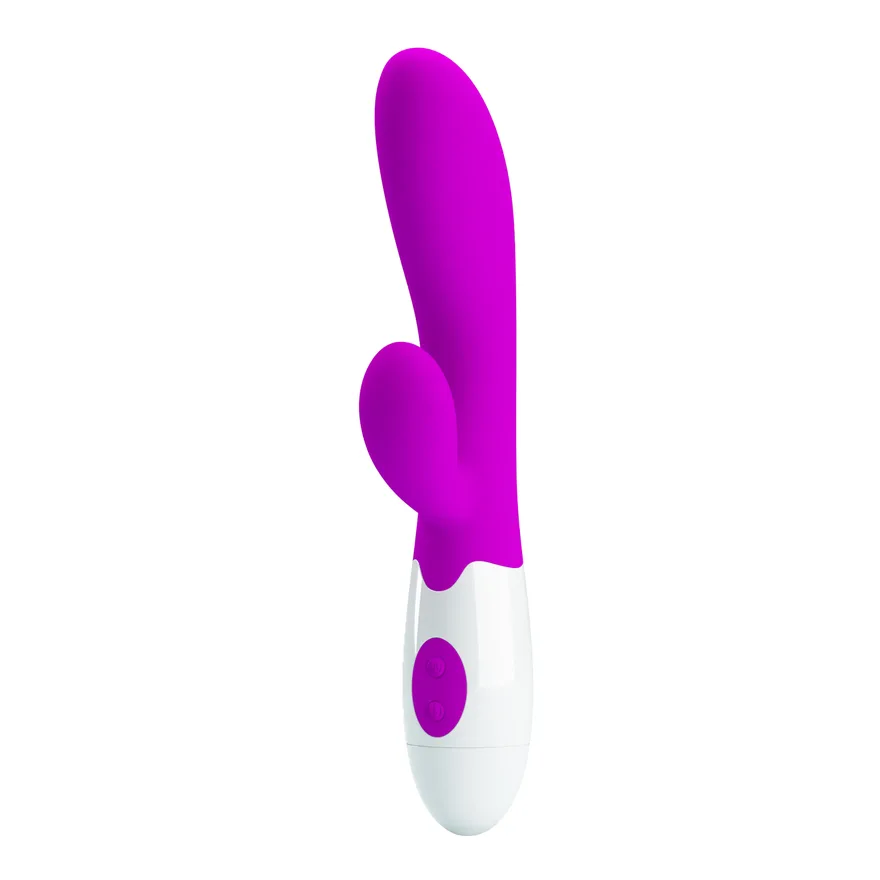
Pretty Love Alvis is a battery-powered rabbit vibrator in silicone with two separate motors and thirty vibration functions. It’s in the absolute entry-level range: no app, no charging cable, no rechargeable battery, and no display — just two buttons, a curved shaft section, and a shorter arm designed to sit against the clitoris while the shaft is inserted.
The specification looks like this according to the manufacturer: thirty vibration functions, the material is silicone, power supply is two AAA batteries, and a net weight of 117 grams. The manufacturer’s own dimension sketch states a total length of 200 millimeters, an insertion part of 100 millimeters, and a width of 33 millimeters. The package measures 210 × 80 × 40 millimeters. In Sweden, the item is sold by four retailers at prices between 222 and 295 SEK, and two of them had it in stock at the price check on 12 September 2026.
This overview is about the item with EAN 6959532313369. The number is verified against the manufacturer’s own product page, where model number BI-014263 is listed with the exact barcode. All four Swedish retailers sell the same item under that number, despite the fact that they call it four different things — which is the first warning sign about how little is actually documented about this product.
The second thing worth saying right away is what the manufacturer does not publish. There is no ingress protection rating, no sound level, no information on how long a pair of batteries lasts, no warranty period, and no statement about phthalates, BPA, or latex. It’s four to five lines that a European premium manufacturer normally includes, and they are all missing here. This does not automatically mean the product is worse, but it does mean that several of the claims circulating in the retail chain cannot be traced back to anyone responsible for them.
A rabbit vibrator is a vibrator with two parts that work simultaneously: a shaft that is inserted and stimulates internally, and a shorter arm that lies on the outside against the clitoris. The name comes from the early models where the outer arm was shaped like a rabbit head with two ears. The point of the design is that both contact points are stimulated in the same motion instead of requiring two products or two hands.
The manufacturer states that Alvis has two motors and describes them as separate: one in the shaft and one in the clitoral arm. It is a technical difference from simpler designs where a single motor sits in the handle and the vibration is transmitted throughout the entire body. With two motors, the source of the vibration is located close to the respective contact surface, which means the energy does not need to pass through a long silicone body before it reaches its destination. What can therefore be confirmed is that the design is the right one for the purpose—however, the manufacturer does not publish how powerful the two motors are in absolute terms.
The manufacturer’s own description is worded like this: an insertion shaft for G-spot vibration and a vibrating arm toward the clitoris, with thirty vibration functions and a satin-matte silicone surface. That is the entire functional description provided by the manufacturer. Everything else that appears in Swedish shop texts is the retailers’ own wording.
It gets complicated here, and it’s worth sorting it out before you compare prices. The same item is sold in Sweden under four different product names:
The manufacturer doesn’t call it either name. It’s listed as item BI-014263 under the brand PRETTY LOVE, made by Liaoyang Baile Health Care Product Co., Ltd. The name Alvis does show up, though, printed on the manufacturer’s own packaging, along with the lines "30 functions of vibration" and "Silicone". So the name is real—it’s just not what the catalog sorts under.
Two details in the retail chain deserve a note because they are directly misleading. Sexonic lists the brand field "HIGH TECH" instead of Pretty Love, which means the item doesn’t show up when you filter by the brand. And Taboo, which otherwise describes the product correctly as battery-powered with two AAA cells, has at the same time tagged it as "Rechargeable Vibrator" on the same page. Alvis is not rechargeable. It has no built-in battery and no charging contact, which is shown both in the manufacturer’s power supply line and in the manufacturer’s own image of the battery compartment. Anyone searching for "rechargeable rabbit vibrator" and ending up here will be disappointed on a point that could have been avoided.
The material question is the only property of an intimate product that cannot be compensated for with experience or care. It determines whether the product is still hygienic years from now, and it determines which lubricants may be used. The manufacturer specifies a single material type for Alvis: silicone.
Silicone is a non-porous material. A non-porous surface can be cleaned, because there are no microscopic voids where residue can get trapped. It is the single most important property of a material that is meant to sit against mucous membranes, and that is why the material declaration weighs more heavily than almost every other line in a specification. Silicone also does not require phthalate plasticizers to become soft—softness comes from the polymer’s own structure—which makes the word silicone by itself a better indication than labels like TPE or jelly rubber, which don’t say anything at all about which plasticizers are included.
At the same time, the manufacturer’s specification is minimal. It says “Silicone” and nothing more. No breakdown of materials by individual part is published by the manufacturer. What can be established from the manufacturer’s own product images is that the colored part—the shaft and the clitoral arm, meaning everything that has contact with the body—is matte silicone, while the handle at the bottom is glossy, white hard plastic with two raised buttons and a detachable end cap. It’s the same build as on most battery-powered vibrators in this price range: silicone where it matters, plastic where the batteries sit.
Taboo describes the surface as “satin-matte silicone,” which matches the manufacturer’s own wording about a satin finish. A matte silicone surface has a practical consequence: it provides more friction against dry skin than a glossy surface, and it attracts lint and dust if the product is stored unprotected. It’s an argument for putting it in a bag in the box rather than leaving it loose.
Phthalates are a group of plasticizers used to make plastic, especially flexible PVC, pliable. Kemikalieinspektionen describes them as substances that can affect the endocrine system and make reproduction more difficult, and several of them are therefore restricted or banned within the EU in a large number of products. This product category is repeatedly the subject of oversight, because it contains flexible plastic against skin and mucous membranes.
The manufacturer publishes no declaration about phthalates, BPA, or latex for BI-014263. Not on the product page, not on the packaging, and not in the image material. That is a clear difference compared to We-Vibe, which for Nova 2 expressly states that the material is made without phthalates, BPA, and latex. The absence of a declaration is not proof that something unwanted is included — as mentioned, silicone needs no plasticizers — but it means that you have no document to rely on if the question becomes relevant.
For anyone who is allergic to latex, it’s worth knowing that the latex information is completely missing. Latex allergy causes reactions in the mucous membranes faster than on regular skin, and an intimate product is therefore exactly the type of use where this information matters. If you’re allergic and want that information in writing, it’s a reason to choose a manufacturer that actually writes it down.
The manufacturer’s own dimension sketch is the most useful part of the entire material. It states three measurements: 200 millimeters from the tip to the bottom, 100 millimeters for the upper part down to the clitoral arm attachment — in other words, the insertable part — and 33 millimeters for the shaft’s width at the widest point.
In practice, that means that about half of the product’s length is the handle and battery compartment. Twenty centimeters total sounds like a lot, but it’s ten centimeters that are inserted, and that’s a modest figure in the category. A diameter of 33 millimeters, on the other hand, is not modest: that corresponds to a little over three centimeters, which for many is at the upper end of what feels comfortable without warming. Compared with Lelo Ina 3, which the manufacturer lists as 110 millimeters insertable part and 37.09 millimeters diameter, Alvis is therefore one centimeter shorter and four millimeters narrower — in other words, the two models are in the same size class despite the price tags not reflecting that.
Here, the first real conflict in the information arises, and it’s worth taking seriously. The retailers’ measurements don’t match the manufacturer’s, and the retailers’ measurements also don’t match each other. Blush Me lists 20.00 centimeters total length, 11.00 centimeters insertable length, and a diameter of 3.50 centimeters in both the min and max fields. Lekosmek lists about 20 centimeters and about 3.3 centimeters. The wholesaler Wasserman lists 20.5 centimeters total, 10.5 centimeters insertable, and up to 3.3 centimeters. The manufacturer states 200, 100, and 33 millimeters. So the spread is one centimeter in insertable length and two millimeters in the diameter.
The rule in such cases is simple: the manufacturer wins. Count on a total of 200 millimeters, 100 millimeters being insertable, and 33 millimeters in width. That Blush Me says that 11 centimeters are insertable and 3.5 centimeters in diameter is a store claim that is higher than the manufacturer’s own drawing, and anyone who buys based on exactly those numbers risks being surprised in the wrong direction.
The manufacturer states the net weight as 117 grams. That figure refers to the product as packed, i.e. without batteries, since batteries are not included.
Two stores publish their own weight in their product listings, and both differ. Lekosmek lists 100 grams, while Taboo lists 80 grams. It’s likely that shipping weights have been added as a standardized estimate rather than actual weighed product weights, but the difference between the stores’ own figures—20 grams, i.e. one fifth—shows how little that kind of store data is worth. Use the manufacturer’s 117 grams and nothing else.
A practical calculation exercise that actually means something: according to Energizer’s datasheet, two alkaline AAA cells typically weigh 11.5 grams each. So, the product in use weighs roughly 117 plus 23, i.e. around 140 grams. It’s light in this category—Lelo lists 150 grams for the Ina 3 even though it has no removable batteries at all—and in practice that’s an advantage, since a rabbit construction is held in place by the wrist during longer stretches.
The manufacturer does not publish any color information in its attribute list. The manufacturer’s own product images and the packaging image show a lilac- or fuchsia-colored variant, while Blush Me and Lekosmek state the color as Pink, and the wholesaler Wasserman lists it as violet. It’s the same item number and the same barcode across all of them, so the difference lies in how each store has translated the color name—not in that there would be multiple variants under the same EAN.
The interface is as simple as it gets. The manufacturer’s own function image names the two buttons: the top one is labeled VIBRATION BUTTON and the bottom one ON/OFF. Both are on the front of the handle, in a raised colored plate that lets you find them without looking. There’s no display, no LED that indicates the mode, and no remote control.
In practice, that means the modes are stepped through in a single loop with repeated presses of the vibration button, and you can’t jump back. If you want to return to a mode you just passed, you have to go around the whole loop again. That’s the entire consequence of a two-button interface with thirty modes—and it’s something to think through before buying—not because it’s bad, but because it’s the trade-off the price is built on.
The on/off button turns the product on and off. The vibration button switches between the functions. Since, according to the manufacturer, the two motors are separate but only have one shared control, you do not control them independently of each other—each position in the loop is a ready-made combination of what the shaft and the arm do. That is the key difference versus more expensive rabbit models, which often have two sets of buttons or an app and thus let you run strong internal vibration against weak external vibration, or vice versa.
The manufacturer does not publish whether the product remembers the last used position when it is turned off, and it also does not provide any information about an automatic shutoff or any lock. A lock is worth missing: a battery-powered product with external buttons can turn itself on in a bag. The practical countermeasure is simple and costs nothing—unscrew the end cap and remove one battery when the product is being packed down.
Thirty is a big number on the packaging, and the manufacturer prints it both in the feature list and on the carton. What it does not mean is thirty intensity steps. In this product category, such a loop typically consists of a few even speeds followed by a large number of patterns: pulses, waves, stair-steps, and combinations of them. The manufacturer does not specify how the thirty functions are distributed between steady vibration and patterns, and none of the Swedish retailers do either.
The comparison with a product that lists its interface is enlightening. Lelo specifies ten settings for Ina 3—a third as many as Alvis—and yet it is still the more expensive and better equipped product. In other words, the number of modes is not an indicator of quality in this category, but a marketing number. What actually affects the experience is how many of the modes are steady speeds, and that number is not published.
Expect that in practice you’ll go back to three or four of the thirty. That’s the pattern across the entire product category, and it’s also why a model with ten well-chosen modes can be experienced as more useful than one with thirty.
The manufacturer’s images show that the clitoral arm is molded as one piece with the shaft, and that the angle between them is fixed. There is no hinge, no adjustment screw, and no bendable core that holds on to a new angle. The arm is short and rounded, without the classic rabbit ears.
This is the single most important fit question on every rabbit vibrator, and it’s the one that determines whether the design works for you or not. The distance between the sliding opening and the clitoris varies from body to body, and a fixed arm only fits if your anatomy matches the distance the designer chose. If it doesn’t fit, neither thirty settings nor two motors help. More expensive models solve this in different ways: We-Vibe builds Nova 2 with an arm that moves along as the shaft moves, and other manufacturers use flexible arms. Alvis has no such solution, and it’s the clearest functional limitation in the design.
What can be established from the measurements is that the arm sits 100 millimeters from the tip, meaning at half the product’s length. If you’ve previously tried a rabbit vibrator and felt that the arm ended up in the wrong place, the odds are high that it will be the same here, because the geometry can’t be changed.
The manufacturer does not publish any decibel value for Alvis—either on the product page or in the image material. None of the four Swedish stores states any measurement value either, and the wholesaler doesn’t either. Anyone who finds an exact decibel number for this model on some other website should ask themselves where the number comes from, since it doesn’t exist in any chain between the factory and checkout.
What can be established on a technical basis is that the design—two small eccentric motors in a housing that is partly hard plastic—is the loudest basic solution in the category. A rotating unbalanced weight generates more noise than a linear motor, and a plastic handle dampens worse than a full-silicone body. Add that the product also has a cavity at the bottom where two batteries sit loosely in a sleeve, and there is another source of noise that isn’t present on a product with a built-in battery.
A practical tip that applies regardless of the model: place the product on a soft surface between uses. A hard tabletop works as a resonance box and noticeably amplifies the sound. If you need a product that is documented to be discreet, that information simply isn’t available for Alvis—and then it’s the wrong product to choose.
This is the most important point in this review, and it needs to be said plainly. The manufacturer states no enclosure rating at all for BI-014263—neither IPX4, IPX6, IPX7, nor even the word waterproof. The attribute list includes function, material, power supply, packaging dimensions, barcode, and number per carton. Nothing about water.
At the same time, several parties further down the chain claim that the product is waterproof. The wholesaler Wasserman writes “Waterproof: Yes” in its specification, and several foreign retailers repeat the same thing. None of them states any rating or any test conditions. According to the order we apply in all reviews, the manufacturer wins when the statements conflict, and the manufacturer says nothing here—which means that the claim of waterproofness is not supported upstream.
Enclosure classes are defined in the international standard IEC 60529. The second digit in an IP marking describes protection against water, and the differences are not small: IPX4 covers splashes from all directions, IPX6 powerful water jets, and IPX7 submersion to a one-meter depth for thirty minutes. So the difference between a product that can handle splashes and one that can handle a bath is not a matter of degrees—it’s three separate test levels.
If the rating is completely missing, the product should be treated as not waterproof. The absence of information is never a sign that the product has been approved—it only means that nobody has taken responsibility for promising anything. There’s also a design detail that calls for caution just here: the battery compartment is opened with a removable end cap, which you can see in the manufacturer’s own image. A seam that the user opens and closes multiple times is the weakest point in every seal, and a cap that’s fitted the wrong way or tightened carelessly lets water in, regardless of what the packaging says.
So the practical advice is conservative: treat Alvis as splash-resistant and not as safe to use in a bath. Rinse the shaft off, never hold the handle under running water, and never submerge the product. If you want a product that you can take into the bath, you should choose a model with a published rating—We-Vibe states IPX7 for Nova 2, and Lelo states that Ina 3 is one hundred percent waterproof.
Clean the silicone part with lukewarm water and unscented soap or a cleaning product intended for intimate products, right after each use. Keep the handle above the water and wipe it instead with a damp cloth. Let the product air-dry completely before putting it away—residual moisture in the seam between silicone and plastic is the most common reason a cheap vibrator starts to smell.
Use a water-based lubricant. Silicone-based lubricants should not be used on silicone products: they break down the surface over time and make it porous, and a porous surface can no longer be cleaned properly—only replaced. Oil-based products such as coconut oil leave a film that’s difficult to remove and that also attracts dirt.
For storage, there are two things to consider that are specific to battery-powered products. Remove the batteries if the product is going to be left unused for longer than a few weeks—alkaline cells can leak, and the leakage destroys the contacts from the inside. And store the silicone separately from other silicone products, because different silicone blends can react with each other and create sticky surfaces. A simple fabric bag solves both problems.
The manufacturer states the power supply for two AAA batteries, and the manufacturer’s own image shows the battery compartment opened with the cover unscrewed and two cells next to it. The wholesaler Wasserman specifies that the batteries are not included, and the same is shown in the Swedish shop texts. So expect an additional cost, and expect the product not to work out of the box.
The end cap at the very bottom of the handle is screwed off, and underneath sits a sleeve with marked poles for the two cells. The manufacturer’s image shows plus and minus markings on the bottom of the compartment. It’s the same solution as on virtually all battery-powered vibrators, and it has the obvious advantage that it doesn’t require tools.
Two things to keep in mind when replacing the batteries. Screw the cap on all the way—an only half-tightened cap gives a loose contact that shows up as the product losing power or shutting off by itself, which is easily mistaken for a broken unit. And don’t mix old and new cells, and don’t mix alkaline with rechargeable ones either. Rechargeable NiMH cells provide 1.2 volts compared to alkaline cells’ 1.5 volts according to Energizer’s datasheet, which means that two rechargeable cells give 2.4 volts instead of 3.0—noticeably weaker vibration, without anything being wrong with the product.
The manufacturer does not publish a runtime for Alvis. There’s no information about how long a pair of cells lasts, and Energizer’s datasheet lists the capacity of an alkaline AAA cell as a curve against discharge current rather than as a single mAh figure—which means that in practice, runtime depends on which of the thirty settings you use. So you can’t give a number, and you should be skeptical of sites that provide one.
What you can, however, determine is what the two designs mean over time. A built-in lithium-ion battery loses capacity with the number of charge cycles, and when the cell is depleted the product is essentially used up, because it’s permanently soldered. Lelo lists 500 mAh and 3.7 volts for Ina 3 with two hours of runtime and two hours of charging; We-Vibe states up to 120 minutes of runtime and 90 minutes of charging for Nova 2. Both are documented, convenient, and finite.
An AAA-driven product has the opposite profile. You don’t get any stated runtime, and you get an ongoing cost, but you also get a product that never becomes unusable because a battery has aged, and that can work just as well in five years as it does today as long as the motors last. Energizer states a storage life of ten years at 21 degrees for its alkaline cells, which means that a spare pair in the box is actually a spare pair. In a product in this price range, it’s a reasonable trade-off—but it’s a trade-off, not a pure advantage, and anyone who wants a charging cable should choose another model.
We do not have price data from shops in your market yet.
The manufacturer publishes thirty functions, 200 millimeters, and 117 grams—but neither the ingress protection rating, operating time, nor the warranty period.
Two comparisons are relevant, and both go up in price: against the Lelo Ina 3, which is the most comparable rabbit vibrator with fully published specifications, and against the We-Vibe Nova 2, which solves exactly the fit issue where Alvis is weakest. All the information below comes from each manufacturer’s own specifications.
Lelo lists the Ina 3 at 200 × 65 × 45 millimeters, with a 110-millimeter insertion part and a diameter of 37.09 millimeters. Alvis measures 200 millimeters overall with a 100-millimeter insertion part and a width of 33 millimeters. So the two are exactly the same length, and the Ina 3 is one centimeter longer and four millimeters thicker on the part that’s inserted. In the hand, they’re comparable products.
Where the comparison stops being even is in everything else. Lelo publishes materials (body-friendly silicone and ABS plastic), battery (lithium-ion 500 mAh, 3.7 volts), charging time (two hours at 5.0 volts and 500 milliamps), runtime (up to two hours), standby mode (up to 90 days), weight (150 grams), number of settings (ten), water resistance (100% waterproof), and warranty (two years plus a ten-year quality warranty). For Alvis, materials, function, power supply, weight, and dimensions are published—and that’s it.
The conclusion is not that the Ina 3 is three times better, but that it is three times better documented. Alvis has more modes on paper, is lighter, and costs a fraction. The Ina 3 gives you a warranty you can invoke, a water resistance you can trust, and a battery with known capacity. Which one is worth the most depends entirely on whether you want a product to try an idea with or one to keep.
We-Vibe lists the Nova 2 at 217 × 85 × 39 millimeters, body-friendly silicone without phthalates, BPA, and latex, USB-charged lithium-ion battery with up to 120 minutes of runtime and up to 90 minutes of charging, an IPX7 enclosure rating, app control, and a two-year warranty. The price is stated by the manufacturer as from 149 euro in its own web store.
The functional difference that matters most lies in the clitoral arm. Nova 2 is built so that the arm stays in contact with the clitoris even when the shaft moves—exactly the weakness that a fixed cast arm like Alvis has. Add IPX7—meaning submersion one meter for thirty minutes according to IEC 60529—and a published material declaration, and you have the three points where Alvis’s specification is blank.
What Alvis has that Nova 2 doesn’t: one-tenth of the price and no battery that ages. That’s not nothing. But if your prior experience with rabbit vibrators is that the outer arm loses contact the moment you move, then that’s exactly the problem Nova 2 is designed to solve—one that Alvis doesn’t address.
A compilation of conflicting information is in itself a result, and this product provides an unusually large number of such information. Four points are worth keeping in mind:
On top of that, there are two pure label errors: Sexonic lists the brand as "HIGH TECH", and Taboo tags a battery-powered product as rechargeable. Neither of the errors affects what you get in the box, but both affect what you think you’re ordering—and it’s exactly such differences that make a product code worth more than a product name when you compare prices.
Four Swedish retailers sell the item with EAN 6959532313369. The lowest price is Sexonic at 222 SEK, and the highest is Lekosmek and Taboo at 295 SEK each. That’s 73 SEK, or a 33 percent difference, for the same product code and the same packaging.
Here, the stock situation matters more than the price spread. The two cheapest retailers were sold out at the price check 12 September 2026: Sexonic at 222 SEK and Blush Me at 249 SEK. What remained in stock were Lekosmek and Taboo, both at 295 SEK. So the lowest price you can actually buy for is therefore 295 SEK, not 222—an difference of 73 SEK, or one-third of the price that a price comparison without stock filters would have shown.
That two of four stores are sold out on a model that has been in the range for several years is, in itself, a small signal. Stores that list a sold-out product may have an old price in the feed, and that price is rarely what you end up paying when the item comes back in. Keep an eye on Sexonic and Blush Me if you’re not in a hurry, but base your calculations on 295 SEK.
Also add the shipping to your calculation. For a product in the 200 SEK price range, the shipping cost is a large part of the total, and it varies more between stores than the item price does. Blush Me, for example, states 29 SEK for shipping and 69 SEK for return shipping in its own product data. Always check the final total at checkout—the prices in the table above are updated when the stores’ product feeds are updated.
It’s for you if you want to try the rabbit vibrator format without spending a thousand SEK on the whole thing. It’s for you who prefer replaceable batteries to a built-in one that ages, for you who don’t want yet another charging cable in the box, and for you who can make do with two buttons. It’s also for the person who wants a backup product to pack in the summer cottage or travel bag, precisely because it doesn’t require power to last for half a year in a drawer.
It doesn’t suit you if you want to use the product in the shower or bath—there’s no published enclosure rating, and the battery compartment is opened with a screw cap. It doesn’t suit you if you need to be able to adjust the angle of the clitoral arm, because it’s molded in one piece. It doesn’t suit you if you want to control the two motors independently of each other. And it doesn’t suit you if you require a published operating time, sound level, warranty period, or materials declaration before purchase, because the manufacturer does not publish any of them.
One more thing belongs in the decision. The product is cheap, but it isn’t free to own: you’ll need to buy batteries—they’re not included—and the operating time is unknown. At a price around 295 SEK, it matters less. If the price creeps upward toward four hundred SEK, the gap to a documented, rechargeable, and waterproof model becomes so small that the math changes—and then it’s that comparison you should make, not the comparison between 222 and 295 SEK.
The manufacturer does not publish any warranty period for this model. There is no warranty page, no warranty terms, and no information in the product listing. None of the four Swedish stores also states any manufacturer warranty. The difference compared to the competitors is clear: Lelo states a two-year warranty plus a ten-year quality warranty for Ina 3, and We-Vibe states a two-year warranty for Nova 2.
What you always have, however, are your statutory rights, and they apply regardless of what the manufacturer promises or fails to promise. Under the Swedish Consumer Sales Act (konsumentköplagen), you have a three-year right to complain about defects in the product. Defects that show up within the first two years are also assumed to have been present at the time of delivery unless the seller can prove otherwise, which in practice is the most important rule for a product without a manufacturer’s warranty.
For distance purchases, you also have a right of withdrawal for fourteen days under the Act on Distance Contracts and Contracts Outside Business Premises (lagen om distansavtal och avtal utanför affärslokaler). Be aware that in practice the right of withdrawal is limited for hygiene products that have been removed from a sealed package—Konsumentverket (the Swedish Consumer Agency) provides guidance on exactly what applies. The right to complain about defects applies, on the other hand, always, even to an opened product.
Practical advice: save the receipt and photograph the packaging’s barcode before you throw the box away. With four stores calling the same item four different things, the EAN number is the only thing that uniquely identifies what you bought, and it’s the information a store will ask for if you need to complain.
Pretty Love Alvis Rabbit Vibrator is ranked på plats 18 av 21 in rabbit vibrator best i test, where the entire category is compared against each other using five shared criteria. Guiden vinns av We-Vibe Nova 2.
Every numerical piece of information in the text can be traced to one of the sources below. The links were checked manually on the specified date.
This page is machine-translated from Swedish. Read the Swedish original